Sand Casting Impeller: OEM Manufacturing Guide
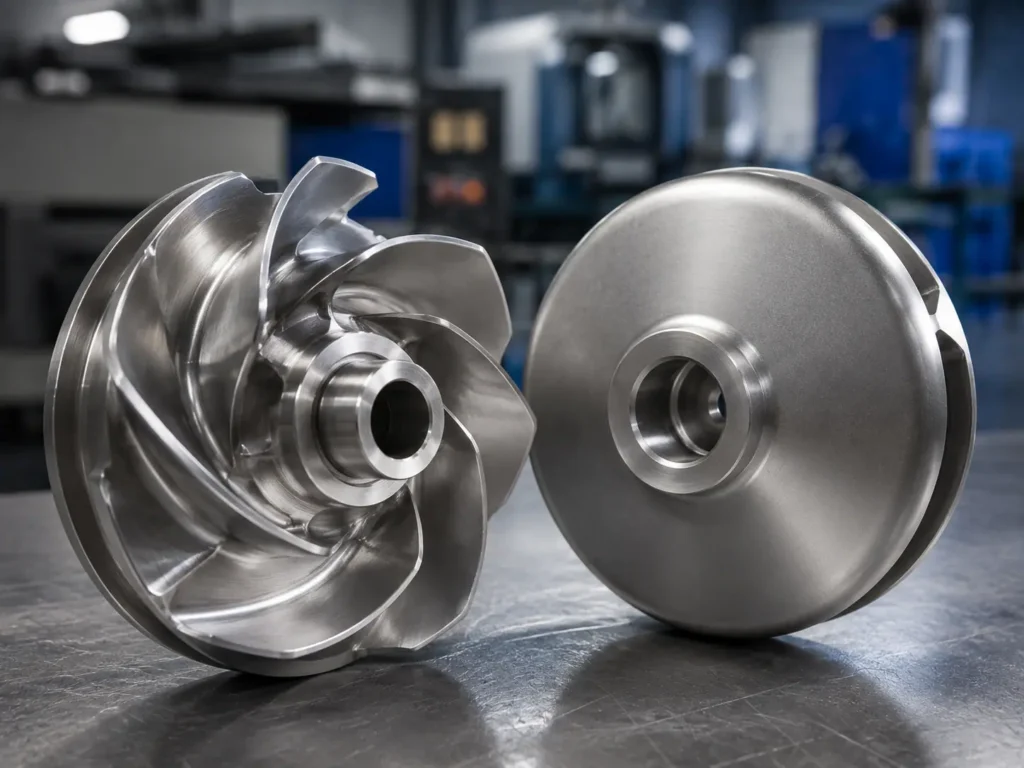
Sand casting impeller production is a manufacturing route for custom metal impeller blanks that are too large, too heavy, too thick, or too simple in geometry to justify investment casting or full CNC machining from solid stock. The sand casting creates the rough impeller shape. CNC finish machining, inspection, surface treatment, and balancing then control the functional surfaces required by the approved drawing.
For OEM buyers, the useful question is not “can this impeller be sand cast?” The better question is whether sand casting gives enough control over pattern accuracy, core stability, section thickness, machining allowance, casting soundness, and repeatability for the impeller’s application.
Sand casting can be a practical route for pump impellers, fan and blower wheels, mixer impellers, slurry or wastewater components, and other industrial rotating parts when the geometry, alloy, quantity, inspection plan, and finished dimensions are reviewed together. It should not be treated as a low-detail substitute for proper engineering control.
What Sand Casting Means for an Impeller
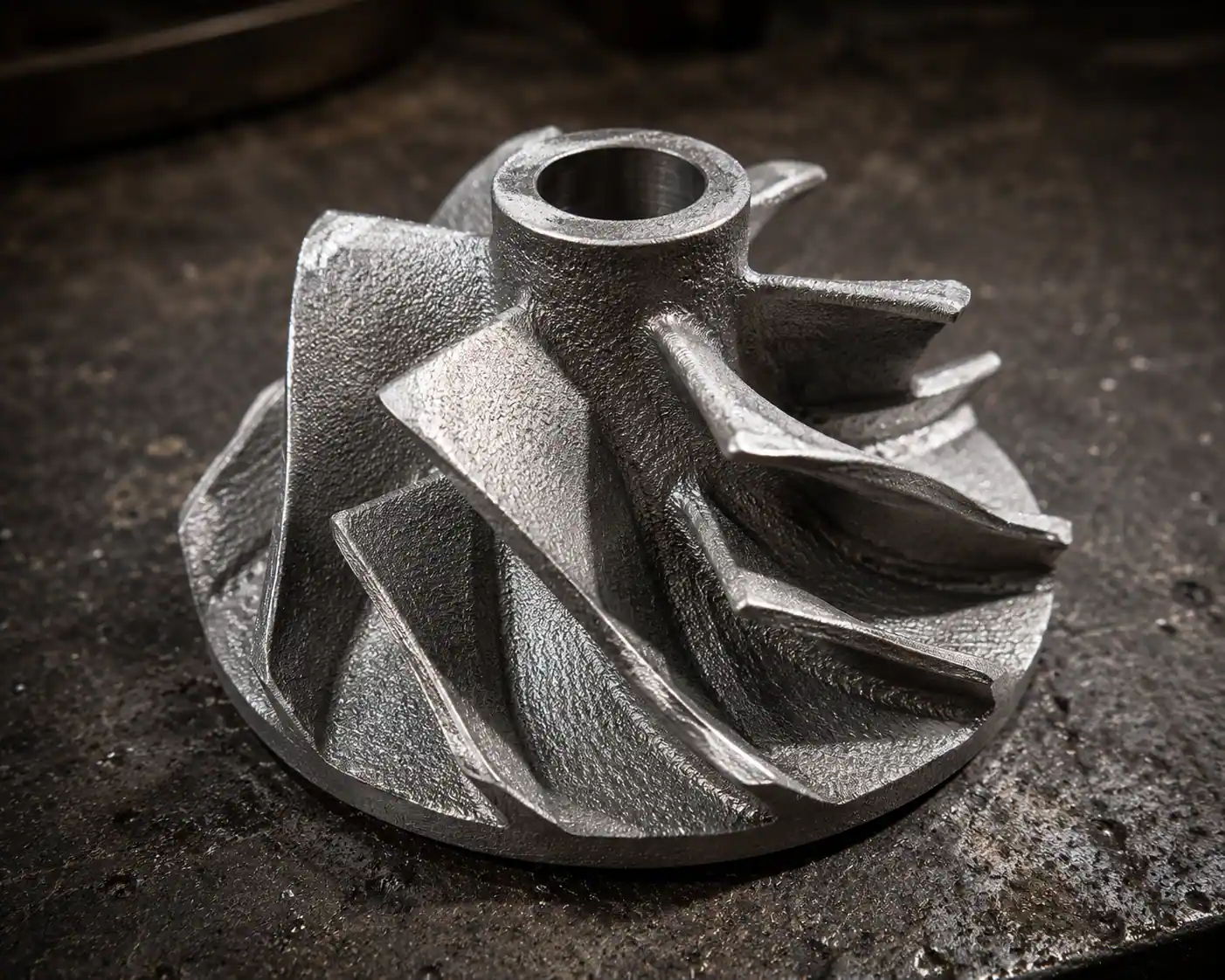
Sand casting uses a pattern to create a mold cavity in sand. Molten metal is poured into that cavity, allowed to solidify, then removed, cleaned, and prepared for later operations. If the impeller has internal passages, shrouds, deep hubs, or enclosed geometry, sand cores may be needed to form those areas.
The result is normally a rough cast blank, not a finished rotating component.
For industrial impellers, sand casting usually needs follow-up work:
- Gate and riser removal
- Shot blasting or cleaning
- Heat treatment when required by material or specification
- CNC machining on bores, hubs, faces, OD, wear-ring areas, and mounting features
- Dimensional inspection
- Casting-defect review and NDT when specified
- Surface treatment, coating, polishing, or passivation when required
- Dynamic balancing when required by speed, size, mass, or buyer specification
Matson reviews sand casting as part of its broader impeller manufacturing route, where casting, machining, inspection, balancing, finishing, documents, and export packing are considered as one production chain.
Sand Casting Impeller Decision Table
| Review item | Sand casting may fit when | Be careful when | Buyer should confirm |
|---|---|---|---|
| Part size and weight | The impeller is larger, heavier, or has thick sections that suit a robust casting blank. | The part is very small, highly detailed, or has thin intricate vanes that may fit investment casting better. | Overall diameter, width, approximate weight target, hub size, shroud condition, and handling limits. |
| Geometry | The design has practical draft, accessible passages, and features that can be formed by pattern and core work. | Closed passages, narrow vane channels, or sharp transitions make molding, cleaning, or inspection difficult. | 3D model, 2D drawing, vane count, passage access, core need, and areas that must remain controlled. |
| Machining plan | The casting can leave stock for bore, hub, face, OD, wear-ring, and other functional surfaces. | The buyer expects final fit surfaces directly from the mold. | Machined surfaces, machining allowance, datum strategy, finished tolerance, and inspection records. |
| Material | The selected alloy is suitable for the casting route, section thickness, heat treatment, and machining sequence. | The alloy is crack-sensitive, difficult to feed, hard to machine, or not clearly specified. | Exact material grade, certificate requirement, heat treatment, service liquid or gas, corrosion, and wear risk. |
| Quality control | Critical zones, acceptance criteria, repair rules, and inspection stages can be defined before production. | Defect acceptance is unclear or balancing is added only after the casting is complete. | Visual inspection, dimensional report, NDT, defect disposition, repair approval, and balance report need. |
| Quantity and repeatability | Tooling, pattern control, and first article review support repeat OEM batches. | The order is a one-off part with unclear drawing, worn sample, or unstable revision control. | Prototype quantity, annual demand, drawing revision, tooling ownership, and change-control process. |
Where Sand Casting Fits Better Than Lost Wax Casting
The lost wax impeller casting article focuses on investment casting for detailed metal blanks, often where finer geometry or smoother as-cast surface is important. Sand casting is a different route. It often becomes more practical when the impeller is larger, heavier, or less suited to wax pattern and ceramic shell production.
Sand casting may be reviewed for:
- Large pump impellers
- Heavy hub or shrouded impeller blanks
- Slurry, wastewater, or industrial service components
- Fan or blower wheels with cast hubs or thick sections
- Mixer or agitator impellers with robust geometry
- Custom industrial impellers where CNC-from-solid would waste too much material
- Repeat OEM parts where pattern control can support future batches
This does not mean sand casting is always cheaper or safer. A sand cast blank can create extra work if the pattern is poor, the core shifts, the machining allowance is missing, or casting defects are found after finish machining. The manufacturing review should compare sand casting, investment casting, fabrication, and CNC machining against the approved drawing rather than choosing a route by part name.
The broader pump impeller casting guide owns the general comparison between investment casting, sand casting, and CNC finish machining. This article is narrower: it explains how to review sand casting specifically for custom impeller production.
Pattern and Core Review Comes Before Quotation
Pattern quality controls much of the rough casting result. If the pattern does not include practical shrinkage compensation, draft, parting strategy, riser positions, machining stock, and handling features, the casting may look close but still fail machining or inspection.
For impellers, core planning can be just as important. A closed or semi-closed impeller may need cores to form flow passages, shroud openings, or internal spaces. Core shift can change vane thickness, passage width, wall thickness, and balance condition. If the drawing has critical passages, the RFQ should identify which areas need dimensional control and which inspection method can verify them.
Buyers should ask early:
- Is a new pattern required, or can existing tooling be used?
- Which surfaces are parting-line sensitive?
- Where will gates and risers be located?
- Which surfaces will be machined after casting?
- Which passages need cores?
- How will core shift be controlled and inspected?
- Which areas must not be heavily ground after casting?
- Can the rough casting be held safely for the first machining setup?
Pattern and core decisions also affect cost. A lower tooling price is not useful if the part needs excessive grinding, cannot clean up on the bore, or exposes defects in the hub after machining.
Machining Allowance Must Be Defined by Feature
A sand cast impeller normally needs more process planning around stock than a near-net precision blank. That does not mean adding excessive material everywhere. The allowance should be designed by feature and route.
Functional areas often need controlled stock:
- Bore, taper, spline, or shaft connection
- Hub face, mounting face, and axial seating surfaces
- Outside diameter and vane tip envelope
- Wear-ring land or sealing diameter
- Shroud face, back face, or cover-related surfaces
- Bolt patterns, threaded holes, keyways, and coupling details
- Selected vane edges or flow surfaces when the drawing requires cleanup
The impeller machining allowance article explains why stock should not be treated as one universal value. Sand casting makes this point even more important because draft, parting lines, risers, core movement, section thickness, and distortion can leave uneven stock around the part.
Before quotation, the buyer should separate surfaces into three groups:
- Surfaces allowed to remain as-cast
- Surfaces requiring cleanup or local grinding
- Surfaces requiring CNC finish machining and inspection
That separation helps the foundry and machining team quote the same part. It also prevents a common RFQ problem: one side assumes a surface is as-cast, while the other side expects a machined finish.
Casting Quality Risks in Sand Cast Impellers
Sand casting is practical, but it brings foundry risks that should be controlled before production. Common review points include shrinkage, gas porosity, sand inclusion, slag inclusion, misrun, cold shut, crack, hot tear, core shift, mismatch, surface roughness, riser-removal marks, local distortion, and repair areas.
The risk is not equal across the impeller. Critical locations usually include:
- Hub-to-vane transitions
- Thick hub sections
- Vane roots
- Shroud connections
- Wear-ring or sealing areas
- Bore-adjacent machining zones
- Gate and riser removal areas
- Closed or difficult-to-clean passages
- Thin vane edges that may be ground or cleaned after casting
The dedicated impeller casting defects guide covers defect types, machining exposure, repair control, and NDT planning in more detail. For a sand casting impeller RFQ, buyers should at least define critical zones, visual acceptance, repair approval, and whether PT, MT, UT, RT, or another inspection method is required by the drawing or application.
Do not assume extra machining allowance will solve casting soundness problems. Porosity or shrinkage can be exposed only after machining. A good process review should address feeding, gating, section transitions, heat treatment, and inspection before the casting is poured.
Material and Heat Treatment Review
Material choice should follow the service condition first. Water, seawater, wastewater, slurry, chemicals, temperature, solids, abrasion, corrosion, duty cycle, and cleaning method all affect the suitable alloy. Sand casting may be discussed for carbon steel, alloy steel, stainless steel, bronze, high-chrome wear materials, or buyer-specific grades, but each material brings different casting, heat treatment, machining, and inspection questions.
The RFQ should name:
- Exact material grade
- Material standard or buyer specification
- Certificate requirement
- Heat treatment or final condition
- Hardness or mechanical test need, if specified
- PMI, chemistry, or heat-number traceability requirement
- Service environment and failure risk if the buyer wants material support
Heat treatment can change distortion and machining sequence. If a hub bore is finished before a heat-treatment stage that later moves the casting, the final runout or fit may be affected. For critical impellers, the manufacturing plan should define whether rough machining, heat treatment, inspection, and final machining happen in separate stages.
Surface Treatment and Balancing Sequence
Sand cast surfaces can be rougher than investment cast surfaces, and roughness is not only a cosmetic issue. Flow surfaces, coating adhesion, cleaning, corrosion behavior, balance correction, and inspection visibility can all be affected.
If the impeller needs painting, coating, rubber lining, passivation, polishing, electropolishing, or other surface treatment, the buyer should mark the exact zones and timing. Some surfaces should be treated after machining. Some surfaces may need masking. Some coating systems can change final dimensions and may need to be considered before balancing or final inspection.
The impeller surface treatment guide owns the finishing discussion. Use the sand casting topic when the main question is whether the casting route, stock, inspection, and post-casting sequence fit the drawing.
Balancing should also be defined early. Sand cast impellers can have uneven mass distribution from local section variation, gate removal, machining cleanup, or repair. If dynamic balancing is required, the RFQ should state the required condition: bare impeller, machined impeller, coated impeller, assembled condition, report format, speed or grade requirement if specified, and any areas where material removal is restricted.
Applications Where Buyers Commonly Review Sand Casting
Sand casting may be considered in several industrial impeller projects:
- Pump OEM impellers where the shape is large or heavy and later machining controls fit surfaces
- Slurry and wastewater impellers where robust sections and wear-resistant materials may be reviewed
- Mixer and agitator impellers where cast hubs, thick blades, or custom shapes need repeat production
- Fan or blower components where a cast hub or heavy wheel section is part of the design
- Replacement or reverse-engineered industrial parts where a worn sample must be reconstructed into an approved drawing
- Low-to-medium-volume OEM parts where a controlled pattern supports future repeat orders
The limitation is equally important. Sand casting is not ideal for every impeller. Very thin vane geometry, extremely tight as-cast detail, highly polished flow paths, small intricate passages, or a requirement for near-finished surfaces may push the project toward investment casting, precision machining, fabrication, or a design revision.
What Buyers Should Send With a Sand Casting Impeller RFQ
A strong RFQ package reduces rework and avoids vague quoting. Send:
- 2D drawing and 3D model, if available
- Drawing revision and governing specification
- Material grade, certificate, and heat-treatment requirement
- Equipment type: pump, fan, blower, mixer, agitator, or custom machine
- Service environment: liquid or gas, solids, corrosion, abrasion, temperature, speed, and duty notes
- Impeller type: open, closed, semi-open, vortex, radial, mixed-flow, axial, fan wheel, or custom profile
- Critical surfaces: bore, hub, keyway, mounting face, wear-ring, OD, vane edge, shroud, and sealing areas
- Machined surfaces and required machining allowance strategy
- As-cast surfaces, grinding limits, and surface-treatment zones
- Casting-defect acceptance, NDT, repair approval, and inspection report needs
- Dynamic balancing requirement and report format
- Prototype, first article, pilot batch, repeat quantity, and annual demand
- Packing, corrosion protection, and export document requirements
If the buyer has only a sample, send photos from multiple angles and mark wear, corrosion, broken vanes, previous repairs, rubbed OD, damaged bore, and coating condition. A worn sample can help start the review, but it should not replace controlled dimensions for production.
First Article and Repeat-Order Control
For repeat OEM production, the first acceptable sand cast impeller should become the baseline for process control. The buyer and manufacturer should preserve the pattern revision, casting model, material route, heat-treatment requirement, machining setup, inspection plan, balance method, surface treatment, and packing requirement.
First article review should confirm:
- The casting route forms the vane, hub, shroud, and passage geometry acceptably
- The rough casting has enough stock on all machined surfaces
- Core shift, parting mismatch, and distortion are within the agreed acceptance plan
- Defects are absent or dispositioned according to approved rules
- CNC machining can meet functional dimensions from controlled datums
- Surface treatment and balancing can be completed after final machining
- Inspection records match the drawing revision and RFQ requirement
A repeat order should not quietly change pattern repair, gating, material source, heat treatment, machining datum, coating system, or inspection sampling. Any change that affects fit, soundness, mass distribution, corrosion resistance, or documentation should be reviewed before production release.
Common Questions Buyers Ask
What is a sand casting impeller?
A sand casting impeller is an impeller blank produced in a sand mold, usually from a pattern and sometimes with cores. It normally still needs cleaning, CNC finish machining, inspection, surface treatment, and balancing before use.
Is sand casting better than lost wax casting for impellers?
Not always. Sand casting often fits larger, heavier, or simpler impeller blanks. Lost wax casting often fits smaller or more detailed designs. The correct route depends on geometry, size, material, quantity, machining allowance, surface requirement, and inspection plan.
Does a sand cast impeller need CNC machining?
In most industrial OEM projects, yes. Bore, hub face, mounting face, keyway, OD, wear-ring surfaces, and other fit features usually need CNC finish machining after casting.
What defects should buyers check in sand cast impellers?
Buyers should review shrinkage, porosity, inclusions, cracks, cold shuts, misrun, core shift, mismatch, surface roughness, riser-removal areas, and critical hub or vane transitions. The inspection method should match the drawing and application risk.
Can Matson review a sand casting impeller from a worn sample?
Yes, for suitable custom projects. Matson can review samples, photos, drawings, 3D files, material grades, application conditions, machining surfaces, inspection requirements, balancing needs, and export packing before quotation.
CTA
Need a sand casting impeller quote for an OEM pump, fan, blower, mixer, or custom industrial component? Send Matson the drawing, 3D model, material grade, application condition, machined-surface list, inspection requirement, balance requirement, quantity, and photos through the contact page. We can review whether sand casting, lost wax casting, CNC machining, fabrication, or a combined manufacturing route fits the project before quoting.