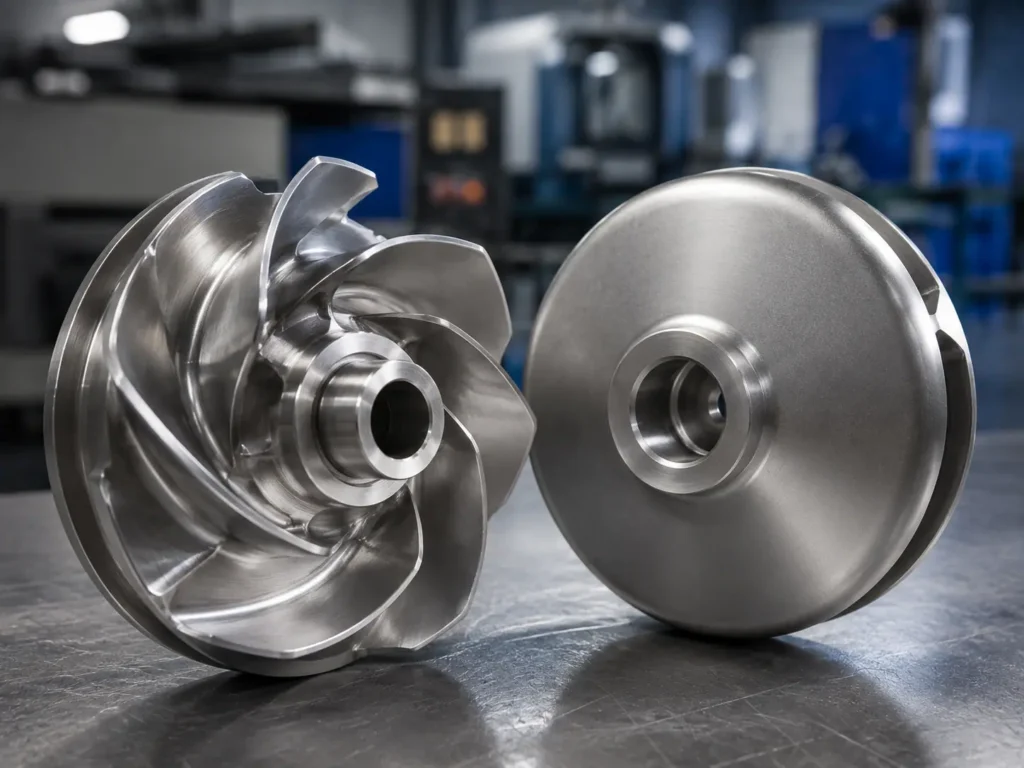
Agitator impeller types are the different blade and hub designs used to move liquid, slurry, viscous material, powders in liquid, or process media inside an industrial mixing tank. Common types include propeller impellers, pitched-blade turbines, Rushton turbines, hydrofoil impellers, anchor impellers, helical ribbon impellers, paddle impellers, and dispersion impellers. For custom manufacturing, the best type is not chosen from the name alone. Buyers should confirm the mixing duty, tank size, shaft connection, blade geometry, material, surface finish, speed, runout, and inspection requirements before production.
Short answer: agitator impeller types should be selected by the mixer OEM or process engineer, then manufactured to a controlled drawing, sample, or specification. Matson manufactures custom mixer and agitator impeller hardware from drawings, 3D files, samples, and project requirements. The manufacturing review should focus on blade form, hub and shaft fit, material, welding, machining, surface treatment, inspection, and documentation, while final process performance should remain with the engineering owner.
This article supports Matson’s mixer impeller manufacturer page and the broader tank agitator impeller RFQ guide. It is about industrial process mixing hardware, not washing machine agitator versus impeller comparisons.
[Image placeholder: Add a real workshop or product image showing several stainless steel agitator impeller types with propeller, turbine, paddle, anchor, hydrofoil, hub, bore, and weld details visible. Alt text: “Agitator impeller types for industrial mixer manufacturing with hub bore and blade geometry”]
Why Agitator Impeller Type Matters
The impeller type affects how material moves inside a tank. Some impellers push flow mostly along the shaft direction. Some push liquid outward toward the tank wall. Some are built for high shear, while others are built for slow, viscous, close-clearance movement.
For a buyer, two things matter.
The impeller must fit the process. A hydrofoil impeller and an anchor impeller solve different mixing problems. A dispersion blade and a paddle impeller are not interchangeable.
The impeller must also be manufacturable. Blade angle, hub fit, weld sequence, material grade, surface finish, and runout can all affect whether the part installs correctly and runs smoothly. A photo can identify the general impeller family, but it usually cannot define the finished part.
Common Agitator Impeller Types
Use this table as a practical starting point. It does not replace mixer design work, but it helps sourcing teams ask better questions before sending an RFQ.
| Agitator impeller type | Typical process discussion | Manufacturing checks | Useful internal reference |
|---|---|---|---|
| Propeller impeller | Axial-flow movement, blending, circulation, lower-viscosity liquids. | Blade pitch, hub bore, rotation direction, blade thickness, material, and balance. | mixer and agitator impellers |
| Pitched-blade turbine | General mixing, suspension support, axial and radial flow components. | Blade angle, blade count, hub connection, weld distortion, and repeatability. | pitched blade turbine vs hydrofoil impeller |
| Rushton turbine | Radial-flow mixing, gas-liquid contact, shear-oriented process duties. | Disc flatness, blade thickness, blade position, hub fit, welds, and balancing. | radial flow impeller |
| Hydrofoil impeller | Axial circulation, lower-shear blending, energy-conscious process mixing. | Blade profile, blade width, pitch direction, hub and shaft fit, runout, and finish. | hydrofoil impeller |
| Anchor impeller | High-viscosity mixing, wall-area movement, close tank-wall clearance. | OD, tank clearance, arm stiffness, shaft connection, weld sequence, and runout. | anchor impeller |
| Helical ribbon impeller | Very viscous batches, pastes, gels, heat-transfer support, wall turnover. | Ribbon pitch, roundness, supports, shaft alignment, weld distortion, and clearance. | helical ribbon impeller |
| Paddle impeller | Simple blending, low-to-moderate speed agitation, basic tank movement. | Flatness, blade angle, hub fit, weld strength, material, runout, and balance. | paddle impeller |
| Dispersion impeller | High-shear dispersion, pigment wet-out, powder incorporation, selected gas-liquid tasks. | Tooth geometry, disc thickness, edge condition, hub and bore, runout, and balance. | dispersion impeller |
Axial Flow, Radial Flow and High-Shear Designs
Agitator impeller types are often grouped by flow direction and mixing effect.
Axial-flow impellers push material mostly up or down along the shaft direction. Propeller and hydrofoil impellers are common examples. They are often discussed for circulation, blending, heat transfer, and selected suspension duties.
Radial-flow impellers push liquid outward toward the tank wall. Rushton-style turbines and some flat-blade turbines are common examples. They may appear in shear-oriented mixing, gas-liquid contact, or process duties where sideward discharge is useful.
High-shear impellers, such as dispersion blades, focus on local shear, powder wet-out, pigment dispersion, or selected gas-liquid contact. The manufacturing challenge shifts toward tooth geometry, disc flatness, runout, and edge condition.
Close-clearance impellers, such as anchor and helical ribbon designs, are often used when viscosity, wall movement, heat transfer, or sticky material becomes important. These parts can look simple, but clearance and roundness are unforgiving.
Do Not Use Washer Search Intent for Industrial Mixing
The keyword export for agitator and impeller contains many high-volume searches about washing machines. Those terms are not a good fit for Matson. A washing machine agitator versus impeller article would bring consumer traffic, appliance comparison intent, and retail replacement questions.
For Matson, the useful part of the keyword group is narrower: agitator impeller, agitator impeller types, types of agitator impellers, stainless steel agitator impeller, and custom agitator impeller. The content should stay inside industrial tanks, OEM mixer hardware, process equipment, and drawing-based manufacturing.
That separation is important. A buyer who needs an industrial agitator impeller is usually not asking which washing machine cleans clothes better. They need to know whether the impeller type, material, hub, shaft connection, surface finish, and process environment have been defined well enough for a quote.
Hub, Shaft and Connection Details
The shaft connection is one of the easiest places to lose a project. A blade type can be correct while the impeller still fails to assemble.
Common agitator impeller connections include straight bore, keyed bore, set screw hub, clamp hub, split hub, flange, bolted hub, welded hub, and custom coupling. Buyers should confirm bore size, shaft size, keyway, hub length, mounting face, bolt pattern, taper, set screw position, and tolerance.
For larger or slower high-torque impellers, the connection may carry heavy load. For faster impellers, runout and balance become more visible. For sanitary-looking or cleaning-sensitive projects, hub transitions, weld cleanup, and surface finish can matter as much as the blade shape.
If the project starts from a worn sample, mark any loose hub, enlarged bore, repaired weld, bent blade, cracked area, or corroded surface. A sample is useful, but a damaged sample should not be copied blindly.
Material and Surface Finish
Agitator impellers are commonly made from stainless steel, carbon steel, alloy steel, duplex stainless, or other buyer-specified materials. The right material depends on liquid chemistry, solids, temperature, abrasion, corrosion, cleaning method, contamination limits, and the required documentation.
304 stainless steel may be enough for mild service. 316L stainless steel is often reviewed for chemical processing, cleaning cycles, chloride exposure, food-adjacent equipment, and corrosion-sensitive tanks. Duplex stainless or other alloys may be needed for tougher corrosion or strength requirements. Carbon steel or coated steel may fit selected general industrial systems when corrosion is limited.
Surface finish should be stated clearly. Polishing, passivation, coating, weld cleanup, electropolishing, and Ra requirements can affect manufacturing sequence, cost, and inspection. A vague request for “smooth finish” is not the same as a drawing-controlled surface requirement.
For chemical service, Matson’s chemical processing impeller page gives broader application context.
Manufacturing Checks Before Production
Different agitator impeller types need different manufacturing routes. Some are fabricated from plate, hub, shaft, and welded blades. Some are cast and then CNC machined. Some require a mixed route with machining, polishing, passivation, or balancing after fabrication.
Matson’s impeller manufacturing capabilities can support casting, CNC machining, surface treatment, dimensional inspection, dynamic balancing, and export packing when the drawing and project requirements are clear.
Important manufacturing checks include:
- blade type, blade count, blade pitch, and rotation direction
- finished outside diameter and tank clearance
- bore, keyway, hub, flange, clamp, or coupling details
- material grade and certificate requirement
- weld size, weld sequence, weld cleanup, and distortion control
- surface finish, polishing, passivation, coating, or electropolishing
- runout, balance grade, and inspection report requirement
- quantity, prototype approval, batch schedule, and packing requirement
The factory should not guess which surfaces are critical. If a bore, flange, blade edge, tank clearance, or finish area needs inspection, call it out before quoting.
RFQ Checklist for Agitator Impeller Types
A useful RFQ should describe both the impeller type and the tank/process context. “Agitator impeller, stainless steel, quote 10 pcs” is not enough.
| RFQ item | Why it matters | What to send |
|---|---|---|
| Impeller type | Different types have different blade geometry, flow behavior, and manufacturing risks. | Propeller, pitched-blade turbine, Rushton turbine, hydrofoil, anchor, ribbon, paddle, dispersion, or custom. |
| Drawing or model | Photos rarely define blade pitch, hub details, or critical tolerances well enough. | PDF, DWG, DXF, STEP, STP, IGS, or a dimensioned sketch. |
| Tank and process context | Material, clearance, and surface finish depend on the operating environment. | Tank size, liquid, viscosity, solids, temperature, pH, chloride, cleaning method, and duty. |
| Blade geometry | Blade count, width, angle, and profile affect both fit and manufacturing route. | OD, blade count, blade width, blade thickness, pitch angle, rotation direction, and pumping direction. |
| Hub and shaft connection | The impeller must mount securely and run correctly on the agitator shaft. | Bore, shaft size, keyway, clamp, flange, set screw, bolt pattern, hub length, and tolerance. |
| Material and finish | Chemicals, cleaning, corrosion, and deposits change the material and finishing plan. | Material grade, certificate need, polishing, passivation, coating, weld cleanup, or Ra requirement. |
| Speed and inspection | Large or fast impellers may need runout control, balance review, or reports. | Operating rpm, runout tolerance, balance grade, dimensional report, and inspection points. |
Common Questions We Actually Get
What are the main agitator impeller types?
Common agitator impeller types include propeller impellers, pitched-blade turbines, Rushton turbines, hydrofoil impellers, anchor impellers, helical ribbon impellers, paddle impellers, and dispersion impellers. The right type depends on the process duty and approved mixer design.
Is an agitator the same as an impeller?
No. The agitator is the mixing assembly or machine, while the impeller is the rotating blade component mounted on the shaft. In sourcing conversations, buyers often use the words loosely, so the drawing should define the actual part.
Which agitator impeller type is best?
There is no universal best type. Hydrofoil, turbine, anchor, paddle, and dispersion impellers solve different process problems. The mixer OEM or process engineer should select the type; the manufacturer should make the approved hardware accurately.
Can Matson manufacture custom agitator impellers from samples?
Yes, if the sample can be measured and the buyer can confirm critical dimensions, material, shaft connection, surface finish, and damaged areas. For worn or bent samples, an approved drawing or reliable measurements are safer.
What should I send for an agitator impeller quote?
Send the impeller type, drawing or 3D file, sample photos, blade dimensions, hub and shaft connection, material grade, tank/process context, operating speed, surface finish, quantity, and inspection or balancing requirements.
Manufacturing Summary
Agitator impeller types are useful names, but names do not manufacture parts. A good RFQ defines the blade family, diameter, blade pitch, hub and shaft connection, material, surface finish, tank clearance, speed, and inspection requirements.
Matson manufactures custom agitator impellers and mixer impellers from drawings, 3D files, samples, and specifications for industrial and OEM projects. Send your agitator impeller type, drawing, sample photos, material grade, shaft connection, surface finish, quantity, and application details through the custom impeller RFQ page.