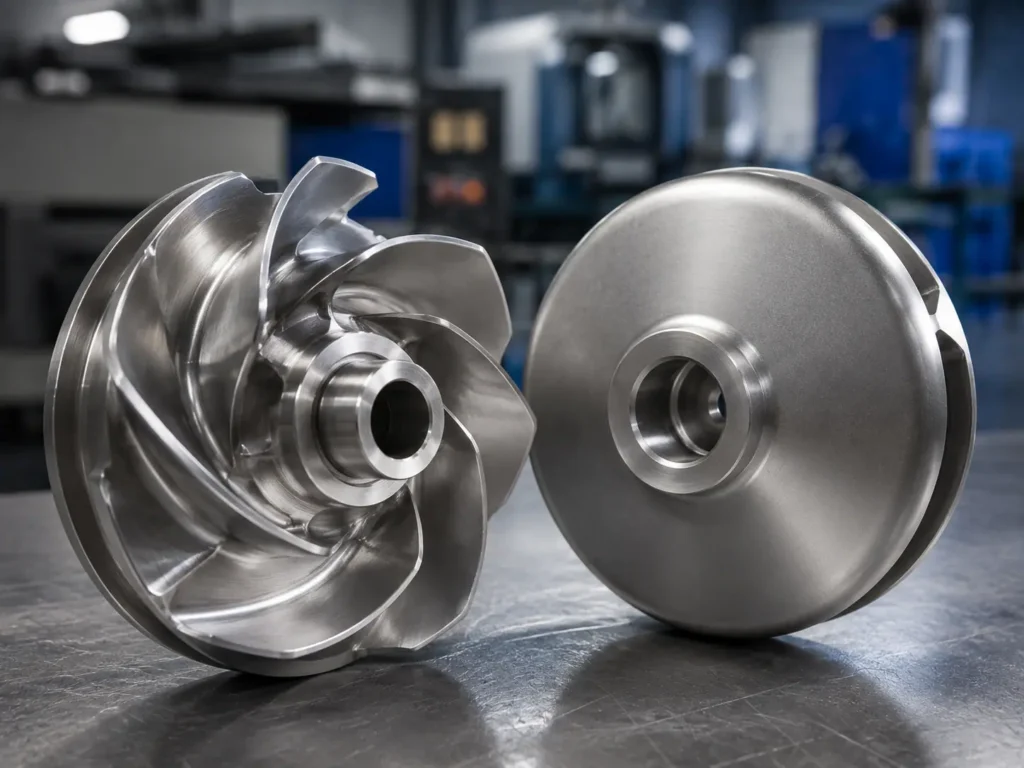
Dispersion impeller refers to a mixer or agitator impeller used for high-shear dispersion, pigment wet-out, powder incorporation, gas-liquid contact, or selected chemical processing duties. In a manufacturing RFQ, the important question is not only “what is the dispersion impeller?” Buyers should confirm blade form, tooth or edge geometry, disc thickness, hub and bore details, material, surface finish, runout, balance requirement, and the process limits owned by the mixer OEM or process engineer.
Matson manufactures custom dispersion impellers and related mixer hardware from drawings, 3D files, confirmed samples, and project specifications. The company can review the manufacturing route, material, machining, welding, inspection, and balancing requirements. Final dispersion performance, tank scale-up, gas-liquid mass transfer, and process guarantees should stay with the equipment designer or process owner.
What Is a Dispersion Impeller?
A dispersion impeller is a mixing component used when the process needs more shear or localized energy than a simple paddle or low-speed agitator provides. The part may be called a dispersion blade impeller, high-shear disperser impeller, sawtooth blade, toothed disc, or gas dispersion impeller, depending on the equipment and process.
Those names overlap, but they are not always identical. A sawtooth dispersion blade used for pigment dispersion is not the same as a gas dispersion impeller used in a reactor. A buyer should not quote the part from the name alone. The drawing, sample photos, operating speed, shaft connection, and process environment are what make the manufacturing requirement clear.
For the full range of custom mixer and agitator impeller categories, see Matson’s mixer impeller manufacturer page. The rest of this guide stays on what makes a dispersion impeller harder to produce than it looks.
Where Dispersion Impellers Are Used
Dispersion impellers are often discussed in chemical processing, coatings, inks, adhesives, resins, pigments, slurry blending, and selected gas-liquid applications. In many of these jobs, the process owner cares about particle wet-out, droplet size, gas distribution, or solids incorporation.
It is worth being clear about scope here. Matson manufactures the hardware to your drawing or sample. We will not promise a final dispersion result — particle wet-out, droplet size, gas distribution — without the tank, viscosity, speed, motor power, baffles, and flow pattern confirmed by the equipment owner. That stays with your process engineering.
| Search / RFQ phrase | What it may mean | Manufacturing caution |
|---|---|---|
| Dispersion impeller | General high-shear or dispersing mixer blade. | Ask for drawing, diameter, thickness, blade edge, hub, bore, material, and RPM. |
| Dispersion blade impeller | Often a disc or toothed blade for wet-out and high-speed dispersion. | Tooth geometry, flatness, edge condition, and balance can be critical. |
| Sawtooth impeller | A toothed disc or high-shear blade. | Do not copy tooth profile from a worn sample without confirming original dimensions. |
| Gas dispersion impeller | Impeller used for gas-liquid contact or reactor service. | Process design belongs to the engineering owner; manufacturing still needs controlled geometry. |
| High-shear dispersing impeller | Fast rotating impeller for dispersion or emulsification duties. | Runout, balance, material strength, and shaft connection need careful review. |
Blade Geometry Matters More Than the Label
Many dispersion impeller problems begin with vague wording. “High shear blade” sounds specific, but it does not define the part. A quote still needs diameter, disc thickness, tooth count, tooth height, tooth direction, tooth angle, hub style, bore, keyway, shaft connection, surface finish, and acceptable runout.
The tooth or edge detail is especially important. On a sawtooth-style dispersion blade, a small change in tooth shape can change how the part behaves in service. From a manufacturing view, it can also change cutting, forming, deburring, polishing, and inspection requirements.
If the buyer sends a worn sample, the risk is higher. Teeth may be rounded. A disc may be bent. The bore may be enlarged by shaft wear. Welds may have been repaired. A copied sample can reproduce the wear instead of the original part. For sample-based work, Matson should confirm which dimensions are original and which are damaged.
Dispersion vs Paddle, Hydrofoil, and Radial Flow Impellers
A dispersion impeller is usually not selected for the same reason as a paddle impeller or hydrofoil impeller. Paddle impellers are often simpler and lower speed. Hydrofoil impellers are often discussed for axial circulation and lower-shear bulk movement. Radial-flow turbine impellers can support sideward flow, shear, or dispersion, but not every radial-flow impeller is a high-shear dispersion blade.
Getting this distinction right before you send an RFQ saves a round of back-and-forth. If you actually need a general tank blade, a paddle impeller or hydrofoil impeller may be the better starting point. If the part is a turbine-style or disc-style mixer, the radial flow impeller guide is also worth a look.
For a true dispersion impeller, the quote should focus on the actual blade or disc hardware, not only the mixing goal.
Material and Surface Finish
Dispersion impellers are commonly made from stainless steel, carbon steel, alloy steel, or other grades specified by the drawing. Material selection depends on the media, temperature, pH, chloride level, solids, cleaning method, abrasion, and whether the buyer needs passivation, polishing, coating, or documentation.
In chemical processing, material choice can be more important than the impeller name. A high-shear blade in the wrong material can corrode, pit, or wear early. A rough tooth edge can trap material or create cleaning problems. A sharp edge may be required in one process but unacceptable in another because of safety, coating, or cleaning expectations.
For chemical service context, buyers can review Matson’s chemical processing impeller page. Final material grade should still be confirmed from the drawing and process environment.
Manufacturing Checks Before Quoting
Dispersion impellers can look like simple discs, but high-speed rotation makes details less forgiving. Flatness, concentricity, bore accuracy, keyway quality, tooth consistency, surface finish, and balance can all affect installation and operation.
Matson’s impeller manufacturing capability is relevant when the part needs controlled cutting, forming, welding, CNC machining, polishing, passivation, coating, dimensional inspection, or balancing documentation.
Important checks include:
- confirm whether the impeller is cut from plate, fabricated, cast, or machined
- check tooth count, tooth profile, and tooth direction against the drawing
- machine the bore, keyway, set-screw hole, mounting face, or hub after fabrication if needed
- inspect disc flatness and runout before shipment
- review edge deburring, polishing, or passivation requirements
- decide whether dynamic balancing is needed for the diameter and RPM
Balancing should not be guessed. A small slow part may need only dimensional inspection. A larger high-speed dispersion impeller may require runout control and dynamic balancing. The buyer should provide operating speed and any balance grade or report requirement.
RFQ Checklist for Dispersion Impellers
The best RFQ is specific. A message that says “need dispersion impeller, stainless steel” leaves too many open questions.
| RFQ item | Why it matters | What to send |
|---|---|---|
| Drawing or 3D file | Defines tooth geometry, hub, bore, and critical dimensions. | PDF, DWG, DXF, STEP, STP, IGS, or a dimensioned sketch. |
| Photos of sample | Shows tooth wear, disc bending, weld condition, and mounting style. | Top, bottom, side, hub close-up, tooth close-up, and worn areas. |
| Blade geometry | Small changes in teeth, angle, or thickness can change both process behavior and manufacturing route. | Diameter, disc thickness, tooth count, tooth height, tooth angle, and edge condition. |
| Hub and shaft connection | Poor fit can cause looseness, vibration, or shaft damage. | Bore, keyway, set screw, clamp, flange, hub height, bolt pattern, and shaft size. |
| Material and process media | Chemical, abrasion, temperature, and cleaning conditions affect material and finish. | Material grade, liquid, solids, pH, chloride, temperature, and cleaning method. |
| Speed and balance | High-speed dispersion hardware can be sensitive to runout and uneven mass. | RPM, acceptable runout, balancing grade, and whether a balancing report is required. |
Common Questions We Actually Get
Is a dispersion impeller the same as a sawtooth blade?
Sometimes, but not always. Many dispersion blades use sawtooth-style edges, but a dispersion impeller can also refer to other high-shear or gas-dispersion hardware. The drawing should define the part.
Can Matson make a dispersion impeller from a sample?
Yes, if the sample can be measured and the buyer confirms which worn areas should be restored to original geometry. Tooth shape, bore size, flatness, and hub dimensions should be checked carefully.
Does Matson design the dispersion process?
Matson can support manufacturing review and custom production from drawings, samples, and specifications. Final process performance, particle size, dispersion time, gas-liquid transfer, and scale-up should be confirmed by the mixer OEM or process engineer.
Does a dispersion impeller need dynamic balancing?
It depends on diameter, RPM, mass distribution, shaft connection, and buyer requirement. High-speed or larger impellers are more likely to need runout control or dynamic balancing.
What material should a dispersion impeller use?
There is no universal material. Stainless steel is common for corrosion resistance, but the final grade depends on pH, chloride, solids, temperature, cleaning, abrasion, and the buyer’s drawing or specification.
Manufacturing Summary
A dispersion impeller should be quoted from geometry and service conditions, not from the name alone. Tooth profile, disc thickness, hub fit, bore accuracy, flatness, runout, material, surface finish, and balancing can all affect whether the part installs and runs correctly.
Matson manufactures custom dispersion impellers, dispersion blade impellers, and selected high-shear mixer hardware from drawings, 3D files, samples, and specifications. Send the drawing or sample photos, blade geometry, material grade, quantity, operating speed, finish requirement, and inspection or balancing needs through the custom impeller RFQ page.