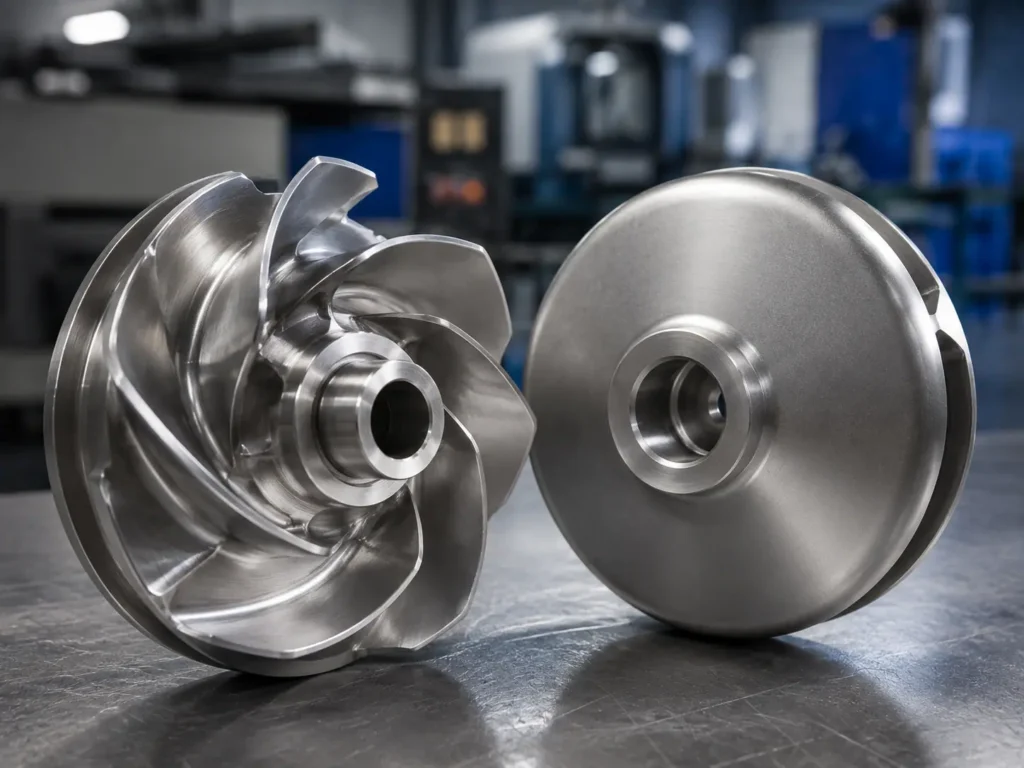
Short answer: a pitched blade turbine and a hydrofoil impeller can both create axial flow in a mixing tank, but they are not interchangeable. A pitched blade turbine is usually the more general, rugged, and shear-capable choice. A hydrofoil impeller is often selected for stronger bulk circulation with lower power draw and gentler shear. For manufacturing, buyers should not choose only from the name. Blade angle, blade width, pumping direction, hub and shaft connection, material, weld quality, runout, and balance all need to be confirmed before production.
This article supports Matson’s mixer impeller manufacturer page. Matson manufactures mixer and agitator impeller hardware from drawings, 3D files, samples, and specifications. Mixing performance, solid suspension duty, scale-up, and process guarantees should remain with the mixer OEM or process engineering owner.
Why This Comparison Matters
The search data around pitched blade turbine vs hydrofoil impeller is not just curiosity. People are usually trying to answer a real process question: which impeller gives better solid suspension, lower power use, shorter blend time, or safer mixing for the product?
Those are process questions first. But once the mixer type is selected, the hardware still has to be manufactured correctly. A blade that is five degrees off, a hub that does not fit the shaft, or a weld that pulls the blade out of position can create a real problem even when the process choice was correct.
That is the angle worth writing about. Not “which impeller is always better.” There is no honest answer like that.
Quick Comparison
Use this table as a practical first filter, not as a final design rule.
| Question | Pitched blade turbine | Hydrofoil impeller | Manufacturing note |
|---|---|---|---|
| Typical flow pattern | Axial with some radial component, depending on blade angle and installation. | Stronger axial circulation with wide profiled blades. | Confirm pumping direction, rotation view, and blade orientation before manufacturing. |
| Solid suspension | Often used for general suspension and moderate mixing duties. | Can be efficient for circulation and selected suspension duties, but geometry and tank setup matter. | Do not copy only diameter; blade width, pitch, and bottom clearance affect the result. |
| Power number | Often higher than hydrofoil-style designs for similar tank circulation goals. | Often selected when lower power draw is a priority. | Power number belongs to process engineering. The manufacturer needs controlled geometry, not just a target number. |
| Shear | Can provide more shear and turbulence than many hydrofoil designs. | Often used where lower shear and smoother circulation are preferred. | Material, blade edge finish, weld cleanup, and surface condition still matter. |
| Fabrication complexity | Usually simpler plate-style blades and hub structure. | Wider, profiled blades can be more sensitive to shape and distortion. | Blade forming, welding sequence, runout, and inspection should be planned early. |
For the dedicated hydrofoil structure article, see Matson’s hydrofoil impeller guide. For a broader tank hardware checklist, use the tank agitator impeller article.
Solid Suspension: Do Not Oversimplify It
A common search intent in this cluster is solid suspension. The tempting answer is to say one impeller is better. That is too simple.
For suspension, the real question is what kind of solids are in the tank, how fast they settle, how much concentration there is, whether the duty is just-off-bottom suspension or uniform suspension, and how the tank is built. Baffles, tank diameter, liquid height, impeller clearance from the bottom, speed, viscosity, and solids size all change the result.
A pitched blade turbine may be selected when the system needs a familiar, robust, general-purpose mixing pattern with more turbulence. A hydrofoil impeller may be selected when the goal is efficient circulation and lower power draw. Both can fail in the wrong tank arrangement.
From a manufacturing side, the risk is different. The pitched blade turbine needs accurate blade angle, consistent blade spacing, and a strong hub connection. The hydrofoil needs careful blade profile, pitch direction, and edge condition. In both cases, a worn sample can mislead the new part if the old blades have bent, thinned, or been repaired.
Power Number Is Context, Not a Purchase Spec
The CSV around this topic has many power number phrases. That tells us users are comparing energy use and mixing performance.
Power number is useful engineering language, but it is not enough for a factory quote. If a buyer sends only “we need a low power number hydrofoil” or “match the PBT power number,” the manufacturing details are still missing.
Matson needs the drawing-controlled shape: diameter, blade count, blade width, blade angle, hub geometry, bore, shaft connection, material, and acceptance requirements. The mixer OEM or process engineer should confirm process values such as power number, pumping number, blend time, Njs, solid suspension target, and scale-up.
The practical handoff looks like this:
| Topic | Process owner should confirm | Manufacturer should confirm |
|---|---|---|
| Power number and flow number | Target values, tank setup, speed, fluid, and scale-up assumptions. | Impeller geometry, blade shape, material, and dimensional acceptance. |
| Solid suspension | Solids size, density, loading, Njs, bottom clearance, tank baffles, and process goal. | Blade angle, blade width, diameter, weld strength, shaft fit, and runout. |
| Blend time | Mixing target, liquid properties, tank layout, operating speed, and test method. | Repeatable geometry, surface finish, blade orientation, and balance if required. |
| Low shear requirement | Product sensitivity, acceptable shear, speed, and process limits. | Blade edge finish, weld cleanup, polish, material, and no unintended sharp edges. |
This split keeps the job clean. The process engineer owns the mixing result. The manufacturer owns the physical part quality.
Blade Angle, Pumping Direction, and Rotation
Pitched blade turbines are often described by blade angle, such as 45 degrees, but the number alone does not finish the RFQ.
The buyer should also confirm whether the impeller is up-pumping or down-pumping, which side the rotation direction is viewed from, whether the motor is above or below the impeller, and how the blades are pitched relative to the shaft. A photo taken from the wrong side can make the blade direction look reversed.
Hydrofoil impellers have the same problem, but the profile can make mistakes harder to catch from casual photos. The leading edge, trailing edge, suction side, pressure side, and pitch direction may matter. If the buyer has only a sample, send top, bottom, side, hub, and blade-edge photos. One photo is not enough.
For a broader flow-direction explanation, see Matson’s axial flow impeller article.
Manufacturing Checks Before Quoting
A pitched blade turbine can look simpler than a hydrofoil impeller, but it still has plenty of failure points if the RFQ is thin.
| RFQ item | Pitched blade turbine concern | Hydrofoil concern | What buyers should send |
|---|---|---|---|
| Blade geometry | Blade angle, blade count, blade width, blade thickness, and spacing. | Blade profile, blade width, leading/trailing edge, pitch, and curvature. | 2D drawing, 3D model, blade dimensions, and close-up photos from several angles. |
| Hub and shaft connection | Bore, keyway, set screw, clamp, flange, coupling, or welded hub. | Same hub risks, often with wider blade load. | Shaft size, bore tolerance, keyway, hub length, bolt pattern, and assembly notes. |
| Material | Usually stainless, carbon steel, alloy, or coated material based on service. | Often stainless for process tanks, but grade still depends on liquid condition. | Material grade, pH, chloride, solids, temperature, cleaning, and certificate requirement. |
| Fabrication and welding | Blade position and weld distortion need control. | Wider profiled blades can move or deform during fabrication. | Weld detail, inspection points, visual standard, polishing, passivation, or coating needs. |
| Runout and balancing | Large diameter or higher speed can create vibration. | Wide blades and uneven mass distribution increase sensitivity. | Operating rpm, acceptable runout, balance grade, and report requirement. |
Matson’s impeller manufacturing work can include casting, CNC machining, fabrication review, surface treatment, dynamic balancing, dimensional inspection, and export packing when the requirements are defined.
When a Pitched Blade Turbine Makes More Sense
A pitched blade turbine can be the more practical choice when the buyer needs a familiar, robust, general-purpose mixer impeller and the application tolerates more turbulence. It is also easier to describe and verify when the drawing is clear: blade angle, blade count, hub, diameter, and shaft connection are straightforward manufacturing inputs.
It may fit projects where the mixer OEM has already approved the design and the buyer needs repeat manufacturing, replacement from a confirmed drawing, or a batch of custom agitator hardware.
The caution: do not assume all PBTs are the same. A 45-degree pitched blade turbine, a different blade width, a different hub height, or an up-pumping version can change both process performance and manufacturing details.
When a Hydrofoil Impeller Makes More Sense
A hydrofoil impeller can make more sense when efficient bulk circulation, lower power draw, lower shear, or smoother axial flow is the goal. It is common in discussions around blending, circulation, selected suspension duties, and process tanks where energy use matters.
The caution is geometry. A hydrofoil is not just a flat blade with a different name. The wide blade profile, edge condition, and pitch direction need clearer drawings or better samples. If the sample is bent, corroded, worn, or a proprietary model, the buyer should confirm the original geometry before using it as the production reference.
What to Send for a Reliable RFQ
For a pitched blade turbine vs hydrofoil impeller project, send:
- Equipment type: mixer, agitator, process tank, wastewater tank, chemical tank, or OEM machine
- Existing impeller type and whether the new part should match it or change it
- 2D drawing, 3D file, or measured sample photos
- Diameter, blade count, blade width, blade thickness, blade angle, and overall height
- Up-pumping or down-pumping requirement
- Rotation direction and viewing side
- Hub type, bore, keyway, shaft size, clamp, flange, set screw, or coupling details
- Material grade, liquid chemistry, solids, viscosity, pH, chloride, temperature, and cleaning method
- Surface finish, weld cleanup, polishing, passivation, coating, or documentation needs
- Operating rpm, runout requirement, balance requirement, and report requirement
- Quantity, sample batch, annual demand, and packing requirement
If the project is a process conversion from PBT to hydrofoil, mark that clearly. Manufacturing a replacement part and changing the mixer process are different jobs.
Common Questions Buyers Ask
Is a pitched blade turbine better than a hydrofoil impeller for solid suspension?
Not always. Solid suspension depends on tank geometry, solids, viscosity, speed, clearance, baffles, and process goal. A pitched blade turbine is often used for robust general suspension, while a hydrofoil impeller can be efficient for circulation and selected suspension duties.
Which has a lower power number, pitched blade turbine or hydrofoil impeller?
Hydrofoil impellers are often selected for lower power draw than many pitched blade turbine designs, but exact power number depends on geometry and process conditions. Treat power number as process-engineering context, not a complete manufacturing specification.
Can Matson manufacture both pitched blade turbines and hydrofoil impellers?
Yes. Matson can review custom mixer and agitator impellers from drawings, 3D files, samples, and specifications, including pitched blade turbine and hydrofoil-style hardware. Final mixing performance should be confirmed by the mixer OEM or process engineer.
What is the biggest RFQ mistake for these impellers?
The biggest mistake is sending only the impeller name and diameter. Buyers should also provide blade angle, blade count, hub and shaft connection, material, rotation direction, pumping direction, surface finish, operating speed, runout or balance requirements, and sample photos.
Should I copy an old sample?
Only with caution. A worn sample may have bent blades, changed edges, corrosion, repaired welds, or an enlarged bore. Use the sample with photos and measurements, but confirm original dimensions when possible.
Talk to Matson
Need a pitched blade turbine or hydrofoil impeller manufactured from a drawing, 3D file, or sample? Send Matson your impeller type, blade geometry, hub and shaft connection, material grade, liquid condition, surface finish, operating speed, quantity, and inspection requirement through the contact page. We can review the manufacturing route, material, machining, welding, surface treatment, balancing, and documentation needs before quoting.