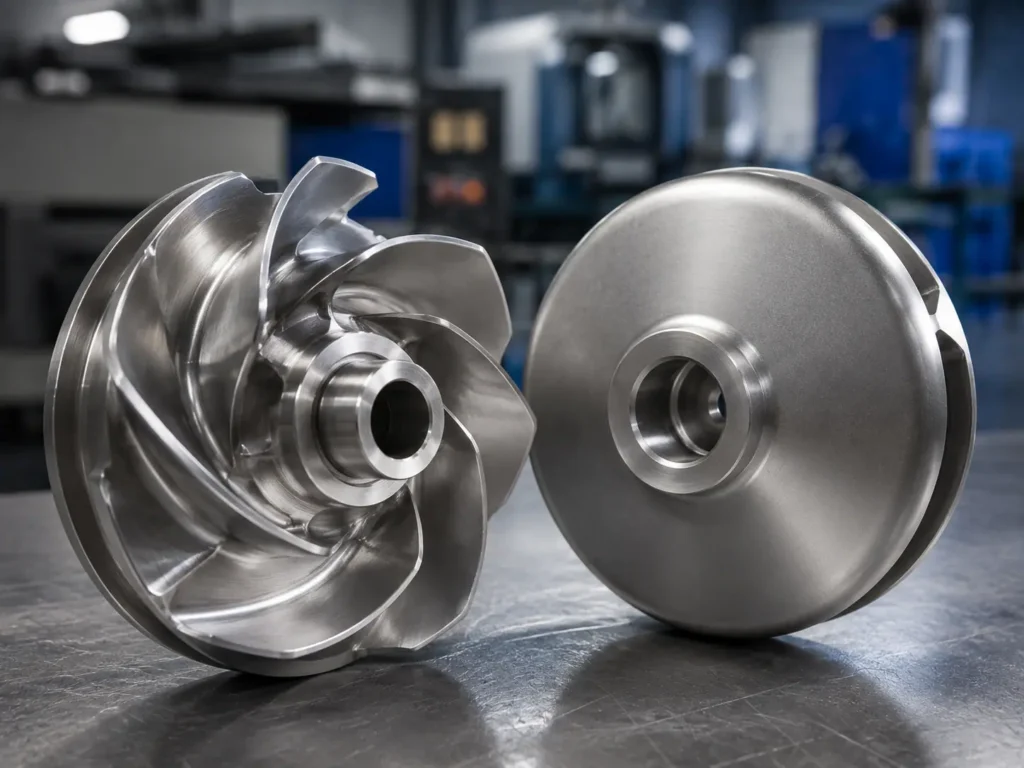
Tank agitator impeller selection is mainly about material, shaft connection, blade geometry, surface finish, process environment, and manufacturing quality. For process mixing equipment in chemical processing, wastewater treatment, food and beverage, coatings, slurry tanks, and OEM systems, the impeller must fit the tank agitator assembly while resisting corrosion, wear, deposits, and mechanical load.
Short answer: a tank agitator impeller should be reviewed around impeller type, diameter, blade count, hub and shaft connection, material grade, weld or casting route, surface finish, operating speed, liquid chemistry, solids, viscosity, temperature, and inspection requirements. Matson manufactures custom agitator impellers from drawings, samples, and specifications, but mixing performance and process design should be confirmed by the mixer OEM or process engineering owner.
This article supports Matson’s mixer impeller manufacturer page and the chemical processing industry page. It focuses on manufacturing and material review, not process-engineering promises.
What a Tank Agitator Impeller Does
A tank agitator impeller is the rotating component that helps move liquid, slurry, or process media inside a tank. Depending on the equipment design, it may be a propeller, pitched-blade turbine, Rushton turbine, hydrofoil, anchor, paddle, or custom blade assembly.
For manufacturing, the important point is simple: the impeller must match the shaft, tank clearance, material requirement, and drawing geometry. A blade shape that looks close in a photo may still be wrong if the hub, bore, keyway, pitch, diameter, or weld detail is different.
Matson can manufacture the hardware from confirmed drawings or samples. The buyer, mixer OEM, or process engineer should control process questions such as mixing intensity, tank circulation, dispersion, suspension, heat transfer, and scale-up.
Tank Agitator Impeller Review Checklist
Use this table before requesting a custom quote. It keeps the conversation practical and manufacturing-focused.
| Review item | Why it matters | What buyers should confirm |
|---|---|---|
| Impeller type | Different blade forms have different manufacturing details and process roles. | Propeller, pitched-blade turbine, Rushton turbine, hydrofoil, anchor, paddle, or custom type. |
| Dimensions | Diameter, blade width, pitch, and height affect tank fit and replacement accuracy. | Outside diameter, blade angle, blade count, overall height, tank clearance, and drawing tolerances. |
| Hub and shaft connection | Poor fit can cause wobble, looseness, shaft damage, or assembly failure. | Bore, keyway, set screw, clamp, coupling, flange, bolt pattern, hub length, and shaft size. |
| Material | Chemicals, solids, abrasion, food/process requirements, and cleaning affect grade choice. | 304, 316L, duplex stainless, carbon steel, alloy steel, coating, or buyer-specified material. |
| Surface finish | Finish affects cleaning, corrosion, deposits, contamination risk, and visual acceptance. | Polishing, passivation, coating, weld cleanup, Ra requirement, and inspection expectation. |
| Manufacturing route | Fabrication, casting, machining, and welding all create different control points. | Weld detail, casting allowance, CNC machining surfaces, heat treatment, and dimensional report. |
| Balance or runout | Large or faster agitator impellers can create vibration if geometry or mass is uneven. | Operating speed, diameter, shaft length, acceptable runout, balancing grade, and report need. |
Materials for Chemical and Process Mixing Equipment
Tank agitator impeller material should be selected from the actual process condition.
304 stainless steel may fit mild water or general processing. 316L stainless steel is often discussed for chemical, food and beverage, cleaning, and corrosion-sensitive service. Duplex stainless may be considered where chloride, corrosion, strength, or longer service life is a bigger concern. Carbon steel or alloy steel may be used in selected industrial tanks when corrosion is limited or coatings are specified.
For chemical processing, the chemical name alone is not enough. Buyers should confirm concentration, pH, chloride, temperature, cleaning liquid, solids, abrasion, and whether the tank has batch or continuous operation.
If the agitator impeller needs a material certificate, passivation, polishing, or surface finish documentation, say that before quoting. These requirements affect manufacturing planning and cost.
For a related corrosion review, see Matson’s chemical pump impeller article. The equipment is different, but the practical material questions are similar: chemical exposure, material grade, surface condition, and documentation.
Hub, Shaft, and Connection Details
The hub and shaft connection are easy to underestimate. They are also common sources of fit problems.
A tank agitator impeller may use a straight bore, keyed bore, set screw, clamp hub, flange, bolted hub, welded hub, or custom coupling. If the bore is off, the impeller may not mount correctly. If the keyway is wrong, torque transfer becomes a problem. If the hub height or bolt pattern is wrong, the assembly may not fit the existing shaft or drive system.
For replacement projects, a worn or corroded sample can mislead the quote. Measure the bore, hub length, keyway, flange, bolt holes, blade angle, blade thickness, and overall diameter instead of copying only the visible shape.
Fabrication, Casting, CNC Machining, and Welding
Tank agitator impellers can be fabricated, cast, machined, welded, or produced through a mixed route. The right process depends on size, blade geometry, material, quantity, surface finish, and inspection requirement.
Fabricated stainless impellers may require controlled welding, weld cleanup, polishing, and passivation. Cast impellers may require machining allowance, heat treatment review, and dimensional inspection. CNC machining may be needed for the bore, hub, flange, keyway, and mounting surfaces.
Matson’s impeller manufacturing work can include casting, CNC machining, surface treatment, dynamic balancing, dimensional inspection, and export packing when requirements are clearly defined.
For food, beverage, pharmaceutical-adjacent, or sanitary-looking projects, do not assume a polished appearance equals a sanitary design. If the buyer requires a specific surface roughness, weld finish, cleaning requirement, or compliance document, it should be specified directly.
What Buyers Should Send for a Quote
A useful RFQ for a tank agitator impeller should include:
- 2D drawing, 3D file, or physical sample
- Impeller type: propeller, pitched blade, Rushton turbine, hydrofoil, anchor, paddle, or custom
- Outside diameter, blade count, blade pitch, blade width, and overall height
- Bore, keyway, hub length, shaft size, coupling, flange, or bolt pattern
- Material grade and required material standard, if known
- Liquid condition, chemical exposure, pH, chloride, temperature, solids, and viscosity
- Surface finish, polishing, passivation, coating, or weld cleanup requirement
- Operating speed, balance requirement, runout requirement, or report need
- Photos of worn, cracked, corroded, repaired, or bent areas
- Quantity, batch schedule, and export packing requirement
If the project is a process redesign, say that clearly. If it is repeat manufacturing from an approved drawing, say that too. Those are different discussions.
Common Questions We Actually Get
What is a tank agitator impeller?
A tank agitator impeller is the rotating blade or mixing component mounted on an agitator shaft to move liquid, slurry, or process media inside a tank.
What material is used for tank agitator impellers?
Common materials include 304 stainless steel, 316L stainless steel, duplex stainless, carbon steel, alloy steel, and coated materials. The right choice depends on liquid chemistry, corrosion, solids, temperature, cleaning, and the buyer’s specification.
Can Matson manufacture tank agitator impellers from drawings or samples?
Yes. Matson can manufacture custom tank agitator impellers from drawings, 3D files, physical samples, photos, and detailed dimensions for industrial and OEM projects.
Can Matson design the mixing performance of the agitator?
Matson focuses on impeller manufacturing, material review, machining, surface treatment, inspection, and documentation. Mixing performance, flow pattern, tank sizing, and scale-up should be confirmed by the mixer OEM or process engineering owner.
What information should I send for a custom tank agitator impeller quote?
Send the drawing or sample, impeller type, diameter, blade count, hub and shaft connection, material, surface finish, operating speed, liquid condition, quantity, and inspection requirements.
Send Us Your Drawing
Need a custom tank agitator impeller for process mixing equipment? Send Matson your drawing, sample photos, material grade, hub and shaft connection, surface finish, liquid condition, quantity, and inspection requirement through the contact page. We can review manufacturing route, material, machining, surface treatment, inspection, and documentation needs before quoting.