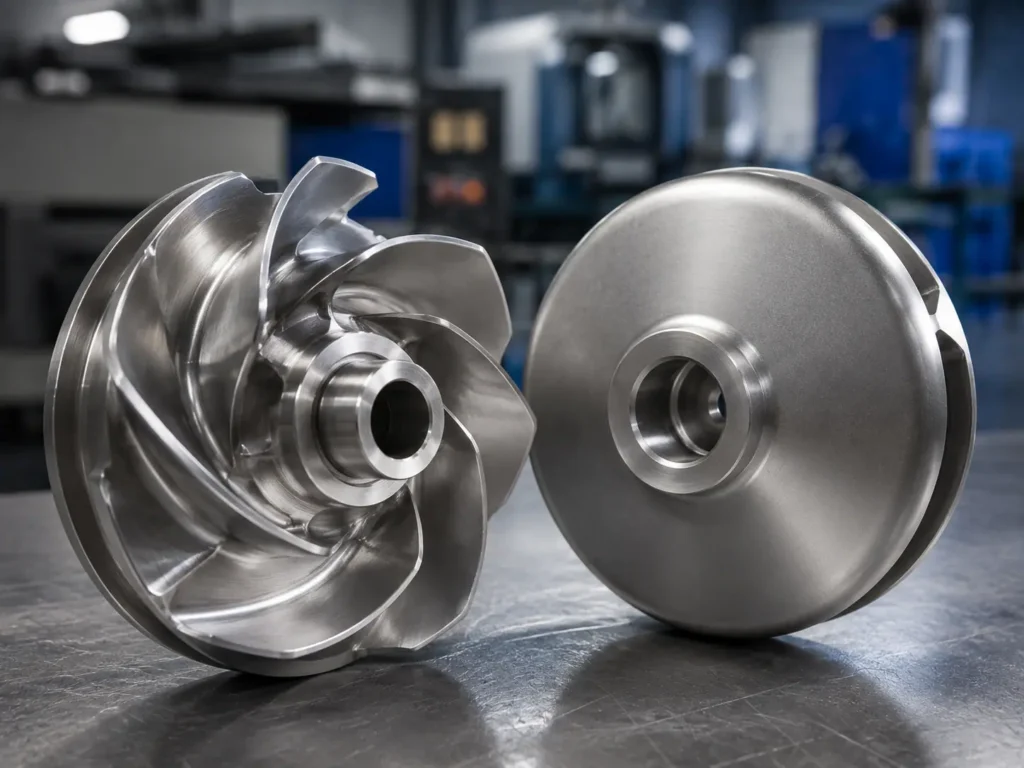
Short answer: a helical ribbon impeller is a close-clearance mixer impeller used for high-viscosity liquids, pastes, gels, coatings, resins, and other slow-moving materials where simple turbines may not create enough bulk turnover. For custom manufacturing, the critical checks are ribbon pitch, outside diameter, tank clearance, concentricity, shaft supports, weld distortion, material, surface finish, operating speed, and whether the design is single or double ribbon.
Matson manufactures custom mixer impellers and agitator impellers from drawings, 3D files, samples, and specifications. For helical ribbon impellers, Matson can review the metal hardware, fabrication route, hub and shaft connection, material, welding, machining, surface treatment, inspection, and documentation. Mixing performance, viscosity range, heat transfer, and scale-up should be confirmed by the mixer OEM or process engineering owner.
What a Helical Ribbon Impeller Is Used For
A helical ribbon impeller is built around one or more spiral ribbons wrapped around a central shaft or support structure. Instead of relying on fast-moving small blades, it usually works at lower speed and larger diameter. The ribbon helps move viscous material along the vessel wall and through the tank height.
This type is often discussed for high-viscosity mixing, heat transfer in jacketed tanks, sticky batches, pastes, gels, coatings, adhesives, resins, and other materials where ordinary axial or radial impellers may leave poor movement near the wall.
That does not mean a helical ribbon is automatically better. It is a process choice first. Tank geometry, viscosity, yield stress, temperature, solids, heating or cooling duty, scraper need, torque, and speed all affect the decision. Matson manufactures the impeller hardware to a confirmed design — the process selection itself should stay with the mixer OEM or the engineering team that owns the tank.
Helical Ribbon vs Anchor Impeller
Helical ribbon and anchor impellers are often discussed together because both can be close-clearance options for viscous materials. They are not the same manufacturing problem.
| Impeller type | Typical use direction | What changes in manufacturing | RFQ risk |
|---|---|---|---|
| Anchor impeller | Large-diameter, low-speed movement near the tank wall. | Arm shape, wall clearance, bottom clearance, hub, welds, and scraper details matter most. | A bent or worn sample can give the wrong outside diameter or clearance. |
| Single helical ribbon impeller | Viscous movement with spiral flow along the tank height. | Ribbon pitch, roundness, support arms, shaft alignment, and weld sequence need control. | Pitch or concentricity errors can create poor fit or rubbing risk. |
| Double helical ribbon impeller | More complex viscous circulation where inner/outer or dual ribbons are specified. | Two ribbon paths, spacing, support structure, and assembly sequence become more sensitive. | It needs a clearer drawing; photos alone are usually not enough. |
For the anchor-style high-viscosity article, see Matson’s anchor impeller guide. For a broader tank hardware checklist, use the tank agitator impeller article.
Pitch and Roundness Are Not Cosmetic
The word “ribbon” can make the part sound simple. In production, the pitch and roundness decide whether the part looks like the approved design.
Ribbon pitch controls the spiral path. If the pitch changes during forming or welding, the finished part may not match the drawing. Roundness controls the relationship between the ribbon and tank wall. A small forming error can become a visible clearance problem at large diameter.
Concentricity also matters. A helical ribbon impeller may look acceptable on the floor, but the real question is how it runs around the shaft centerline. If the shaft, hub, support arms, and ribbon are not aligned, the outer ribbon can run too close to the wall on one side and too far away on the other.
That is why the RFQ should not say only “helical ribbon impeller, stainless steel, quote 1 pc.” The drawing should define the ribbon pitch, ribbon width, ribbon thickness, outside diameter, support arm positions, shaft diameter, hub details, and inspection datum.
High-Viscosity Mixing: Useful Manufacturing Questions
Most people searching for a helical ribbon impeller already have a high-viscosity mixing problem in front of them. That is the part worth getting right.
High-viscosity material loads the shaft, support arms, welds, ribbon, and drive system differently from thin liquid. Sticky material can also make surface finish and weld cleanup more important. If the material heats, cools, cures, crystallizes, or holds solids, the factory should know that before quoting.
We do not need to calculate the final mixing result to ask the practical manufacturing questions that affect your part:
- Is the material a paste, gel, resin, coating, slurry, adhesive, or viscous liquid?
- Is the tank jacketed for heating or cooling?
- Does the material stick to the wall or build up on the impeller?
- Is the impeller single ribbon, double ribbon, anchor plus ribbon, or custom?
- What operating speed and torque range has the mixer OEM approved?
- Is polishing, passivation, coating, or special weld cleanup required?
These questions keep the quote grounded in the part that has to be manufactured.
Fabrication and Welding Risks
Helical ribbon impellers are usually fabrication-sensitive. The ribbon must be formed, positioned, supported, and welded without losing the geometry that the drawing calls for.
Long ribbon sections can move during forming. Support arms can pull during welding. A welded joint can shrink and alter roundness. If the part is large and close to the tank wall, a small error may cause rubbing or uneven clearance.
| Manufacturing check | Why it matters | What buyers should send |
|---|---|---|
| Ribbon pitch | Pitch controls vertical movement and must match the approved design. | Drawing pitch, ribbon path, direction, and whether it is single or double ribbon. |
| Outside diameter and clearance | Close-clearance designs can rub if the OD or roundness is wrong. | Finished OD, tank ID, side clearance, bottom clearance, and inspection datum. |
| Shaft and supports | The ribbon depends on a stable shaft and support-arm structure. | Shaft size, hub style, support arms, weld locations, coupling, and bearing/support notes. |
| Ribbon section | Width, thickness, and edge condition affect strength, forming, and cleaning. | Ribbon width, thickness, edge finish, material grade, and forming requirement. |
| Welding and distortion | Weld sequence can change pitch, roundness, and runout. | Weld detail, visual standard, inspection points, and acceptable runout or roundness. |
| Surface finish | Sticky, corrosive, or cleaning-sensitive material can punish rough welds. | Polishing, passivation, coating, Ra value, weld cleanup, or certificate requirements. |
Matson’s impeller manufacturing work can include fabrication review, CNC machining for hubs and bores, surface treatment, dimensional inspection, dynamic balancing when required, and export packing.
Material and Finish Choices
Many helical ribbon impellers are made from stainless steel because viscous mixing often appears in chemical, coating, food-adjacent, resin, adhesive, and cleaning-sensitive tanks. Still, “stainless” is not a finished material specification.
304 stainless steel may fit mild service. 316L is often reviewed when corrosion, cleaning chemicals, chloride, or contamination risk matters more. Duplex stainless, carbon steel, alloy steel, coatings, polishing, and passivation can also be discussed based on the drawing and operating condition.
Surface finish can be as important as the grade. Rough welds can trap sticky material. Sharp edges can collect buildup. Heat tint can become a corrosion concern if passivation is required. If the buyer needs a specific finish or documentation, it should be included before quoting.
For chemical-process context, Matson’s chemical processing impeller page is a useful application reference.
What Buyers Should Not Guess
Do not guess pitch from a photo. The ribbon path can look different depending on viewing angle.
Do not copy a damaged sample without marking bent or worn areas. A used ribbon can be twisted, flattened, cracked, repaired, or pulled out of round.
Do not ignore tank clearance. A helical ribbon impeller often works close to the tank wall, so OD, roundness, shaft runout, thermal condition, and tank ID matter.
Do not assume a double helical ribbon is just two single ribbons. Spacing, support sequence, ribbon direction, assembly order, and inspection become more complex.
Do not treat power number or viscosity range as a manufacturing specification. Those belong to process engineering. The manufacturer needs geometry, material, shaft connection, and acceptance criteria.
A Better RFQ Checklist
For a custom helical ribbon impeller quote, send:
- 2D drawing, 3D file, or measured sample photos
- Single ribbon, double ribbon, anchor-ribbon, or custom structure
- Ribbon pitch, ribbon direction, ribbon width, ribbon thickness, and outside diameter
- Tank inside diameter, bottom shape, side clearance, and bottom clearance
- Shaft diameter, hub, coupling, keyway, flange, support arms, and bearing/support context
- Material grade, coating, polishing, passivation, or certificate requirement
- Liquid condition, viscosity, solids, temperature, pH, chloride, cleaning method, and corrosion risk
- Operating speed, torque context if available, runout requirement, and inspection report requirement
- Photos of bent, repaired, cracked, worn, or out-of-round areas
- Quantity, batch schedule, packing, and documentation requirements
If the project is a new mixer design rather than repeat manufacturing from an approved drawing, say that clearly. Process selection and hardware production are different conversations.
Common Questions Buyers Ask
What is a helical ribbon impeller?
A helical ribbon impeller is a mixer impeller with one or more spiral ribbon blades around a central shaft. It is commonly discussed for high-viscosity mixing and close-clearance tank applications.
Is a helical ribbon impeller good for high-viscosity mixing?
It can be, especially when the process needs slow bulk turnover and wall-area movement. Final suitability depends on tank geometry, viscosity, temperature, speed, torque, material behavior, and process target.
What is the difference between an anchor impeller and a helical ribbon impeller?
An anchor impeller usually follows the tank wall with large arms. A helical ribbon impeller adds a spiral ribbon path that can support vertical circulation in viscous materials. Manufacturing a ribbon impeller is usually more sensitive to pitch, roundness, and weld sequence.
Can Matson manufacture double helical ribbon impellers?
Matson can review double helical ribbon impellers when the buyer provides a drawing, 3D model, or detailed sample measurements. Double-ribbon geometry needs clear pitch, spacing, support-arm, shaft, clearance, and inspection requirements.
What information matters most for a helical ribbon impeller RFQ?
The most important items are drawing or sample data, ribbon pitch, OD, tank ID, clearance, shaft and support details, material grade, surface finish, viscosity context, operating speed, runout or inspection requirement, and quantity.
Talk to Matson
Need a custom helical ribbon impeller for a high-viscosity mixer or agitator? Send Matson your drawing, 3D file, sample photos, ribbon pitch, tank dimensions, clearance requirement, shaft and support details, material grade, surface finish, liquid condition, quantity, and inspection needs through the contact page. We can review fabrication, welding, machining, material, surface treatment, inspection, and documentation before quoting.