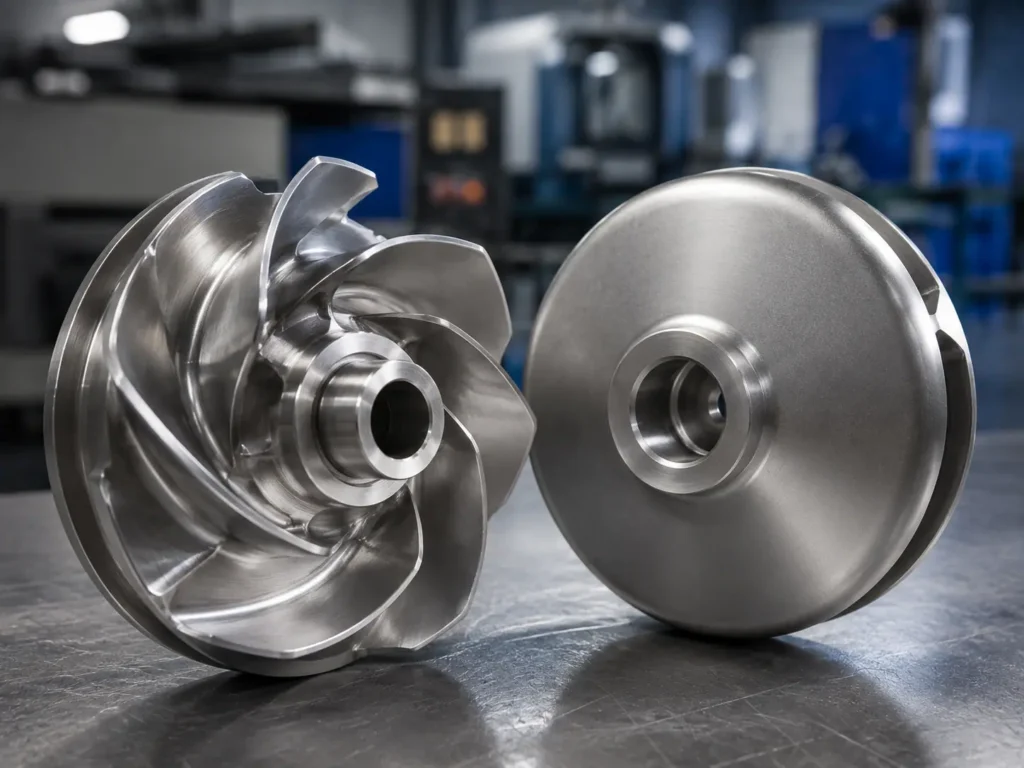
Semi-open impeller pump designs sit between closed and open impeller arrangements. A semi-open impeller usually has one shroud or backplate and one open side, giving the pump more hydraulic control than a fully open impeller while keeping more access and solids tolerance than a fully closed impeller.
Short answer: a semi-open impeller pump can be useful for wastewater, chemical process liquid, dirty water, and some light-solids applications, but the open-side clearance, casing or wear-plate relationship, material, vane condition, CNC machining, and balancing requirement must be confirmed before manufacturing. Matson can manufacture semi-open impellers from drawings or samples, while final pump selection should remain with the pump OEM or engineering owner.
Matson manufactures centrifugal pump impellers and other custom pump impellers from drawings, samples, and project specifications. This article focuses on semi-open impeller manufacturing review; for a broader comparison, see open vs closed pump impeller.
What Is a Semi-Open Impeller Pump?
A semi-open impeller pump uses an impeller with vanes supported by one shroud or backplate, while the other side remains open. This geometry gives the impeller more structure than a fully open design, but the open side still depends heavily on clearance control.
That open-side clearance is the detail buyers should not ignore. If the clearance is too large, internal recirculation can increase and pump performance can drop. If the clearance is too tight, rubbing, heat marks, wear, and vibration can appear.
For custom manufacturing, “semi-open” is only the starting description. The drawing should still define bore, hub height, keyway, vane count, rotation direction, OD, open-side clearance, material, and balancing requirement.
Semi-Open vs Open vs Closed Impeller
Use this comparison as a manufacturing review, not as a universal pump selection rule.
| Impeller type | Basic structure | Typical advantage | Main manufacturing risk |
|---|---|---|---|
| Closed impeller | Vanes enclosed between two shrouds. | Good hydraulic control in clean-liquid service. | Hidden passages, tighter fit, and clearance sensitivity. |
| Open impeller | Exposed vanes with no full shroud support. | Easier inspection and cleaning access. | Vane wear, lower clean-water efficiency, and front clearance control. |
| Semi-open impeller | One shroud or backplate with one open vane side. | Middle option for light solids, process liquid, and clearance adjustment. | Open-side clearance, wear-plate/casing relationship, and balance after machining. |
The semi-open design is often practical, but it is not a shortcut around engineering review. The pump casing, liquid condition, speed, material, and wear history still decide whether the design is suitable.
Where Semi-Open Impellers Fit
Semi-open impellers often appear in applications where the liquid is not perfectly clean, but the pump still needs more structure and control than a fully open impeller gives.
Examples include dirty water, wastewater, some chemical process liquids, light sludge, liquids with suspended solids, and selected process pumps where cleaning access or clearance adjustment matters. In chemical service, corrosion and material compatibility may be more important than the geometry name. In wastewater service, fiber and clogging history may decide whether semi-open is enough or a vortex design should also be reviewed.
For wastewater type selection, Matson’s sewage pump impeller types article compares vortex, open, and semi-open directions in more detail.
Clearance Is the Central Issue
Semi-open impeller performance depends strongly on the clearance between the open vane side and the casing, wear plate, or adjacent pump surface. This clearance affects leakage, recirculation, wear, rubbing risk, and pump performance.
| Clearance item | Why it matters | What buyers should confirm |
|---|---|---|
| Open-side clearance | Controls leakage and rubbing risk near the exposed vane side. | Specified clearance, casing surface, wear plate, and adjustment method if any. |
| Wear plate or casing condition | A new impeller against a worn casing surface may still perform poorly. | Photos, dimensions, repair history, and whether mating surfaces are replaced. |
| Vane edge condition | Worn vane edges can make a sample look smaller or less defined than the original part. | Original drawing, worn-area photos, and which dimensions are reliable. |
| Hub and axial position | Hub height and mounting face decide where the impeller sits inside the pump. | Bore, hub height, mounting face, keyway, shaft fit, and datum. |
| Balancing after machining | Clearance machining and uneven vane wear can affect mass distribution. | Pump speed, balance grade, report requirement, and final-machined condition. |
Do not ask a manufacturer to guess the clearance from a worn sample unless the buyer accepts the risk. Drawings and mating-part dimensions are safer.
Manufacturing and CNC Machining Notes
Semi-open impellers may be cast and then finish machined at functional surfaces. The open side can make vane inspection easier than a closed impeller, but it also exposes vane edges and clearance surfaces to wear.
Critical manufacturing points often include:
- Bore and shaft fit
- Hub height and mounting face
- Keyway, taper, thread, or retaining detail
- Outside diameter and trim diameter
- Open-side vane edges and clearance surface
- Wear plate or casing relationship
- Rotation direction and vane count
- Dynamic balancing requirement
Matson’s CNC machined impeller article explains why functional surfaces such as bore, hub, OD, wear-ring, and vane edges should be defined before quoting.
Material and Wear Review
Semi-open impellers are often used where the liquid is not perfectly clean. That means material selection should not be an afterthought.
For wastewater or dirty water, buyers may need stainless steel, duplex stainless, carbon steel, alloy steel, or another project-specified material depending on corrosion, grit, fibers, and cost target. For chemical process liquid, pH, chloride, solvent exposure, temperature, and cleaning cycles matter. For abrasive service, vane edge wear and section thickness should be reviewed carefully.
For broader material guidance, see Matson’s pump impeller material selection guide.
When Semi-Open Is Not Enough
Semi-open does not automatically solve solids-handling problems. If the liquid contains large solids, long fibers, rags, or heavy clogging history, a vortex or other solids-handling design may be more appropriate, depending on the pump.
If the main problem is abrasive slurry, the discussion should shift toward wear-resistant material, section thickness, speed, and slurry-specific geometry. A semi-open impeller made from the wrong material can still fail quickly in grit or hard-particle service.
The practical rule: use semi-open as a candidate geometry, not as a guarantee.
What Buyers Should Send for RFQ
For a semi-open impeller pump project, send:
- Approved 2D drawing and 3D model if available
- Physical sample and photos from front, back, side, bore, hub, and worn areas
- Open-side clearance, casing surface, wear plate, or adjustment information
- Finished OD, trim diameter, inlet eye, outlet width, vane count, and rotation direction
- Bore, hub height, mounting face, keyway, shaft fit, and datum references
- Material grade, liquid condition, solids, fibers, temperature, corrosion, and abrasion risk
- Pump speed, impeller mass, balancing grade, runout requirement, and report requirement
- Quantity, batch schedule, packing, and documentation needs
If the old sample is worn on the open side, mark that clearly. The worn vane edge may not show the original working clearance or hydraulic geometry.
Common Questions We Actually Get
What is a semi-open impeller pump?
A semi-open impeller pump uses an impeller with one shroud or backplate and one open vane side. It sits between closed and open impeller designs.
When should buyers consider a semi-open impeller?
Semi-open impellers are often reviewed for wastewater, dirty water, chemical process liquid, and light-solids applications where clearance, cleaning access, and reasonable flow control all matter.
Is a semi-open impeller better than an open impeller?
Not always. A semi-open impeller has more structure than a fully open impeller, but the right choice depends on pump casing, liquid condition, solids, clearance, material, and speed.
Why is clearance important for a semi-open impeller?
The open-side clearance affects leakage, recirculation, rubbing, wear, and pump performance. It should come from the drawing, pump specification, or mating-part dimensions.
Can Matson manufacture a semi-open impeller from a sample?
Matson can review sample-based manufacturing, but worn vane edges, hub surfaces, and open-side clearance areas should not be copied blindly without checking the original dimensions.
Send Us Your Drawing
Need a semi-open impeller manufactured from a drawing or sample? Send Matson the drawing, sample photos, open-side clearance, material grade, liquid condition, pump speed, balancing requirement, quantity, and inspection needs through the contact page. We can review casting, CNC machining, material, inspection, and balancing details before quoting.