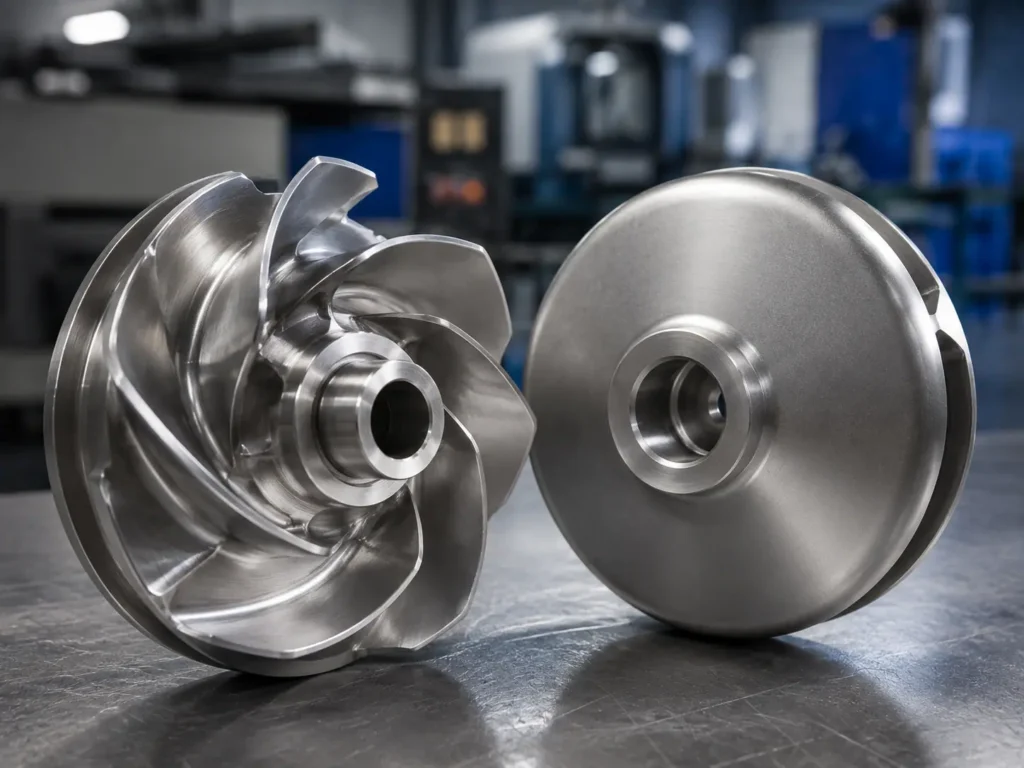
Sewage pump impeller types are chosen for clog resistance, solids passage, wear, corrosion, pump casing fit, and the real wastewater condition. The common choices are vortex, open, and semi-open designs. Closed impellers can appear in cleaner water service, but they are not the default answer for sewage, sludge, fibers, and dirty wastewater.
Short answer: vortex impellers are usually reviewed when clog resistance matters most. Open impellers make cleaning and inspection easier. Semi-open impellers are often the practical middle ground when the pump needs some solids handling but still needs reasonable hydraulic control. The final choice should be confirmed against solids size, fiber content, pump speed, casing geometry, material, clearance, and balancing requirement.
Matson manufactures custom pump impellers from drawings, 3D files, samples, and project specifications. For a sewage pump impeller or wastewater pump project, we would rather review the actual working condition than choose from a type name alone.
Quick Comparison
Use this table as a first filter. It is not a substitute for the drawing, casing relationship, solids condition, and material review.
| Sewage pump impeller type | Where it fits | Main advantage | What buyers should confirm |
|---|---|---|---|
| Vortex impeller | Sewage, sludge, fibers, solids-handling wastewater pumps | Lower clogging risk because more solids can pass through the volute area instead of tight vane passages | Solids size, casing match, efficiency expectation, material, pump speed |
| Open impeller | Dirty water, light sludge, liquid with suspended solids | Easier cleaning, easier inspection, more tolerance than closed designs | Vane wear, clearance, mounting face, balance, corrosion |
| Semi-open impeller | Wastewater, chemical wastewater, process effluent, moderate solids | Balance between flow control and solids handling | One-side clearance, corrosion, solids, machining allowance, casing fit |
| Closed impeller | Clean water or cleaner transfer service | Higher clean-water efficiency | Whether the liquid is actually clean enough; clogging and passage wear risk |
Why Sewage Pump Impellers Are Different
Sewage and wastewater do not behave like clean water. The liquid can carry rags, fibers, sludge, sand, grit, grease, organic solids, chemical residue, and corrosion risk. A design that looks efficient in clean service can become a maintenance problem when it meets the real pump station.
That is why the first question should not be “which impeller is best?” The better question is: what has to pass through the pump without blocking, and what material must survive the liquid?
For broader type background, see the guide to pump impeller types. This article narrows the discussion to sewage, sludge, and wastewater applications.
Vortex Impellers for Clog Resistance
A vortex impeller is often reviewed for sewage pumps because it can reduce direct contact between the impeller vanes and larger solids. The flow pattern helps move difficult liquid through the pump with lower clogging risk.
That benefit has a cost. A vortex design may give up some hydraulic efficiency compared with a cleaner-flow closed impeller. In wastewater work, that trade is often acceptable if it keeps the pump running and reduces blockage.
For RFQ review, do not only say “vortex impeller.” Send the solids size, fiber condition, liquid chemistry, pump speed, casing information, and whether the current part is clogging, wearing, or vibrating. A vortex impeller still needs correct material, bore fit, hub height, mounting surfaces, and balance review.
Open Impellers for Easier Cleaning and Inspection
Open impellers expose the vanes, so cleaning and inspection are easier. That matters when the liquid carries suspended solids, fibrous material, or sludge that can collect around the working surfaces.
Open does not mean low precision. The vane shape, bore, hub height, mounting face, outside diameter, and clearance still control whether the part fits and runs correctly. If the impeller is copied from a worn sample, the original vane thickness or edge shape may already be lost.
Open impellers can also wear faster because the vane surfaces are exposed. If the wastewater contains abrasive grit or sand, material selection becomes a serious part of the quote. For that decision, the article on pump impeller material selection gives a broader material framework.
Semi-Open Impellers for Wastewater Balance
Semi-open impellers sit between closed and open designs. They have one shroud and one open side. In many wastewater and process effluent pumps, this is the compromise: better solids tolerance than a closed design, with more flow control than a fully open impeller.
The important point is clearance. The open-side clearance has to match the pump and application. Too much clearance can reduce performance. Too little clearance can create rubbing, clogging, wear, or assembly problems.
For a semi-open sewage pump impeller, the drawing should show the bore, hub height, vane profile, outside diameter, mounting face, and key clearances. If the buyer only has a sample, take photos and measure the part before shipping it. A badly worn sample can make the wrong geometry look normal.
For a related comparison, see open vs closed pump impeller.
Material and Manufacturing Review
Wastewater impellers often need both corrosion resistance and wear resistance. Stainless steel 316 or 316L, duplex stainless, bronze, carbon steel, alloy steel, or wear-focused materials may be discussed, but the right answer depends on the fluid and the drawing.
If the buyer specifies cast stainless material, ASTM A743/A743M is commonly used for corrosion-resistant castings for general application, while ASTM A744/A744M is used for severe corrosion-resistant cast stainless service. These are not automatic material choices. They are useful reference points when the drawing or buyer specification already calls for that standard.
For rotating parts, balance should not be treated as an afterthought. ISO 21940-11 covers procedures and tolerances for balancing rigid rotors, and it is a useful reference when a drawing or project requires a defined balancing grade. The actual requirement should come from the pump speed, diameter, mass, application, and buyer specification.
Matson’s impeller manufacturing route can include casting, CNC machining, surface treatment, dynamic balancing, dimensional inspection, and material documentation. Exact process route should be confirmed from the drawing and material.
What Buyers Should Confirm Before Quoting
For sewage pump impeller types, the most useful RFQ is not long. It is specific.
Send:
- 2D drawing or 3D file
- Physical sample or clear photos if no drawing exists
- Current impeller type, if known
- Pump application: sewage, sludge, wastewater, lift station, treatment plant, or process effluent
- Solids size, fiber condition, grit, sand, or sludge details
- Liquid chemistry, pH, chloride, or corrosion condition if known
- Pump speed, outside diameter, bore, hub height, and casing information
- Material grade or previous material
- Current problem: clogging, early wear, corrosion, vibration, or poor fit
- Quantity, batch schedule, and inspection or balancing requirement
If the old impeller failed early, do not reorder the same design blindly. Check whether the root issue was clogging, abrasion, corrosion, cavitation, wrong clearance, poor fit, or balance. Material change alone will not fix a pump that is working outside its intended condition.
Common Questions We Actually Get
What are the main sewage pump impeller types?
The main sewage pump impeller types are vortex, open, and semi-open designs. Closed impellers are more common in cleaner water service and need careful review before being used in dirty wastewater.
Which impeller type is best for sewage pumps?
There is no single best type. Vortex designs are often chosen for clog resistance, open designs for easier cleaning, and semi-open designs for a balance of solids handling and hydraulic control.
What information should I send for a custom sewage pump impeller quote?
Send the drawing or sample, impeller type, material grade, solids size, liquid condition, pump speed, quantity, and any balancing or inspection requirement. Photos of clogging, wear, or corrosion are useful.
Can Matson manufacture vortex, open, and semi-open sewage pump impellers?
Yes. Matson manufactures custom pump impellers from drawings, 3D files, physical samples, or detailed dimensions, including vortex, open, and semi-open designs for industrial wastewater projects.
Should a sewage pump impeller use stainless steel?
Stainless steel can be useful when corrosion is important, but it is not always the best answer for abrasive sludge or grit-heavy wastewater. Material should be confirmed against corrosion, solids, wear, drawing, and service life target.
Send Us Your Drawing
Need help reviewing a sewage pump impeller type for wastewater service? Send Matson your drawing, sample photos, material grade, liquid condition, solids details, quantity, and balancing requirement through the contact page. We can review the type, material, casting route, machining interfaces, inspection, and balancing needs before quoting.