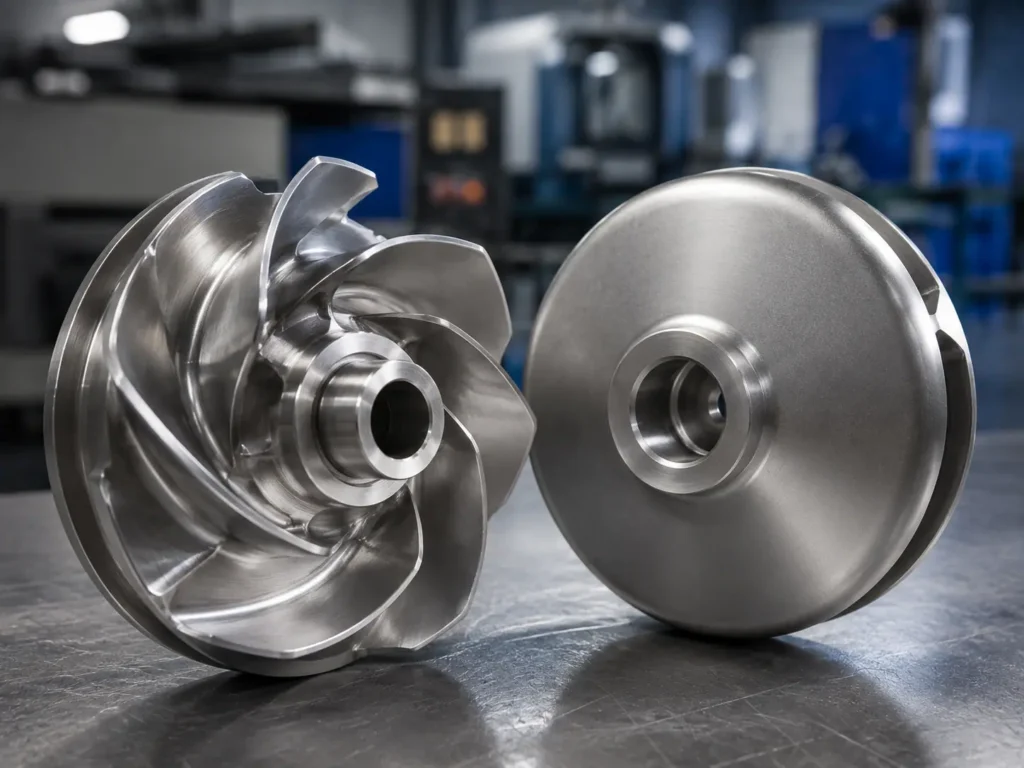
Open vs closed pump impeller is not just an efficiency comparison. In industrial pump projects, the choice depends on liquid cleanliness, solids content, clogging risk, corrosion, abrasion, pump casing, clearance, speed, and how accurately the impeller can be cast, machined, inspected, and balanced.
Short answer: a closed pump impeller is usually better for clean liquids and higher efficiency. An open pump impeller is easier to clean and more forgiving when the liquid carries light solids. A semi-open impeller sits between them and is often the practical choice for wastewater, chemical, and general process pump applications where the liquid is not perfectly clean.
Matson manufactures custom pump impellers from drawings, 3D files, samples, and project specifications. If you are comparing open, closed, or semi-open designs for a custom pump impeller, start with the working condition before asking for a quote.
Quick Comparison
Use this table as a first filter. The final answer still has to match the pump casing, shaft, speed, material, tolerance, and service environment.
| Impeller type | Best fit | Main advantage | Main risk |
|---|---|---|---|
| Closed pump impeller | Clean water, process liquids, many centrifugal pumps | Higher efficiency and controlled flow | Less tolerant of solids, fibers, clogging, and clearance errors |
| Open pump impeller | Liquids with light suspended solids or easier cleaning needs | Simple geometry, easier access, easier inspection | Lower efficiency and more exposure to vane wear |
| Semi-open impeller | Wastewater, chemical, slurry-light, and general process service | Balanced choice between efficiency and solids handling | Clearance and material still need careful review |
What Is a Closed Pump Impeller?
A closed pump impeller has vanes enclosed between front and back shrouds. This structure creates a more controlled flow path and is commonly used in centrifugal pumps handling clean or relatively clean liquids.
The main reason buyers choose a closed impeller is efficiency. When the liquid is clean, the pump casing is correct, and the clearances are controlled, a closed impeller can support stable hydraulic performance.
The weakness is tolerance. A closed impeller is less forgiving. Bore accuracy, hub height, sealing surfaces, outside diameter, vane passage, and balance all matter. If the liquid carries solids, fibers, sludge, or abrasive particles, the same enclosed flow path can become a clogging or wear problem.
For RFQ review, a closed impeller usually needs better drawing information than a simple photo. Send the 2D drawing, 3D file, material grade, pump speed, and any balancing requirement.
What Is an Open Pump Impeller?
An open pump impeller has exposed vanes without full front and back shrouds. It is easier to see, clean, inspect, and sometimes manufacture, depending on geometry.
Open impellers are often considered when the liquid is not perfectly clean. Light solids, fibers, or dirty process liquid can make an open structure more practical than a closed design. Maintenance access is also easier because the vane surfaces are not hidden between two shrouds.
The tradeoff is efficiency and wear exposure. An open impeller may lose hydraulic efficiency compared with a closed impeller in clean liquid service. The exposed vanes can also wear faster in abrasive fluids.
This does not mean open impellers are rough or low-precision parts. Bore fit, mounting face, vane geometry, surface finish, and dynamic balance still matter. A poorly made open impeller can still vibrate, lose performance, or damage the pump.
Where Semi-Open Impellers Fit
A semi-open impeller has one shroud and one open side. In real industrial pump sourcing, this is often the middle ground.
Semi-open impellers are used when the buyer needs some solids handling, easier passage, or easier cleaning, but does not want to give up too much hydraulic control. They are common in wastewater, chemical processing, sludge-light, and general process pump applications.
For an industrial water pump impeller or wastewater pump project, semi-open designs may be reviewed when the liquid has suspended solids but the pump still needs reasonable efficiency. For chemical service, the discussion often moves quickly from geometry into material, corrosion, and surface treatment.
Semi-open does not mean simple. The one-side clearance is important. If the clearance is wrong, performance can drop or wear can increase. Material selection should be checked together with the pump liquid, temperature, corrosion risk, solids, and speed.
Efficiency vs Solids Handling
The usual textbook answer is that closed impellers are more efficient. That is often true in clean-liquid centrifugal pump service.
But industrial buyers should be careful with that sentence. Efficiency only matters if the impeller can keep running in the real fluid. A closed impeller that clogs every week is not the better design. An open impeller that handles dirty liquid but wastes too much energy may also be wrong. A semi-open impeller may be the practical compromise.
| Working condition | Likely direction | Why |
|---|---|---|
| Clean water or clean process liquid | Closed impeller | Efficiency and controlled flow are usually more important than cleaning access |
| Light solids or dirty process liquid | Open or semi-open impeller | More tolerance for particles and easier cleaning |
| Wastewater with fibers or sludge | Semi-open or vortex-type discussion | Clogging risk matters more than clean-water efficiency |
| Abrasive slurry | Slurry-specific impeller discussion | Wear resistance, section thickness, and material become the main issues |
| Chemical liquid | Depends on cleanliness and corrosion | Geometry and material must be reviewed together |
For a broader overview of closed, open, semi-open, vortex, mixed-flow, and slurry designs, see the guide to pump impeller types.
Manufacturing Differences
Open, closed, and semi-open impellers can all be cast and machined, but the manufacturing review is different.
A closed impeller may require more careful casting control because the vane passages are enclosed. Machining access can be more limited, and clearance control is critical. If the design is complex, investment casting plus finish machining may be reviewed.
An open impeller is easier to inspect visually, but it still needs machining control on the bore, hub, mounting surfaces, outside diameter, and any critical vane areas. Because the vanes are exposed, damage, wear, and imbalance can also be easier to see.
A semi-open impeller needs careful clearance review on the open side. If it is used in corrosive or solids-bearing liquid, material selection becomes part of the manufacturing decision. Stainless steel, duplex stainless, bronze, high-chrome, or other alloy options may be considered depending on the application.
For casting, CNC machining, inspection, and balancing capability, see Matson’s impeller manufacturing page.
Material Selection Still Matters
Choosing open or closed geometry does not solve the material question.
A closed stainless steel impeller can still fail if the liquid contains chloride and the grade is wrong. An open impeller can still wear quickly if the fluid carries abrasive particles. A semi-open impeller in wastewater may need corrosion and wear resistance together.
Material should be reviewed after the working condition is clear. For deeper material guidance, see the article on pump impeller material selection.
What to Send for an RFQ
If you are deciding between open, closed, and semi-open impellers, send:
- 2D drawing, 3D file, or physical sample
- Current impeller type if known
- Liquid condition: clean water, wastewater, chemical, sludge, slurry, seawater, or process liquid
- Solids content, fiber condition, or abrasive particles
- Pump speed and balancing requirement
- Material grade or previous material
- Outside diameter, bore, hub height, mounting dimensions, and key tolerances
- Photos of worn or failed parts, if the project is a replacement or improvement
- Quantity and expected batch schedule
- Required certificates, dimensional report, or balancing data
Matson manufactures to drawing or sample. We do not recommend choosing an impeller type from a photo alone. Send the details through the contact page for a practical quotation review.
Common Questions We Actually Get
Is a closed pump impeller always better than an open impeller?
No. A closed pump impeller is often more efficient in clean liquid service, but it is not always better. Dirty liquid, fibers, sludge, or solids may make an open or semi-open impeller more practical.
When should I use an open pump impeller?
Use an open pump impeller when easier cleaning, inspection, or light solids handling matters more than maximum clean-water efficiency. The final choice still depends on the pump design and working condition.
What is the advantage of a semi-open impeller?
A semi-open impeller gives a middle option between closed and open designs. It can handle some solids better than a closed impeller while keeping more structure and flow control than a fully open impeller.
Which impeller is better for wastewater pumps?
Wastewater pumps often use semi-open, vortex, or other solids-handling designs. Solids size, fibers, corrosion, abrasion, and clogging risk decide the final choice.
Can Matson manufacture open, closed, and semi-open pump impellers?
Yes. Matson manufactures custom pump impellers from drawings, 3D files, physical samples, or detailed specifications, including open, closed, and semi-open designs.
Send Us Your Drawing
Need help comparing an open vs closed pump impeller for an industrial project? Send Matson your drawing, sample photos, liquid condition, material grade, quantity, and balancing requirement. We can review the part from a manufacturing angle and quote based on casting, machining, finishing, inspection, and documentation needs.