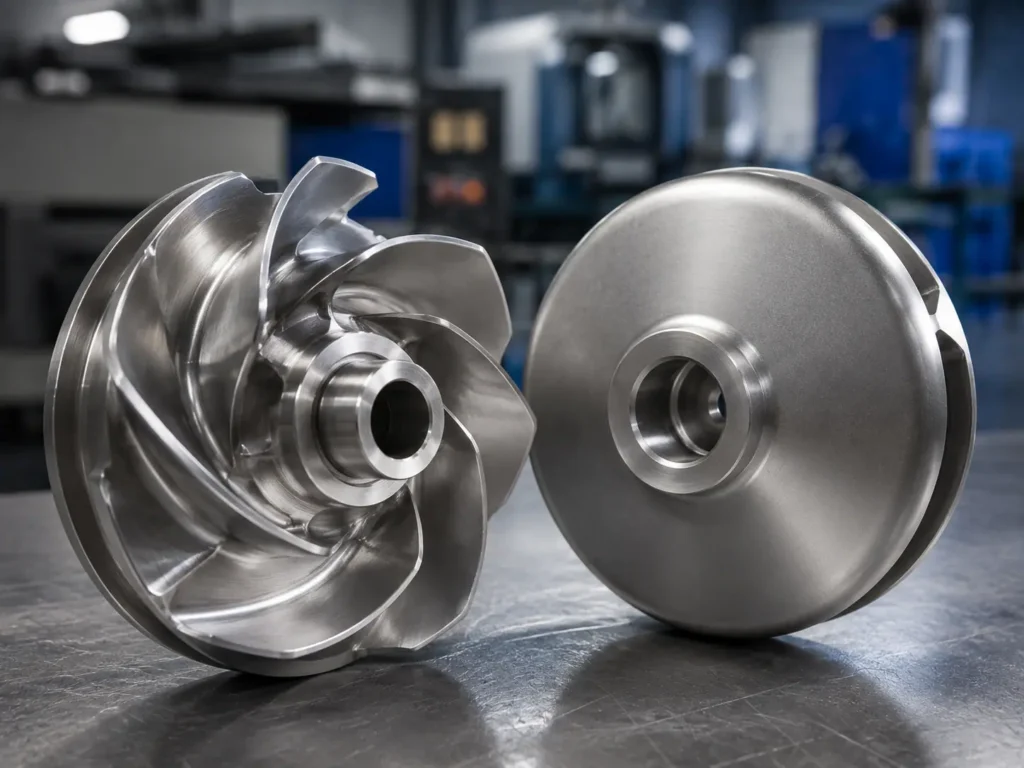
A CNC machined impeller is an impeller whose critical surfaces are finished by CNC machining so the part can fit the shaft, casing, hub, mounting face, wear ring, or other equipment interface. In many industrial projects, the impeller is first cast, fabricated, or rough formed, then CNC machined where precision, assembly fit, and inspection matter.
Short answer: CNC machining matters after casting when the impeller needs controlled bore size, hub height, mounting face flatness, keyway, shaft fit, wear-ring surfaces, outside diameter, vane edges, or other functional dimensions. A cast impeller may look correct, but without CNC finish machining on the right surfaces, it may not assemble, seal, balance, or run reliably.
Matson provides impeller manufacturing support for cast, CNC machined, balanced, and inspected impellers made from drawings, samples, or project specifications. For unusual geometry or sample-based projects, Matson can also review drawing-based custom industrial impellers.
Why Casting Alone Is Usually Not Enough
Casting is useful for curved vanes, shrouds, hubs, and complex impeller shapes. But a casting is not automatically a finished rotating part.
The cast blank may include draft, machining allowance, surface variation, and dimensional tolerance that are acceptable for a near-net shape but not acceptable for assembly. The pump shaft, fan shaft, mixer shaft, casing, wear ring, or coupling needs specific dimensions. That is where CNC machining becomes important.
For buyers, the practical question is not only “Can this impeller be cast?” It is “Which surfaces must be machined after casting, and what dimensions should be inspected before shipment?”
Critical Surfaces That Often Need CNC Machining
Use this table as a manufacturing review checklist before requesting a quote.
| Machined feature | Why it matters | What buyers should confirm |
|---|---|---|
| Bore | The impeller must fit the shaft correctly without looseness or interference. | Bore diameter, tolerance, datum, surface finish, and whether the sample bore is worn. |
| Hub height and hub face | Controls axial position, assembly stack-up, and contact with mating hardware. | Hub height, face flatness, perpendicularity, and mounting datum. |
| Keyway or spline | Transfers torque from the shaft to the impeller. | Keyway width, depth, location, corner radius, orientation, and drawing standard. |
| Mounting face or flange | Controls bolted connection, runout, and assembly stability. | Bolt pattern, face runout, thickness, flatness, and hole tolerance. |
| Wear ring or sealing surface | Affects leakage, clearance, efficiency, and rubbing risk in pump applications. | Diameter, roundness, surface finish, clearance requirement, and mating part condition. |
| Outside diameter | Can affect casing clearance, performance, balance, and replacement fit. | Finished OD, allowable trim, tolerance, and whether the OD is functional. |
| Vane edges or selected surfaces | May need cleanup or controlled geometry in selected designs. | Whether machining is required, where material can be removed, and how it affects balance. |
When CNC Machining Matters Most
CNC finish machining is especially important when the impeller is a rotating part with tight fit surfaces.
Pump impellers often need bore, hub, mounting face, wear-ring, OD, or clearance surfaces machined after casting. Fan and blower impellers may need hub, bore, mounting, backplate, or balancing-related surfaces controlled. Mixer and agitator impellers may need shaft bore, coupling, flange, keyway, or hub machining.
Machining also matters when the buyer is replacing a failed or worn sample. A worn sample may not show the original bore, hub height, OD, vane edge, or wear surface. If the factory copies the worn condition, the new part can repeat the same fit problem.
For casting-specific planning, see Matson’s article on pump impeller casting.
3-Axis and 5-Axis Machining Considerations
Not every impeller needs 5-axis machining. Many functional surfaces can be finished with conventional turning, milling, boring, drilling, or 3-axis machining.
5-axis machining may be useful when access is difficult, vane geometry is complex, surfaces are angled, or the drawing requires controlled machining on curved or hard-to-reach areas. It should be specified only when the design and tolerance justify it.
The safe RFQ language is simple: send the drawing and identify which surfaces are functional. The manufacturer can then review whether turning, milling, 3-axis CNC, 5-axis machining, or another setup is appropriate.
Material, Hardness, and Machining Route
Material affects machining. Stainless steel, duplex stainless, bronze, carbon steel, alloy steel, high-chrome wear materials, and heat-resistant materials do not machine the same way.
A hard or wear-resistant material may be excellent for service life but difficult to finish machine. A corrosion-resistant alloy may need surface treatment such as passivation after machining. Bronze may machine differently from stainless steel. Duplex stainless may require careful process control and documentation.
This is why the material grade, casting route, and CNC machining plan should be reviewed together. A drawing that looks simple can become difficult if the material is hard, the hub is deep, the bore tolerance is tight, or access to the machining surface is limited.
Inspection After CNC Machining
Machining without inspection is incomplete for many industrial impellers.
Buyers should define which dimensions need to be checked: bore, hub height, mounting face, keyway, OD, wear ring, flange, bolt pattern, or runout. Depending on the project, inspection may include caliper checks, micrometer checks, bore gauges, height gauges, CMM inspection, runout checks, material verification, or photo documentation.
Do not add inspection requirements after production if they are already known. If a dimensional report, material certificate, balancing report, or pre-shipment photo is needed, put it in the RFQ.
Balancing After Machining
CNC machining changes material distribution. Casting variation also affects balance. For rotating impellers, balancing may need to happen after machining, not before.
ISO 21940-11 is often referenced for rigid-rotor balancing terminology and grades when a drawing or buyer specification defines a balance class. The actual balancing requirement should come from the operating speed, diameter, mass, application, and equipment specification.
If the impeller is large, high-speed, heavy, or used in critical equipment, include the balancing requirement before production. For more detail, see Matson’s article on pump impeller balancing.
What Buyers Should Send for a CNC Machined Impeller Quote
A useful RFQ should include:
- 2D drawing, 3D file, or physical sample
- Material grade and casting, forging, fabrication, or rough blank information
- Which surfaces must be CNC machined
- Bore, hub height, mounting face, keyway, OD, wear-ring, flange, and hole dimensions
- Tolerances, datum references, surface finish, and runout requirements
- Whether 3-axis or 5-axis machining is specified or open for review
- Operating speed, balance requirement, and report requirement
- Application: pump, fan, blower, mixer, compressor, or custom equipment
- Photos of worn, corroded, repaired, or damaged surfaces if quoting from a sample
- Quantity, batch schedule, inspection documents, and export packing requirement
If there is no drawing, mark the functional surfaces clearly on the sample photos. A single photo is not enough for final CNC machining review.
Common Questions We Actually Get
What is a CNC machined impeller?
A CNC machined impeller is an impeller whose critical surfaces, such as the bore, hub, mounting face, keyway, OD, or wear-ring area, are finished by CNC machining for fit, tolerance, and inspection.
Does a cast impeller still need CNC machining?
Yes, in many industrial projects. Casting creates the near-net shape, but the bore, hub, mounting face, keyway, wear surfaces, and other functional dimensions often need CNC finish machining.
When does an impeller need 5-axis machining?
5-axis machining may be useful for complex vane geometry, angled surfaces, difficult access, or strict drawing requirements. It should be reviewed from the actual drawing rather than assumed for every impeller.
Can Matson machine impellers from samples?
Matson can review samples, photos, and measurements for custom impeller manufacturing. Worn samples should be measured carefully because original bore, hub, vane, or clearance dimensions may be lost.
What information should I send for a CNC machined impeller quote?
Send the drawing or sample, material, functional surfaces, machining tolerances, datum references, surface finish, quantity, inspection requirement, and balancing requirement.
Send Us Your Drawing
Need a CNC machined impeller after casting or sample reproduction? Send Matson your drawing, sample photos, material grade, functional surfaces, machining tolerances, quantity, and balancing requirement through the contact page. We can review casting, CNC machining, inspection, balancing, and documentation needs before quoting.