Pump impeller material selection is not a simple stainless steel versus bronze choice. For industrial pumps, the right material depends on the liquid, corrosion risk, solids content, abrasion, temperature, pump speed, impeller type, and the manufacturing route.
Short answer: clean water often works with stainless steel or bronze. Chemical liquid pushes the discussion toward 316L, duplex stainless, or another corrosion-resistant alloy. Slurry and mining service often need high-chrome or hard alloy materials. Seawater often brings bronze, duplex stainless, or super duplex into the conversation.
Matson manufactures custom pump impellers from drawings, 3D files, samples, and project specifications. If you are comparing materials for a custom pump impeller, start with the working condition before asking for a price. A material that looks safe on paper can still fail early if the liquid carries sand, chloride, acid, fibers, or abrasive particles.
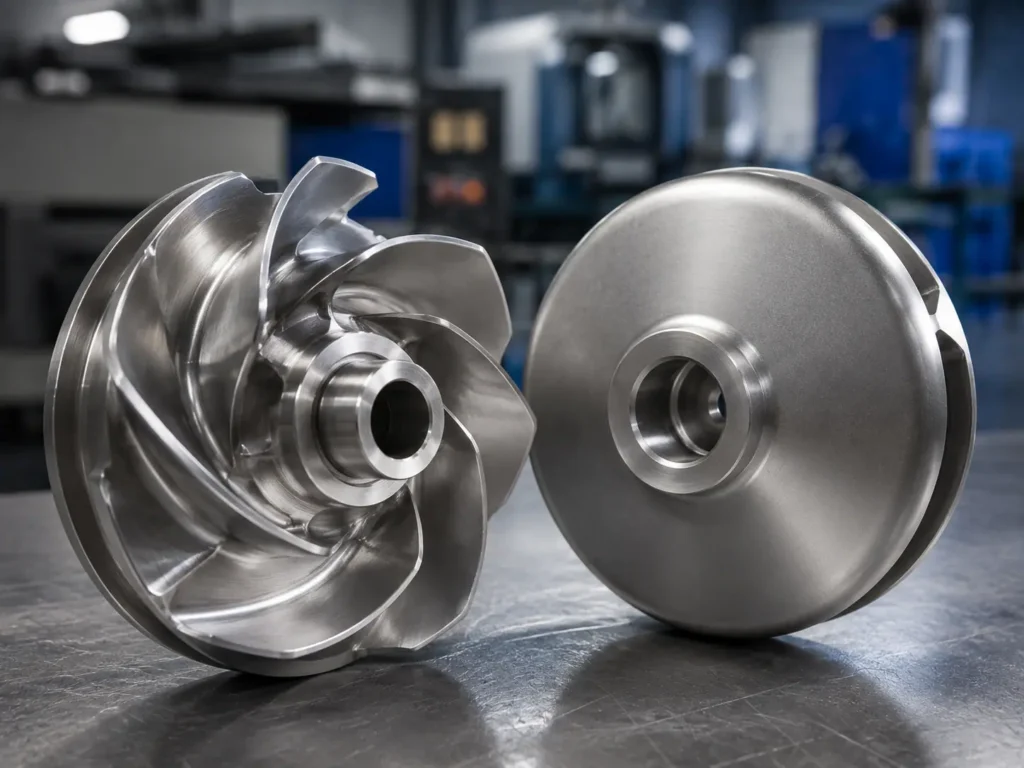
[Image placeholder: Add one real workshop or product image showing stainless steel, bronze, or cast pump impellers with visible material differences. Alt text: “Pump impeller material selection for stainless steel bronze and cast industrial impellers”]
Quick Material Selection Table
Use this table as a first filter. Final material selection should still be checked against the drawing, fluid chemistry, temperature, solids, speed, casting route, machining allowance, and required service life.
| Material family | Common use | Why buyers choose it | What to confirm before quoting |
|---|---|---|---|
| 304 stainless steel | Clean water and mild process liquid | General corrosion resistance and good machinability | Chloride level, liquid temperature, required surface finish |
| 316 / 316L stainless steel | Water, wastewater, chemical and process pumps | Better corrosion resistance than 304 in many environments | Chemical exposure, pH, chloride, temperature, passivation need |
| Duplex / super duplex stainless | Seawater, chemical, chloride-rich service | Higher corrosion resistance and strength in demanding liquid | Exact grade, casting feasibility, machining, project specification |
| Bronze / brass | Marine, seawater, water pump impellers | Good seawater history and useful anti-corrosion behavior | Alloy grade, dezincification risk, shaft/casing compatibility |
| Carbon steel | General industrial service where corrosion is limited | Cost and strength for non-corrosive conditions | Coating, corrosion allowance, liquid condition, service life target |
| Alloy steel / hard alloy | Abrasive slurry, mining, heavy-duty service | Wear resistance and strength | Hardness, impact risk, particle size, balance, casting quality |
| High-chrome white iron | Mining slurry, tailings, abrasive sludge | Strong abrasion resistance | Impact condition, section thickness, machining limits, service life |
Start With the Liquid, Not the Material Name
Many RFQs start with a material grade. That is useful, but it is not enough.
I would rather see the liquid condition first: clean water, wastewater, seawater, acid, solvent, sludge, slurry, or process liquid. Then solids. Then temperature. Then pump speed and impeller structure.
A buyer may ask for a stainless steel pump impeller because the old part was stainless. That does not prove the grade was correct. If the old impeller failed from chloride corrosion, switching from 304 to 316L, duplex, or another corrosion-resistant grade may matter more than copying the old label. If the failure was abrasive wear, a tougher or harder material discussion may be needed instead.
Material selection also changes with pump impeller types. A closed impeller for clean liquid has a different risk profile from a vortex impeller handling sewage or a slurry pump impeller working in tailings.
Stainless Steel Pump Impellers
Stainless steel is common for industrial pump impellers because it gives a practical balance of corrosion resistance, casting feasibility, machining, and surface finishing.
304 stainless steel can work in clean water and mild service. It is not a magic material. Chlorides, temperature, acids, and cleaning chemicals can change the decision quickly.
316 and 316L are often better choices for water, wastewater, and chemical process conditions. The extra corrosion resistance can be worth the cost when the liquid is more aggressive. In some cases, passivation or electropolishing also matters, especially when buyers care about surface condition and corrosion behavior.
For harsh chloride or seawater service, duplex or super duplex stainless may enter the discussion. These grades should be treated carefully. The drawing, casting route, heat treatment, machining, and project specification all need to line up.
Bronze and Brass Pump Impellers
Bronze and brass are still relevant in water and marine pump applications. They are not old-fashioned just because stainless steel is common.
For a marine pump impeller or seawater pump project, bronze can be a practical material choice. The exact alloy matters. So does the shaft, casing, water chemistry, and whether the part is copied from a drawing or a worn sample.
One warning: do not confuse industrial bronze pump impellers with small rubber outboard impellers. Matson’s work is custom metal impeller manufacturing for industrial and OEM projects, not retail rubber replacement parts.
Materials for Wastewater and Chemical Pumps
Wastewater and chemical service are where simple material advice starts to fail.
Wastewater can carry solids, fibers, sand, chloride, and corrosive compounds. A material that resists corrosion may still wear quickly if grit is high. A material with good wear resistance may still be wrong if corrosion is severe.
For an industrial water pump impeller, 316L stainless, duplex stainless, bronze, or other grades may be considered depending on fluid chemistry and solids. For a chemical pump impeller, the chemical name alone is not enough. Concentration, temperature, pH, chloride level, and intermittent cleaning conditions all affect the material decision.
If the pump handles unknown process liquid, send the material specification or the operating condition before asking the factory to choose. A responsible manufacturer should not guess from the word “chemical.”
Materials for Slurry and Mining Service
Slurry pump impellers live a harder life. Abrasion is often the main problem, but impact and corrosion may also be present.
High-chrome white iron, hard alloy steel, and selected duplex stainless steels can be considered for mining slurry, tailings, sludge, and abrasive media. The right choice depends on particle size, hardness, velocity, impact condition, pump speed, and expected service life.
For a slurry pump impeller, a worn sample is useful, but it can also mislead the quote. The most worn areas may no longer show the original vane profile or thickness. Photos help. Measurements help more. A drawing, 3D file, or confirmed sample is better.
Casting, Machining, and Material Choice
Material selection is tied to the manufacturing route.
Some impellers are best made by investment casting plus finish machining. Others are better suited to sand casting with machining allowance. High-hardness wear materials may limit how much machining can be done after casting. Stainless steel may need surface treatment. High-speed impellers may need tighter balancing control.
That is why material choice should be reviewed together with impeller manufacturing requirements: casting method, CNC machining, bore tolerance, hub height, mounting face, vane surfaces, inspection, and dynamic balancing.
If the drawing specifies both a difficult material and tight post-casting machining, the factory should check feasibility before quoting. A cheap quote that ignores the process route is not useful.
Common Material Selection Mistakes
The first mistake is choosing the material from a previous failed part without asking why it failed.
If the old impeller failed from corrosion, copying the same grade repeats the problem. If it failed from abrasion, a corrosion-resistant stainless steel may still wear too fast. If it failed from vibration, material may not be the main cause at all; balance, bore fit, clearance, or damage could be the real issue.
The second mistake is treating stainless steel as one material. 304, 316, 316L, duplex, and super duplex are different choices. They do not carry the same cost, corrosion behavior, casting behavior, or machining difficulty.
The third mistake is quoting from photos only. A photo does not show bore size, hub height, wall thickness, worn clearance, balance grade, or material chemistry. It is useful for first review, not enough for production.
What to Send for a Material Review
For a cleaner quote, send:
- 2D drawing, 3D file, or physical sample
- Current material grade, if known
- Liquid or slurry condition
- Temperature, pH, chloride, acid, solvent, or other chemical exposure
- Solids content, particle size, or fiber condition
- Pump speed and balancing requirement
- Outside diameter, bore, hub height, mounting dimensions, and key tolerances
- Quantity and expected batch schedule
- Photos of failed or worn parts, if the project is a replacement or improvement
- Required certificates, dimensional reports, or balancing data
Matson manufactures pump impellers to drawing or sample. For material questions, the best RFQ is not “Can you make this in stainless steel?” It is “Here is the drawing, the liquid, the old material, and the failure condition. What manufacturing route and material should we review?”
Send those details through the contact page for a practical quotation review.
Common Questions We Actually Get
What is the best material for a pump impeller?
There is no single best material. Pump impeller material selection depends on the liquid, corrosion risk, solids, abrasion, temperature, pump speed, impeller type, and expected service life.
Is stainless steel always better than bronze for pump impellers?
No. Stainless steel is useful in many industrial pump applications, but bronze can still be practical for marine and water pump service. The exact fluid, alloy grade, shaft, casing, and operating condition decide the better choice.
Which pump impeller material is better for chemical service?
Chemical pump impellers often use 316L stainless, duplex stainless, super duplex, or other corrosion-resistant materials. The chemical name alone is not enough; concentration, temperature, pH, chloride, and cleaning conditions should be reviewed.
What material is used for slurry pump impellers?
Slurry pump impellers often use high-chrome white iron, hard alloy steel, or selected duplex stainless materials. Particle size, impact, abrasion, corrosion, and service life target should be checked before choosing.
Can Matson help choose a material from a sample?
Matson can review a physical sample, photos, dimensions, and working condition for a custom impeller RFQ. A worn sample should be measured carefully because it may no longer show the original vane profile, clearance, or wall thickness.
CTA
Need help reviewing pump impeller material for an industrial project? Send Matson your drawing, sample photos, current material, liquid condition, quantity, and failure details if available. We can review the manufacturing route and quote the impeller based on material, casting, machining, finishing, inspection, and balancing requirements.