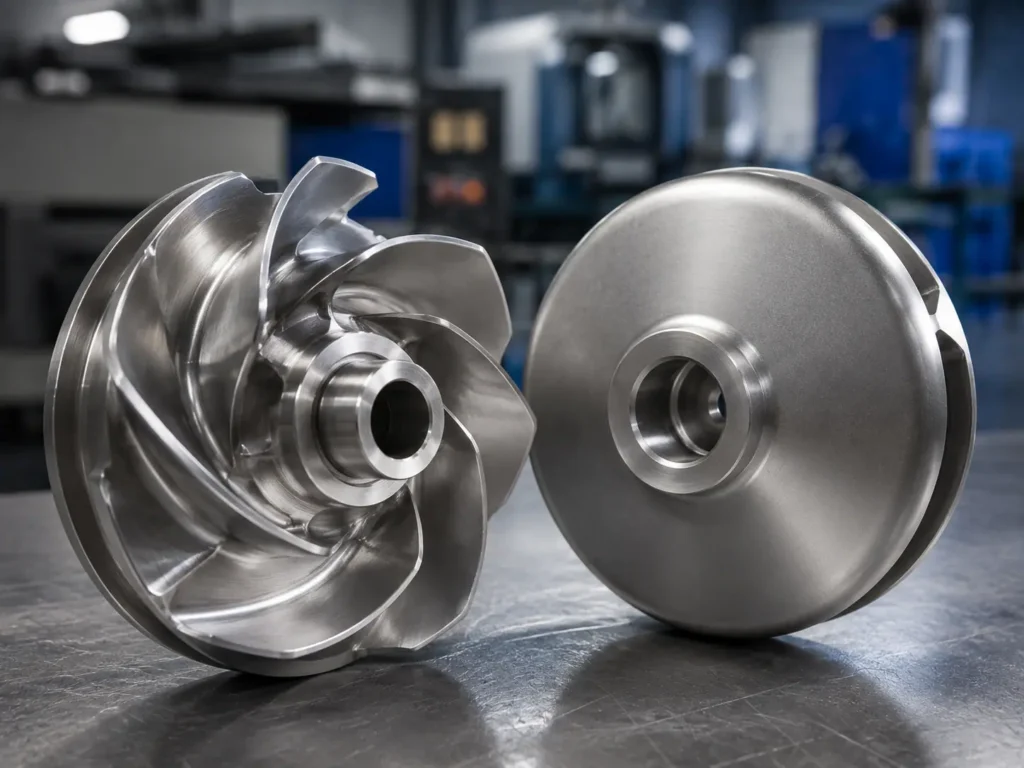
Open impeller pump designs are often considered when a pump needs easier cleaning, better access to the vane area, or more tolerance for light solids than a closed impeller can provide. In industrial pump applications, an open impeller is not automatically the “best solids-handling” option, but it can be a practical choice when the liquid is not perfectly clean and the pump design allows the required clearance control.
Short answer: an open impeller pump can fit wastewater, dirty water, light sludge, some chemical process liquids, and applications where inspection or cleaning access matters. It is usually less efficient than a closed impeller in clean liquid service, and it still needs careful review of clearance, material, speed, wear, machining, and balancing before manufacturing.
Matson manufactures custom pump impellers from drawings, 3D files, samples, and buyer specifications. For an open impeller pump project, Matson reviews the part from a manufacturing angle: casting route, vane geometry, CNC machining, material, inspection, dynamic balancing, and export packing.
What Is an Open Impeller Pump?
An open impeller pump uses an impeller with exposed vanes instead of vanes enclosed between two shrouds. The open side makes the vane area easier to inspect and clean. It can also give the pump more tolerance when the liquid contains light suspended solids.
That open geometry is the main advantage, but also the main limitation. Because the flow is less enclosed, an open impeller often depends more heavily on the clearance between the impeller and the pump casing or wear plate. If that clearance is wrong, pump performance can drop and wear can increase.
This is why buyers should not treat open impellers as loose, simple parts. Bore accuracy, hub height, vane geometry, outside diameter, mounting face, material, and balance still decide whether the impeller fits and runs correctly.
Where Open Impellers Fit
Use this table as a first review before sending an RFQ.
| Application condition | Open impeller fit | What buyers should confirm |
|---|---|---|
| Dirty water or light wastewater | Often worth reviewing | Solids size, fibers, clogging history, clearance, and material. |
| Process liquid with light solids | Possible when cleaning access matters | Particle size, corrosion risk, temperature, surface finish, and pump speed. |
| Clean water where efficiency is the main goal | Usually not the first choice | Closed impeller or other OEM-specified geometry may be more efficient. |
| Fibrous wastewater or rags | Needs caution | Open may not be enough; vortex or other solids-handling designs may be better. |
| Abrasive slurry | Only after slurry-specific review | Wear pattern, particle hardness, material, section thickness, and operating speed. |
| Replacement from a worn sample | Needs careful measurement | Original OD, vane wear, bore condition, hub height, and clearance surfaces. |
Benefits of an Open Impeller Pump
The practical benefit is access. Exposed vanes are easier to see, clean, measure, and inspect than the internal passages of a closed impeller. For wastewater or dirty process liquid, this can help maintenance teams understand clogging, wear, or damage faster.
Open impellers can also be useful where the liquid carries light suspended solids. The geometry gives less enclosed space for material to lodge inside the impeller. That does not mean every open impeller is a solids-handling impeller. Passage width, vane shape, casing design, speed, and the actual solids still matter.
For wastewater selection context, Matson’s article on sewage pump impeller types compares vortex, open, and semi-open designs in more detail.
Limits Buyers Should Not Ignore
Open impellers can lose efficiency compared with closed impellers in clean-liquid centrifugal pump service. They can also be more sensitive to front clearance. If the clearance is too large, internal recirculation can increase and pump performance can fall. If clearance is too tight, rubbing and wear become risks.
The exposed vane edges can also wear quickly in abrasive service. A wastewater pump moving light solids is different from a mining slurry pump carrying hard particles. Buyers should not use “open” as a shortcut for severe slurry service unless the pump OEM or engineering owner has already confirmed the design.
For a clean-liquid focused comparison, see the article on closed impeller pump. For broader geometry comparison, see open vs closed pump impeller.
Manufacturing Considerations
An open impeller may look easier to manufacture because the vanes are visible. That is only partly true.
Casting quality still matters. Vane thickness, leading edges, hub transition, shrinkage risk, and surface condition should be reviewed against the drawing and material. CNC finish machining may be needed for the bore, hub, mounting face, keyway, outside diameter, wear surfaces, and other critical interfaces.
Because the vanes are exposed, damage and imbalance can also be more visible. But visible does not mean harmless. A small casting defect, vane thickness difference, or machining datum issue can still create vibration. Balancing should be confirmed before production when the pump speed, mass, diameter, or buyer specification requires it.
Matson’s impeller manufacturing page covers casting, CNC machining, surface treatment, inspection, dynamic balancing, and documentation scope.
Material and Wear Notes
Material selection depends on both liquid and solids.
For wastewater, stainless steel, duplex stainless, carbon steel, or other project-specified materials may be reviewed depending on corrosion, abrasion, cost target, and drawing requirements. For chemical process liquid, compatibility with the liquid is the first question. For slurry or grit-heavy service, abrasion resistance and wear history become more important.
Do not choose the material only from the impeller type. An open stainless steel impeller can still wear in grit. A hard material can still corrode if the liquid chemistry is wrong. A material that works in clean water may not survive dirty wastewater or abrasive slurry.
For a deeper material review, see pump impeller material selection.
When to Consider a Vortex Design Instead
Open impellers are useful, but they are not the only answer for solids.
If the liquid contains large solids, rags, stringy material, or frequent clogging problems, a vortex design may be a stronger direction. A vortex impeller can keep more solids away from direct vane contact in some pump designs, though it also has its own efficiency and casing requirements.
If the project has clear solids-handling or wastewater RFQ intent, the dedicated vortex impeller pump page is the better next step.
What Buyers Should Send for an Open Impeller Quote
For a reliable RFQ, send:
- 2D drawing, 3D model, or physical sample
- Pump model or drawing number if available
- Finished outside diameter and trim diameter
- Bore, hub height, mounting face, keyway, and critical clearances
- Open-side clearance or wear plate information if available
- Pump speed and balancing requirement
- Liquid type: wastewater, dirty water, chemical process liquid, slurry, seawater, or clean water
- Solids size, fibers, grit, particle hardness, and clogging history
- Material grade, previous material, or required ASTM / EN / project specification
- Worn-part photos showing vane edges, hub, bore, and rubbing areas
- Quantity, inspection report, certificate, and packing requirements
If the sample is worn, say so. An open impeller can lose vane edge detail, diameter, and clearance surfaces during service. Copying a worn part without checking the original drawing can repeat an already bad condition.
Common Questions We Actually Get
When should I use an open impeller pump?
Use an open impeller pump when the liquid has light solids, cleaning access matters, or inspection of the vane area is important. The final choice still depends on pump design and operating condition.
Is an open impeller pump good for wastewater?
It can be, especially for dirty water or light wastewater. For large solids, rags, or heavy clogging risk, buyers should also review vortex or other solids-handling designs.
Is an open impeller less efficient than a closed impeller?
Often yes in clean liquid service. Open impellers may trade some efficiency for easier cleaning, inspection, and solids tolerance.
What information should I send for a custom open pump impeller quote?
Send the drawing or sample, diameter, bore, hub, clearance, pump speed, liquid condition, solids information, material grade, quantity, and balancing requirement.
Can Matson manufacture open pump impellers from samples?
Yes. Matson can review sample-based manufacturing, but worn samples need careful measurement because vane edges, diameter, and clearance surfaces may no longer match the original part.
Send Us Your Drawing
Need an open pump impeller manufactured from a drawing or sample? Send Matson the drawing, photos, material grade, pump speed, liquid condition, solids information, quantity, and balancing requirement through the contact page. We can review casting, CNC machining, material, inspection, and balancing details before quoting.