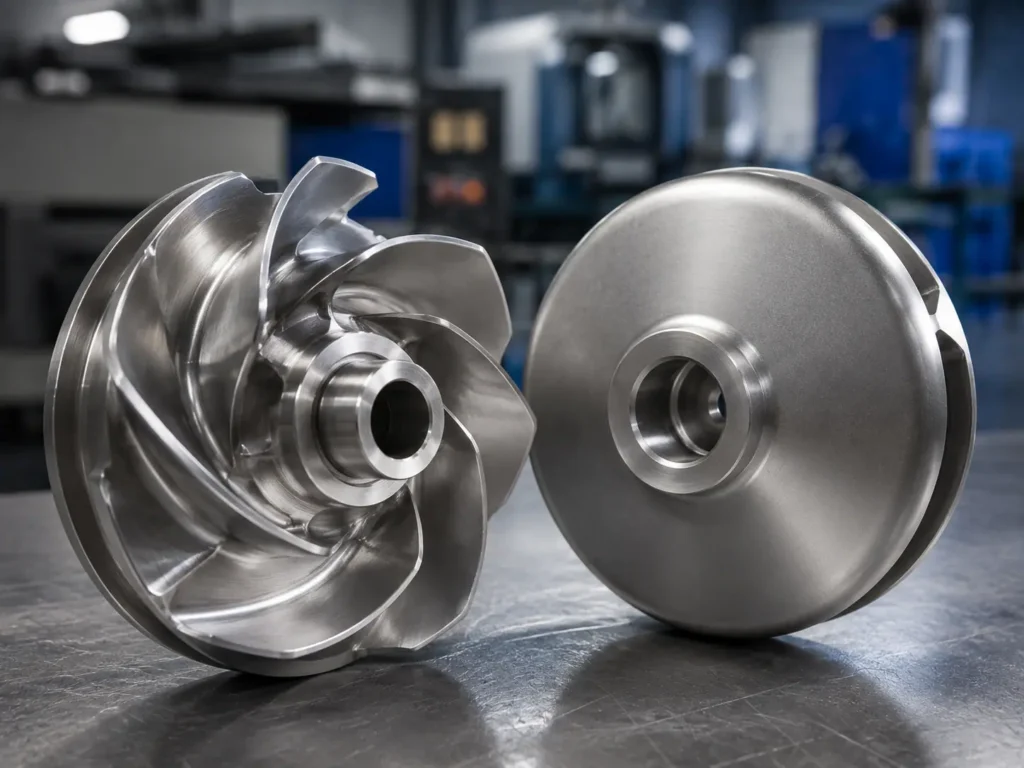
Closed impeller pump applications usually involve clean or relatively clean liquids where efficiency, controlled flow, and stable pump performance matter more than solids handling. For industrial buyers, the key question is not simply whether a closed impeller is “better.” The better question is whether the liquid condition, pump casing, clearance, material, speed, and manufacturing requirements are suitable for a closed design.
Short answer: a closed impeller pump is often a good fit for clean water, seawater with proper material selection, many chemical process liquids, cooling circulation, and industrial transfer duties with limited solids. It is usually not the first choice for fibrous wastewater, sludge, large solids, or abrasive slurry unless the pump OEM has specified that design for the duty.
Matson manufactures custom pump impellers from drawings, 3D files, samples, and buyer specifications. When the drawing calls for a closed impeller, Matson reviews the part from a manufacturing angle: casting route, CNC machining, bore and hub accuracy, material, inspection, balancing, and export packing.
What Is a Closed Impeller Pump?
A closed impeller pump uses an impeller with vanes enclosed between two shrouds. The shrouds create a controlled passage for the liquid as the impeller rotates inside the pump casing.
This structure is common in centrifugal pumps because it can support good hydraulic efficiency when the liquid is clean and the clearances are controlled. In the right service, a closed impeller can help keep flow stable and reduce internal leakage compared with more open geometries.
The same structure also explains the limitation. Solids, fibers, scale, or abrasive particles have less open space to pass through. If the liquid is dirty, the enclosed passages may increase clogging risk or concentrated wear.
When a Closed Impeller Design Fits
Use this table as a buyer-side filter before asking for a quote.
| Application condition | Closed impeller fit | What buyers should confirm |
|---|---|---|
| Clean water or cooling circulation | Often suitable | Diameter, rpm, casing clearance, material grade, and balancing requirement. |
| Seawater or marine cooling | Possible with correct material | Bronze, duplex stainless, or specified alloy, plus corrosion requirement and certificates. |
| Chemical process liquid | Possible when the liquid is clean enough | Chemical compatibility, temperature, corrosion risk, surface finish, and passivation if required. |
| Wastewater with fibers or rags | Usually risky | Ask whether vortex, open, or semi-open designs are more suitable for clogging control. |
| Abrasive mining slurry | Only if specified by pump engineering | Solids size, particle hardness, wear pattern, material, section thickness, and slurry-specific design. |
| Unknown replacement from worn sample | Needs careful review | Original drawing, worn-area photos, OD loss, vane damage, bore wear, and pump duty. |
Where Buyers Make Mistakes
The most common mistake is treating a closed impeller as the high-efficiency answer for every pump. That is too simple.
Efficiency only helps if the impeller can keep operating in the real liquid. A closed impeller in clean process water may be a strong choice. The same geometry in wastewater with fibers can clog. In slurry service, abrasive particles may attack the vane inlet, outlet, shroud, and clearance areas quickly.
Another mistake is quoting from a photo. A closed impeller hides part of the vane geometry between the shrouds. A photo rarely tells enough about vane angle, passage width, bore, hub height, wear ring, balancing condition, or casting details. A drawing or accurate sample measurement is much safer.
For a broader comparison of open, closed, and semi-open geometry, use Matson’s article on open vs closed pump impeller. This article stays focused on closed impeller pump applications and manufacturing checks.
Manufacturing Notes for Closed Pump Impellers
A closed impeller can be more demanding to manufacture than it looks from the outside.
Casting quality matters because the internal passages are less visible and may be harder to clean, inspect, or finish than exposed vanes. The correct process depends on size, material, quantity, section thickness, and drawing complexity. Investment casting, sand casting, and CNC finish machining may all be reviewed depending on the part.
Machining also matters. Buyers should not check only the outside diameter. The bore, hub height, keyway, mounting face, wear ring area, inlet eye, and any critical clearance surfaces can decide whether the part fits the pump.
Dynamic balancing should be discussed when speed, diameter, mass, or project specification requires it. A closed impeller with uneven casting wall thickness, poor machining datum, or hidden material defects can create vibration risk. The balancing grade should come from the drawing, pump speed, impeller mass, and buyer requirement.
For process capability details, see Matson’s impeller manufacturing page.
Material Selection Still Comes First
A closed impeller design does not solve the material question.
For clean water, stainless steel, bronze, or carbon steel may be discussed depending on the drawing and project requirement. For seawater, bronze, duplex stainless, or other corrosion-resistant alloys may be reviewed. For chemical liquids, corrosion resistance, temperature, concentration, and surface treatment can matter more than the basic impeller structure.
If abrasion is present, material and wear pattern should be reviewed together. A closed impeller made from the wrong material can fail even if the geometry is correct. A material that works in clean water may not survive the same way in slurry, chemical corrosion, or seawater chloride exposure.
For more detail, see pump impeller material selection.
What Buyers Should Send for a Closed Impeller Quote
For a reliable RFQ, send:
- 2D drawing, 3D model, or physical sample
- Pump model or drawing number if available
- Finished outside diameter and trim diameter
- Bore size, hub height, keyway, mounting face, and wear ring details
- Pump speed, balancing requirement, and normal duty condition
- Liquid type: clean water, seawater, chemical, condensate, process liquid, slurry, or wastewater
- Solids content, particle size, fibers, or abrasion risk if present
- Material grade, previous material, or required ASTM / EN / project specification
- Surface finish, passivation, coating, or polishing requirement
- Photos of worn or failed impellers if the project is replacement or improvement
- Quantity, inspection documents, certificates, and packing requirements
If only a sample is available, tell the manufacturer whether the sample is worn. A worn closed impeller may have lost diameter, clearance surfaces, or vane edge detail, and copying it directly can repeat an already damaged condition.
Common Questions We Actually Get
When should I use a closed impeller pump?
Use a closed impeller pump when the liquid is clean or relatively clean, efficiency matters, and the pump design is built for controlled clearance and stable hydraulic performance.
Is a closed impeller pump good for wastewater?
Not usually for fibrous or solids-heavy wastewater. Closed passages can increase clogging risk. For wastewater, buyers often review semi-open, open, or vortex designs instead.
What information should I send for a custom closed pump impeller quote?
Send the drawing or sample, diameter, bore, hub, keyway, pump speed, material grade, liquid condition, quantity, balancing requirement, and photos of any worn areas.
Can Matson manufacture closed pump impellers from samples?
Yes, Matson can review sample-based manufacturing, but a worn sample should be checked carefully. Drawings, dimensions, material information, and operating context make the quote more reliable.
Is a closed impeller always more efficient?
A closed impeller is often efficient in clean liquid service, but the actual result depends on pump design, clearance, speed, liquid condition, and whether the impeller is manufactured correctly.
Send Us Your Drawing
Need a closed pump impeller manufactured from a drawing or sample? Send Matson the drawing, photos, material grade, pump speed, liquid condition, quantity, and balancing requirement through the contact page. We can review casting, CNC machining, material, inspection, and balancing details before quoting.