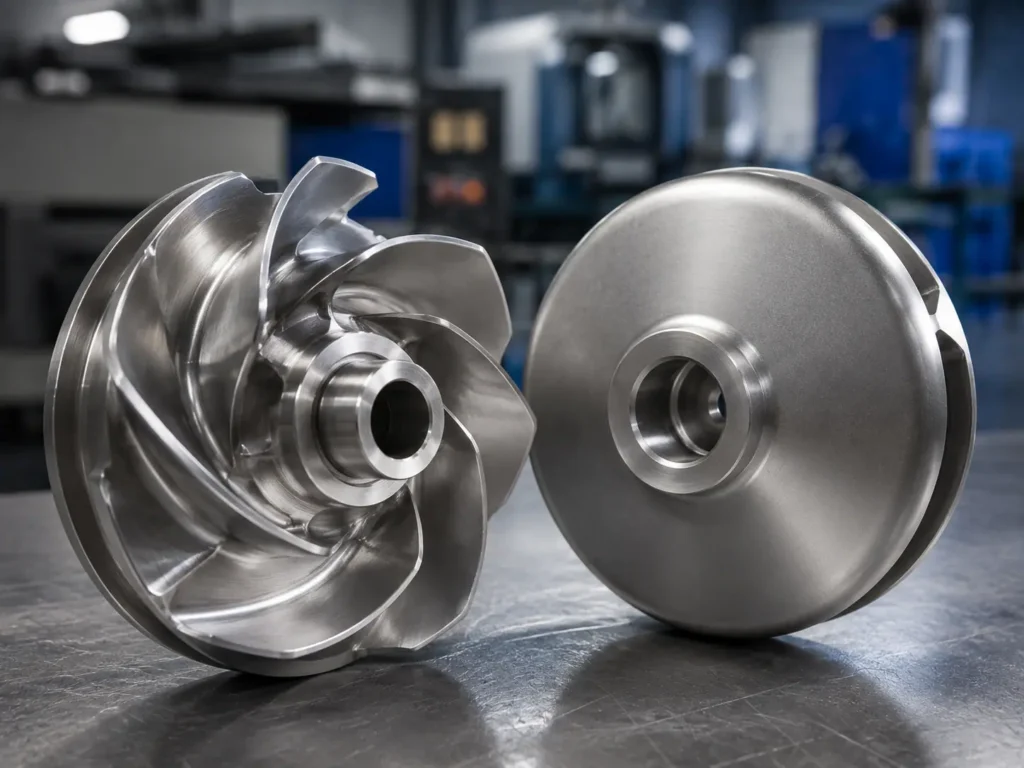
A wear ring in centrifugal pump service helps control the clearance between rotating and stationary parts. In practical terms, it reduces internal leakage, protects expensive casing or impeller surfaces from direct wear, and gives the pump a defined clearance surface that can be inspected during maintenance.
Short answer: for custom impeller manufacturing, buyers should treat the wear ring as part of the impeller fit review, not as a small accessory detail. The drawing, casing relationship, running clearance, material, machining surface, and sample condition all matter. A correct impeller shape can still create leakage, rubbing, vibration, or early wear if the wear-ring dimensions are wrong.
Matson manufactures industrial custom pump impellers from drawings, samples, and project specifications. We do not position this article as a wear-ring retail or repair guide. The focus here is how wear-ring information affects impeller manufacturing, CNC machining, inspection, and RFQ review.
If the impeller is a closed centrifugal design, this topic connects closely with Matson’s guide to closed impeller centrifugal pump fit and clearance review.
What Is a Wear Ring in a Centrifugal Pump?
A wear ring is a replaceable or controlled wear surface used near the impeller and casing interface in many centrifugal pumps. Depending on the pump design, the wear ring may be fitted on the casing, on the impeller, or on both sides of the running clearance.
Its job is not only to “take wear.” It helps maintain the designed clearance between high-pressure and low-pressure zones inside the pump. When that clearance becomes too large, internal leakage can increase and pump performance can drop. When the clearance is too tight or the part is misaligned, rubbing, heat marks, vibration, or seizure risk can appear.
For a manufacturer making a new impeller from a drawing or sample, the wear ring area should be treated as a functional dimension. The outside diameter alone is not enough.
Why Wear-Ring Clearance Matters
Wear-ring clearance is not a universal number that can be copied from a generic chart. It depends on pump design, impeller diameter, material, temperature, liquid, shaft movement, casing condition, operating speed, and the OEM or engineering specification.
| Review item | Why it matters | What buyers should confirm |
|---|---|---|
| Wear-ring location | The ring may belong to the casing, the impeller, or both. The manufacturing responsibility changes with the design. | Impeller wear ring, casing wear ring, or both; send the pump section drawing if available. |
| Running clearance | Too much clearance can increase leakage. Too little clearance can cause rubbing or heat damage. | Specified clearance, mating-part diameter, material, temperature, and operating condition. |
| Impeller fit surface | The wear-ring surface may need CNC finish machining, roundness control, and inspection. | Finished diameter, tolerance, surface finish, datum, and inspection method. |
| Casing condition | A new impeller fitted against a worn casing ring may still perform poorly. | Casing ring size, wear condition, photos, and whether mating parts are being replaced. |
| Material pairing | Material pairing affects galling, corrosion, abrasion, and service wear. | Impeller material, casing material, ring material, fluid, solids, temperature, and corrosion risk. |
| Sample reliability | A worn sample may no longer show the original wear-ring diameter. | Which sample surfaces are worn, repaired, corroded, or unreliable. |
The safe RFQ approach is simple: send the approved clearance or mating-part dimensions. Do not ask the factory to guess from a worn impeller edge.
Impeller Wear Ring vs Casing Wear Ring
Some buyers use “pump wear ring” as a general phrase, but the actual part relationship matters.
An impeller wear ring is attached to or machined as part of the impeller-side running surface. A casing wear ring is installed in the pump casing. In some designs, both surfaces are replaceable. In others, one side may be machined directly into the impeller or casing.
For custom impeller manufacturing, this distinction affects quotation and inspection. If Matson is manufacturing only the impeller, the RFQ still needs the mating casing-ring dimensions. Without that information, the new part may look correct on the bench but have the wrong clearance in the pump.
This is also why a worn sample needs careful review. A bright rubbing mark around the wear-ring area may show where contact happened, but it does not automatically show the original design diameter.
Material and Surface Finish Notes
Wear-ring material should be selected with the pump design and working environment in mind. Clean water, wastewater, chemical liquid, seawater, slurry, and hot process fluid do not create the same risk.
Bronze, stainless steel, duplex stainless, carbon steel, alloy steel, and harder wear-resistant materials may all appear in different pump projects. The right choice depends on the drawing, pump specification, fluid, solids, corrosion risk, and mating material. A harder material is not always safer if galling, corrosion, or machining difficulty creates a new problem.
Surface finish also matters. A rough, out-of-round, or poorly machined wear-ring surface can affect clearance and rubbing risk. For cast impellers, the wear-ring surface is often one of the areas that should be CNC finish machined after casting.
For broader material review, Matson’s pump impeller material selection article gives a useful starting point.
CNC Machining and Inspection
The wear-ring area is usually not just a cosmetic surface. It may need controlled diameter, roundness, concentricity, surface finish, and relationship to the bore or mounting face.
That creates a machining question: what datum should be used? If the bore is machined from one setup and the wear-ring surface from another setup without a controlled datum, the individual measurements may pass but the assembled runout can still be wrong.
Matson’s CNC machined impeller article explains why bore, hub, mounting face, keyway, wear-ring, and OD surfaces often need finish machining after casting.
Buyers should confirm whether the quotation needs:
- Finished wear-ring diameter and tolerance
- Mating casing-ring or impeller-ring diameter
- Required running clearance
- Surface finish requirement
- Datum relationship to bore, hub, or mounting face
- Runout or concentricity requirement
- Dimensional report or inspection photos
If these items are important, include them before quoting. Adding them after production can change machining, inspection, and cost.
When a Worn Sample Is Risky
Sample-based impeller manufacturing is possible, but wear-ring surfaces need special caution.
A failed impeller may have lost material around the ring area. The casing may also be worn. If the new impeller copies the worn diameter exactly, the replacement may keep the excessive clearance and repeat the performance problem.
The same issue appears when a sample has rubbing marks. If the old impeller rubbed because of shaft movement, poor bearing condition, casing distortion, incorrect mounting, or prior machining error, copying that damage does not solve the root cause.
In wear-related projects, send photos and measurements of both the impeller and the mating pump parts when possible. Matson can manufacture to defined dimensions, but final clearance selection should come from the pump OEM, approved drawing, or engineering owner.
For broader damage diagnosis, see Matson’s pump impeller failure guide.
What Buyers Should Send for RFQ
For a centrifugal pump impeller with wear-ring requirements, send:
- Approved 2D drawing and 3D file if available
- Pump section drawing or casing relationship drawing
- Existing impeller sample and clear photos
- Wear-ring location: impeller side, casing side, or both
- Finished wear-ring diameter, tolerance, and surface finish
- Mating-part diameter and required running clearance
- Bore, hub height, mounting face, keyway, OD, and runout requirements
- Material grade, certificate need, and working liquid condition
- Pump speed, operating temperature, solids, corrosion or abrasion risk
- Balancing grade and report requirement if specified
- Quantity, batch plan, packing, and export document requirements
If the keyword you searched was “how to remove wear ring in centrifugal pump,” this article is probably not the right guide. Removal is a maintenance operation and depends on pump design. For manufacturing, the more important question is what dimensions should be restored or controlled on the new impeller.
Common Questions We Actually Get
What is the purpose of a wear ring in centrifugal pump service?
A wear ring helps control running clearance, reduce internal leakage, and provide a replaceable or controlled wear surface between the impeller and casing area.
What is centrifugal pump wear ring clearance?
It is the running clearance between the wear-ring surfaces. The correct value should come from the pump drawing, OEM specification, mating-part dimensions, or engineering owner, not from a universal online chart.
Can Matson manufacture an impeller if wear-ring dimensions are missing?
Matson can review the project, but missing wear-ring dimensions create risk. Buyers should send the drawing, casing-ring dimensions, worn sample photos, or approved clearance before production.
What material is used for a wear ring in centrifugal pump applications?
There is no single material for every pump. Material depends on the impeller, casing, fluid, corrosion risk, abrasion, temperature, and drawing requirement. Stainless steel, bronze, alloy steel, and other project-specified materials may be reviewed.
Is this a wear-ring removal guide?
No. This is a manufacturing and RFQ review article for custom impellers. It explains why wear-ring location, clearance, material, machining, and sample condition matter before a new centrifugal pump impeller is made.
Send Us Your Drawing
Need a centrifugal pump impeller manufactured from a drawing or sample? Send Matson the drawing, wear-ring dimensions, mating-part information, material grade, critical clearances, pump speed, quantity, and inspection requirement through the contact page. We can review the casting, CNC machining, inspection, and balancing route before quoting.