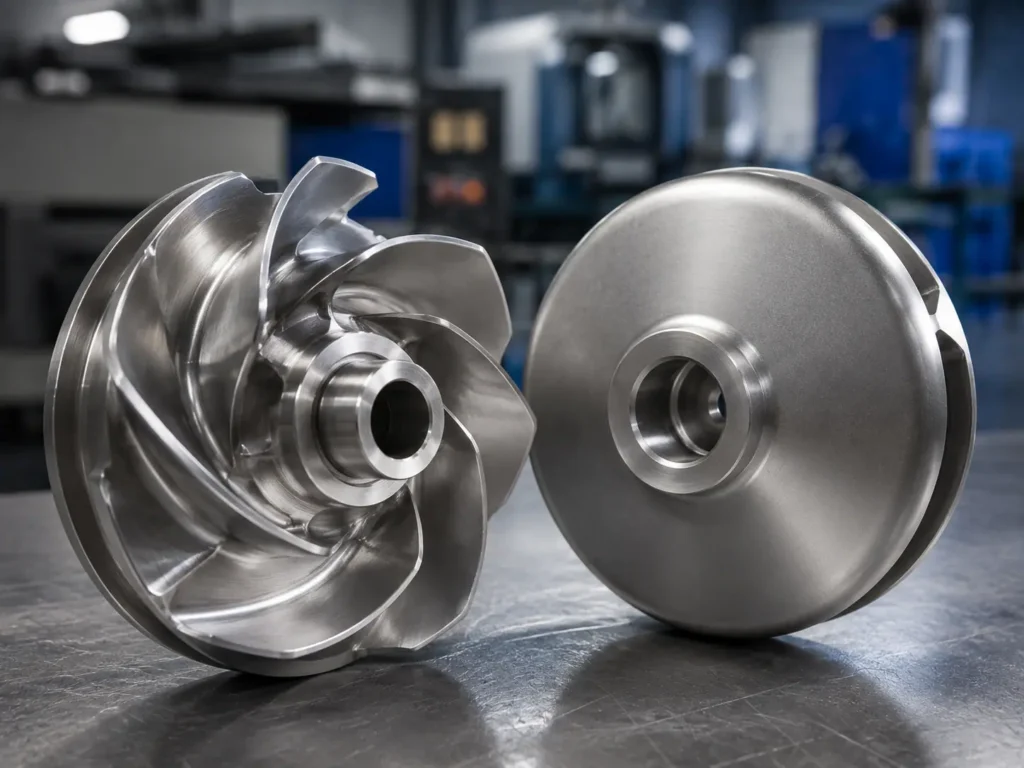
Pump impeller failure can show up as pitting, vane wear, cracking, corrosion, rubbing marks, broken edges, vibration, reduced flow, or repeated pump underperformance. For industrial buyers, the important point is that the impeller is often where the damage is visible, but the root cause may come from the liquid, suction condition, solids, material choice, clearance, balance, casting quality, or a worn sample copied without enough review.
Short answer: common pump impeller failure causes include cavitation, abrasive wear, corrosion, wrong material, poor fit, excessive clearance, imbalance, rubbing, fatigue cracking, and operating the pump outside the intended duty condition. Before ordering a replacement impeller, buyers should confirm the damage pattern, original drawing, material grade, pump speed, liquid condition, solids, shaft fit, casing clearance, balancing requirement, and inspection documents.
Matson manufactures custom pump impellers from drawings, 3D files, samples, and buyer specifications. For a failed impeller, Matson can review the part from a manufacturing and RFQ perspective: material, casting route, CNC machining, bore fit, hub height, inspection, balancing, and whether the sample is too worn to copy directly.
Start With the Failure Pattern
“The impeller failed” is not enough information for a useful quote.
A pitted impeller may point toward cavitation or corrosion. A polished groove may point toward rubbing or wrong clearance. A thin vane edge may point toward abrasive wear. A cracked hub may point toward stress, fit, material, casting defect, or repeated vibration. A broken vane may involve impact, fatigue, poor casting quality, or operation outside the expected condition.
The first review should ask:
- Where is the damage located?
- Is the metal missing, cracked, rubbed, corroded, or deformed?
- Did the pump show vibration, noise, lower flow, or seal problems before failure?
- Did the liquid, speed, temperature, or duty point change?
- Is the failed part still close to the original drawing?
Without those answers, a factory can quote a shape, but the same failure may return.
Common Pump Impeller Failure Causes
Use this table as a first screening tool before sending an RFQ.
| Failure cause | Typical signs | What buyers should confirm |
|---|---|---|
| Cavitation | Pitting, rough torn metal, noise, vibration, loss of performance. | NPSH margin, suction restriction, liquid temperature, operating point, inlet condition. |
| Abrasive wear | Thin vane edges, directional wear, material loss along flow paths. | Solids, sand, grit, slurry density, particle hardness, impeller speed, wear-resistant material. |
| Corrosion | Surface attack, discoloration, pitting, dezincification, chemical damage. | pH, chloride, chemical exposure, temperature, material grade, galvanic compatibility. |
| Rubbing or clearance problem | Bright wear marks, heat marks, worn OD, damaged wear ring or casing contact. | OD, hub height, axial clearance, shaft runout, casing condition, mounting face. |
| Imbalance or vibration | Repeated bearing or seal problems, uneven wear, cracked areas, noisy operation. | Pump speed, balance grade, bore fit, keyway, sample damage, balancing report. |
| Casting or machining problem | Porosity, weak section, wrong bore, poor datum, uneven vane thickness. | Drawing, casting method, machining allowance, inspection plan, material certificate. |
Cavitation Failure Is Not Just a Material Problem
Cavitation is one of the most common impeller failure topics because the damage is easy to see and expensive to repeat.
The Hydraulic Institute explains NPSH margin as the difference between NPSH available and NPSH required, and insufficient NPSH margin can lead to noise, vibration, performance degradation, and reduced pump reliability. For buyers, the practical lesson is simple: a new impeller cannot fix a suction-side or operating-point problem by itself.
If the impeller shows pitting near the eye or vane inlet, send more than photos. Send pump speed, liquid temperature, suction condition, service history, and whether the pump is running away from its intended duty point.
For a deeper explanation, see Matson’s article on pump impeller cavitation.
Abrasion, Corrosion, and Material Mismatch
Abrasion and corrosion often get mistaken for each other.
A slurry or wastewater pump may lose material because sand, grit, mineral particles, or sludge wear down the vane surfaces. A chemical or seawater pump may lose material because the selected grade cannot handle the liquid chemistry. Some applications have both problems at once: corrosion weakens the surface, then solids remove material faster.
Do not choose material only by copying the old part. If the old impeller failed early, the old grade may be part of the problem. Stainless steel, duplex stainless, bronze, high-chrome white iron, and hard alloys all need to be reviewed against the liquid, solids, temperature, and expected service life.
For material selection context, use Matson’s pump impeller material selection guide before quoting a replacement.
Fit, Clearance, and Rubbing Damage
Not every failure is chemical or hydraulic.
An impeller can fail because it does not fit correctly. Bore error, hub height error, wrong keyway, incorrect mounting face, excessive runout, wrong OD, or poor clearance can create rubbing, heat, vibration, or reduced pump performance.
This is especially risky when a buyer sends a worn sample and asks for a direct copy. The damaged sample may no longer show the original OD, vane profile, bore condition, clearance surface, or hub dimension. Copying what remains can reproduce a bad fit.
For a focused manufacturing review of fit and clearance, see closed impeller centrifugal pump notes when the part is a closed centrifugal design.
Balance, Vibration, and Fatigue
An impeller is a rotating part. If it is unbalanced, damaged, repaired without rebalancing, or machined from an inaccurate reference, vibration can grow into bearing problems, seal problems, cracks, and early failure.
ISO 21940-11 is commonly referenced for procedures and tolerances for balancing rotors with rigid behavior when a buyer specification calls for a defined balancing approach. The correct balance requirement should come from the pump speed, impeller mass, diameter, drawing, and project specification.
Damage can also create imbalance after the pump is in service. Cavitation pitting, abrasive wear, corrosion, and broken vane edges remove material unevenly. That is why a replacement impeller RFQ should ask whether balancing data or a balancing report is required.
For more detail, see Matson’s article on pump impeller balancing.
Casting and Machining Checks After Failure
When a failed impeller is replaced, manufacturing review should not stop at the outside shape.
Casting quality, material verification, machining datum, bore tolerance, hub height, keyway detail, mounting face, OD, vane thickness, and balance correction all affect the finished part. If the failed impeller was cast, the replacement route may need to review casting method, machining allowance, surface finish, and inspection before production.
For stainless steel castings, ASTM A743/A743M may appear in corrosion-resistant casting specifications. For bronze castings, ASTM B584 or ASTM B148 may appear depending on the alloy family. The buyer should send the actual drawing note or project standard instead of asking the manufacturer to guess.
For casting route and finish machining context, see pump impeller casting.
What Buyers Should Send for a Failure Review
Send:
- 2D drawing and 3D file if available
- Failed impeller photos from front, back, side, bore, hub, vane inlet, vane outlet, and damaged areas
- Physical sample if no drawing exists
- Current material grade, old certificate, or material test result
- Pump type, impeller type, vane count, rotation direction, and original OD
- Bore, hub height, keyway, mounting face, wear ring, and clearance dimensions
- Pump speed, balance requirement, and vibration history
- Liquid condition: clean water, wastewater, chemical liquid, seawater, slurry, sludge, or process fluid
- Solids, fibers, sand, grit, particle hardness, pH, chloride, temperature, and corrosion history
- Service life before failure and whether failure happened suddenly or gradually
- Required material certificate, dimensional report, balancing report, and inspection documents
If the sample is badly worn, say so clearly. A damaged sample is useful evidence, but it is not automatically a safe production reference.
Reorder or Redesign?
Matson should not be positioned as the final pump hydraulic designer. The pump OEM, engineering owner, or system designer should confirm hydraulic selection, operating point, NPSH margin, and system changes.
From a manufacturing standpoint, reordering the same impeller may make sense when the old part reached expected service life and the drawing is still valid. A deeper review is needed when the same failure repeats, the part failed early, the material is unknown, the sample is heavily worn, or the pump duty has changed.
In those cases, the buyer may need both sides of the review:
- System and pump review from the pump OEM or engineering team
- Manufacturing review from the impeller supplier for material, casting, machining, inspection, and balancing
That separation keeps the RFQ honest and avoids overpromising.
Common Questions We Actually Get
What causes pump impeller failure?
Pump impeller failure can be caused by cavitation, abrasion, corrosion, wrong material, poor clearance, rubbing, imbalance, casting defects, machining errors, fatigue, or operation outside the intended pump duty.
What information should I send for a failed pump impeller quote?
Send the drawing or sample, failed-part photos, material grade, pump speed, liquid condition, solids or corrosion details, key dimensions, quantity, balancing requirement, and inspection documents needed.
Can a failed impeller be copied from a sample?
Sometimes, but a failed or worn sample must be measured carefully. The original vane profile, OD, bore, hub height, and clearance surfaces may be damaged or missing.
Is impeller failure always caused by bad material?
No. Material matters, but failure may also come from cavitation, suction restriction, wrong operating point, abrasive solids, poor clearance, imbalance, or manufacturing fit issues.
Can Matson help review pump impeller failure before quoting a replacement?
Matson can review failed impeller photos, drawings, samples, material, dimensions, casting route, machining points, inspection, and balancing requirements from a manufacturing perspective before quoting.
Send Us Your Drawing
Need a replacement pump impeller after failure? Send Matson your drawing, failed sample photos, material grade, pump speed, liquid condition, damage history, quantity, and balancing requirement through the contact page. We can review the impeller from a manufacturing, material, casting, machining, inspection, and RFQ perspective before quoting.