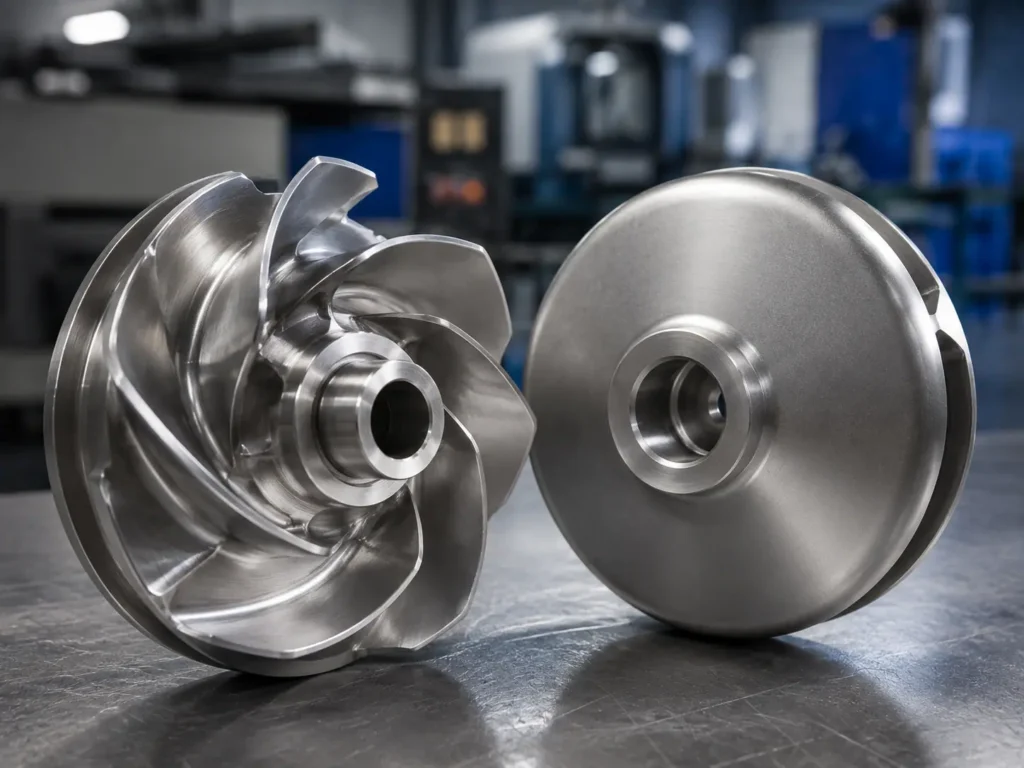
Pump impeller cavitation happens when vapor bubbles form in a low-pressure area of the pump and then collapse against the impeller surface. The damage can look like pitting, rough erosion, vane edge loss, vibration, noise, and reduced pump performance. For industrial buyers, the important point is simple: replacing the impeller without checking the cause can repeat the same failure.
Short answer: pump impeller cavitation is usually linked to suction condition, operating point, liquid temperature, vapor pressure, flow restriction, or an impeller that no longer matches the real duty condition. Material choice can improve service life, but it does not fix the hydraulic cause by itself.
Matson manufactures custom pump impellers from drawings, samples, and project specifications. If a failed impeller shows cavitation damage, send photos, dimensions, material grade, liquid condition, pump speed, and the failed part history before asking a pump impeller manufacturer to quote the next batch.
What Cavitation Does to a Pump Impeller
Cavitation is not normal wear. Normal abrasive wear often looks more directional and is tied to solids, sand, slurry, or particles. Cavitation damage often looks like small pits, torn metal, rough patches, and sponge-like erosion in high-stress flow areas.
On a pump impeller, cavitation often appears near the vane inlet, suction side, eye area, or other low-pressure zones. The exact location depends on the impeller geometry and pump condition.
The common symptoms are:
- Pitting or honeycomb-like erosion on vane surfaces
- Rough, torn, or uneven metal near the impeller eye
- Increased vibration
- Crack risk in severe cases
- Lower flow or head
- Noisy operation, often described as gravel-like sound
- Repeated failure after replacing the same impeller design
If a buyer only sends a photo and says “the impeller is damaged,” the diagnosis is still incomplete. Cavitation, corrosion, abrasion, poor balance, wrong clearance, and material mismatch can overlap.
Main Causes of Pump Impeller Cavitation
Most cavitation problems start before the impeller. The impeller shows the damage, but the suction condition or operating point often creates it.
| Cause | What happens | What buyers should check |
|---|---|---|
| Insufficient NPSH available | The liquid pressure drops too low near the impeller eye, so vapor bubbles form. | Suction head, pipe layout, liquid temperature, vapor pressure, inlet losses. |
| Restricted suction line | The pump cannot receive enough liquid smoothly. | Blocked strainer, undersized pipe, partially closed valve, long suction line. |
| Pump running away from best efficiency point | Internal recirculation and unstable flow increase local pressure drops. | Actual flow, system curve, valve position, pump duty change. |
| Liquid temperature too high | Higher temperature raises vapor pressure and makes vapor bubbles easier to form. | Operating temperature, process changes, cooling condition. |
| Wrong or worn impeller geometry | Clearance, vane shape, or diameter no longer matches the pump condition. | Drawing, worn sample, OD, bore, hub height, vane profile, casing fit. |
| Air or gas entering suction | Unstable suction flow can look like cavitation and accelerate damage. | Leaks, seals, vortexing tank outlet, liquid level, inlet turbulence. |
This is why a cavitation article should not stop at “choose a harder material.” Hard material can survive longer in some services, but it does not remove a suction restriction or wrong operating point.
Cavitation Damage vs Abrasion vs Corrosion
Buyers often mix these three problems together because all of them can make an impeller look worn.
Cavitation damage usually has a pitted, rough, torn-metal look. Abrasion often follows the flow path and is common in sand, slurry, sludge, and mining service. Corrosion can show discoloration, attack around edges, or uneven material loss tied to chemical exposure.
In wastewater, chemical, and slurry applications, more than one problem can happen at the same time. A wastewater pump can suffer from solids wear and cavitation. A chemical pump can suffer from corrosion and cavitation. A mining slurry pump can suffer from heavy abrasion and vibration-related damage.
For damage review, ask three questions first:
- Is the lost metal caused by vapor bubble collapse, particles, chemistry, or impact?
- Is the damage local near the impeller eye or spread across the whole flow surface?
- Did the failure happen suddenly after a duty change, or slowly over normal service?
When the answer is unclear, do not copy the failed part blindly. Treat it as a manufacturing review plus operating-condition review.
Why Impeller Type Matters
Cavitation risk and visible damage can change with impeller structure. A closed impeller, open impeller, semi-open impeller, vortex impeller, or slurry pump impeller does not fail in exactly the same way.
A closed pump impeller has tighter flow passages and clearance sensitivity. If the pump runs outside the intended condition, damage near the eye or vane inlet can become serious. Open and semi-open impellers may be easier to inspect, but they still suffer from poor suction condition, unstable flow, and erosion.
For a deeper comparison of geometry, see the article on open vs closed pump impeller selection.
If the buyer does not know the original design intent, the safest route is to compare the drawing, casing condition, pump duty, and failed sample. Photos alone are not enough.
Material Choice Helps, But It Is Not the Whole Fix
Material matters. It can improve resistance to corrosion, abrasion, and surface damage. But material is not a cure for every cavitation problem.
Stainless steel, duplex stainless, bronze, high-chrome white iron, and hard alloy materials each have their place. The right choice depends on liquid chemistry, solids, temperature, speed, and service life target.
If the failed impeller shows cavitation plus corrosion, the material discussion becomes important. If the failed impeller shows cavitation plus abrasive slurry wear, hardness and section thickness may matter. If the failed impeller failed mainly because the pump was starved at suction, the better material may only delay the next failure.
For material review, link the failure pattern back to pump impeller material selection, not just the old material label.
Manufacturing Considerations for a Replacement Impeller
When a cavitation-damaged impeller is replaced, the manufacturing question is not only “Can you make the same part?”
Sometimes the answer is yes: the pump condition was corrected, and the buyer needs the same drawing manufactured again. Sometimes the answer is no: the old sample is too worn, the original dimensions are missing, or the material was not suitable for the real liquid.
Matson’s manufacturing review usually needs:
- 2D drawing or 3D file if available
- Failed impeller photos from multiple angles
- Physical sample if no drawing exists
- OD, bore, hub height, keyway, mounting face, and vane dimensions
- Current material grade
- Pump speed and balancing requirement
- Liquid, temperature, solids, corrosion condition, and service history
- Expected quantity and future batch plan
If the sample is badly damaged, copying it directly can reproduce the wrong geometry. A worn vane edge or damaged eye area may no longer show the original profile. That is where drawing confirmation, dimensional inspection, and process review matter.
For casting, machining, surface treatment, inspection, and dynamic balancing, see Matson’s impeller manufacturing capability page.
When to Reorder, When to Review
Reordering the same impeller makes sense when the pump has a known service life, the failure pattern is expected, and the operating condition has not changed.
Review the impeller before reordering when:
- Cavitation damage appears much earlier than expected
- The same part fails repeatedly
- The pump duty has changed
- The liquid temperature or chemistry changed
- The impeller sample is heavily worn
- Vibration or noise increased before failure
- The buyer cannot confirm original material or dimensions
This is where failure traffic should become a serious RFQ conversation. A buyer who searches for pump impeller cavitation often has a real problem, not just a textbook question.
Practical RFQ Notes
For a faster quote, do not only send “we need one impeller.” Send the failure context.
A useful RFQ for cavitation-related damage should include the drawing, material grade, quantity, pump speed, application, liquid condition, and photos of the damaged areas. If the impeller is from wastewater, chemical, marine, mining, or other severe service, include solids, corrosion, and temperature information.
Matson manufactures custom pump impellers from drawings and samples for industrial pump OEMs, distributors, and equipment builders. If your existing impeller has cavitation damage, send the project details through the contact page so the part can be reviewed for material, casting, machining, inspection, and balancing requirements.
Common Questions We Actually Get
What causes pump impeller cavitation?
Pump impeller cavitation is commonly caused by insufficient suction pressure, restricted suction lines, high liquid temperature, wrong operating point, air entry, or an impeller that no longer matches the real duty condition.
What does cavitation damage look like on an impeller?
Cavitation damage often looks like pitting, rough torn metal, honeycomb-like erosion, or surface loss near the impeller eye and vane inlet. It can also appear with vibration, noise, and reduced pump performance.
Can a better material stop pump impeller cavitation?
A better material can improve service life, especially when corrosion or abrasion is also present. It cannot fix suction restriction, wrong operating point, poor pipe layout, or excessive liquid temperature by itself.
Should I copy a cavitation-damaged impeller sample?
Only with caution. A damaged sample may not show the original vane profile, clearance, or wall thickness. Send photos, measurements, material information, and any drawing or pump data before copying it.
Can Matson manufacture a replacement impeller after cavitation failure?
Yes. Matson can manufacture custom pump impellers from drawings, 3D files, physical samples, or detailed dimensions. For cavitation-related failure, include the damaged part history and operating condition so the quote is not based on shape alone.
Send Us Your Drawing
Need a replacement or improved manufacturing review for a cavitation-damaged pump impeller? Send Matson your drawing, failed sample photos, material grade, pump speed, liquid condition, quantity, and balancing requirement. We can review the part from a manufacturing and RFQ perspective before quoting the next impeller.