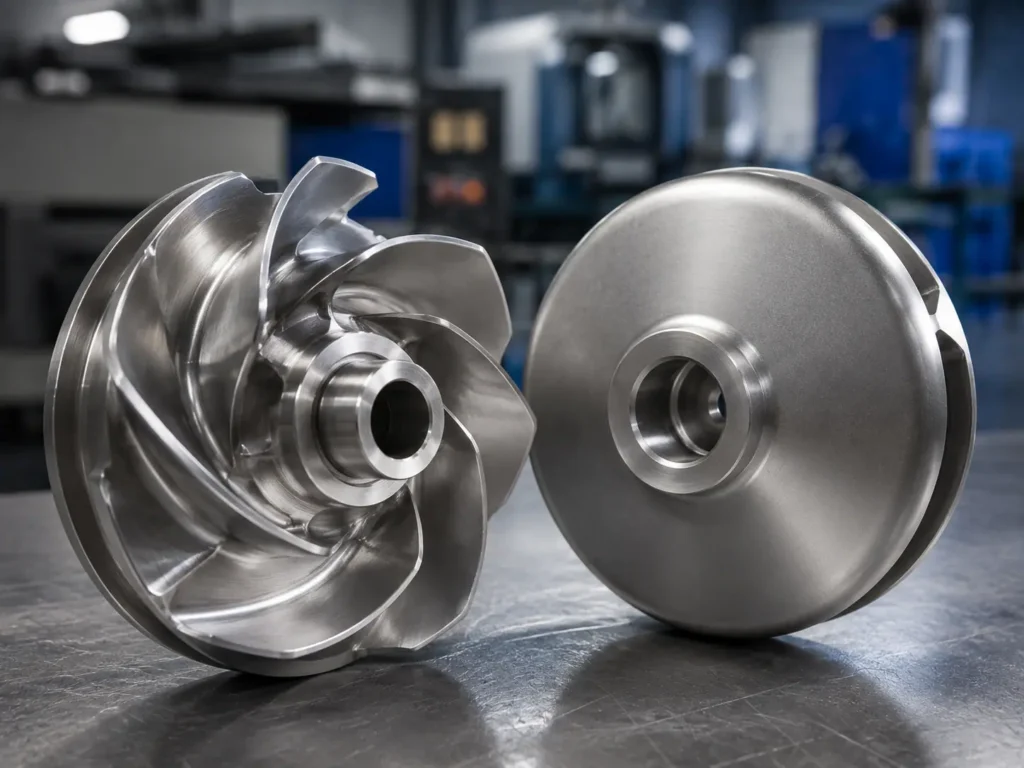
Pump impeller balancing matters because an unbalanced impeller can create vibration, bearing load, seal problems, noise, and early pump failure. For custom pump impeller manufacturing, balancing is not a decorative final step. It is part of making the impeller usable in the real pump.
Short answer: pump impeller balancing should be reviewed when the impeller has meaningful speed, diameter, weight, tight clearance, demanding documentation, or a history of vibration. The exact balancing requirement should come from the drawing, pump speed, buyer specification, and application condition.
Matson manufactures custom pump impellers from drawings, samples, and project specifications. For cast and CNC machined impellers, balancing should be discussed early with the impeller manufacturing route, not only after the part is already finished.
Why Balancing Matters
A pump impeller rotates inside a casing. If the mass is not distributed evenly around the axis, the rotating part creates centrifugal force. At low speed, the problem may be small. At higher speed or larger diameter, the same small imbalance can become a serious vibration problem.
Vibration is not just uncomfortable noise. It can affect bearings, seals, shaft life, clearances, and pump efficiency. In some cases, buyers blame the material or casting quality when the real issue is balance, bore fit, damaged geometry, or poor installation.
For custom pump impellers, the balancing question is practical:
- How fast does the pump run?
- How large and heavy is the impeller?
- Is the impeller closed, open, semi-open, vortex, mixed-flow, or slurry type?
- Does the drawing specify a balance grade or test requirement?
- Does the buyer need a balancing report?
- Is the impeller copied from a worn sample?
Without these details, “balance it” is too vague for production.
Static Balancing vs Dynamic Balancing
Buyers often use the word balancing as if it means one thing. In manufacturing, the requirement has to be clearer.
| Balancing type | What it checks | Typical relevance | What to confirm |
|---|---|---|---|
| Static balancing | Heavy spot in one plane when the part is supported or rotated slowly. | Simple, lower-speed, or less demanding rotating parts. | Whether static balance is enough for the pump speed and buyer requirement. |
| Dynamic balancing | Unbalance during rotation, often considering more than one plane. | Higher-speed, larger, heavier, or more demanding pump impellers. | Speed, acceptable residual unbalance, report format, and drawing requirement. |
| Buyer-specified balancing grade | A defined acceptance level from drawing or project specification. | OEM, industrial pump, and documented batch production. | Exact grade, test speed, correction method, and documentation required. |
For many industrial pump projects, dynamic balancing is the safer conversation. But that does not mean every small impeller needs the same level of balancing. The correct requirement depends on the pump and the drawing.
When a Pump Impeller Needs Balancing Review
Not every RFQ needs a long balancing discussion. But some projects should never skip it.
Balancing review is important when:
- The pump runs at higher speed
- The impeller has a large diameter or heavy mass
- The part has asymmetric geometry or complex vanes
- The buyer reports vibration, noise, bearing wear, or seal failure
- The impeller is cast and then machined
- The bore, hub, keyway, or mounting face is critical
- The impeller is copied from a worn or damaged sample
- The buyer requires a balancing report
If a pump previously had vibration problems, do not only ask for the same impeller again. Check the bore, hub height, mounting face, shaft fit, vane damage, material loss, and whether the old sample is still close to original geometry.
Balancing is also related to failure diagnosis. A damaged impeller from cavitation, corrosion, or abrasion can become unbalanced as material is lost. For failure-related review, see the article on pump impeller cavitation and damage review.
How Manufacturing Affects Balance
Pump impeller balancing is connected to the full manufacturing route.
Casting creates the basic shape. CNC machining controls the bore, hub, mounting face, and key interfaces. Surface treatment changes the finished surface. If the impeller has thick sections, uneven vane geometry, or machining allowance left in the wrong place, balance can be affected.
This is why a balancing requirement should be known before production. If the drawing requires a certain balance level, the factory should plan casting allowance, machining sequence, and correction method around that requirement.
For a custom pump impeller, the most useful RFQ includes the drawing and the balancing requirement together. Sending only a photo and asking for “same as sample” leaves too many assumptions.
What a Balancing Report Can Include
Some buyers only need the impeller manufactured to drawing. Others need documentation for internal quality control or OEM production records.
A balancing report may include:
- Part name or drawing number
- Material or batch reference
- Test method or machine reference
- Rotating speed or test condition, when specified
- Initial unbalance and corrected result, when recorded
- Balance grade or acceptance requirement, when supplied by the buyer
- Operator/date or inspection record
Matson can discuss inspection and balancing documentation when requested. The exact report content should be confirmed before production because different buyers and pump builders ask for different formats.
Common Causes of Balance Problems
Balance problems do not always come from poor manufacturing. They can also come from wrong input data or damaged samples.
Common causes include:
- Worn sample used as the production reference
- Bore size or hub height copied incorrectly
- Keyway, mounting face, or shaft fit not confirmed
- Uneven casting thickness
- Vane damage before balancing
- Material loss from corrosion, abrasion, or cavitation
- Repair welding or grinding without rebalancing
- Missing balancing requirement in the RFQ
This is why the drawing matters. If no drawing exists, the sample should be measured carefully. A worn sample may hide the original vane profile or wall thickness.
Balancing and Impeller Type
Different pump impeller types create different balancing considerations.
A closed impeller may have internal passages and shrouds that make damage harder to see. An open impeller is easier to inspect, but exposed vanes can still create imbalance if worn or machined unevenly. A slurry pump impeller may face heavy material loss in abrasive service. A vortex or wastewater impeller may handle solids, but that does not remove the need to check vibration risk.
The question is not “which impeller type always needs balancing.” The better question is “what does the drawing, speed, diameter, and application require?”
What to Send for a Balancing RFQ
For a clean quote, send:
- 2D drawing or 3D file
- Physical sample or sample photos if no drawing exists
- Pump speed or operating RPM
- Outside diameter, bore size, hub height, and key mounting dimensions
- Material grade
- Impeller type and application
- Quantity and batch schedule
- Required balance grade or buyer specification, if any
- Whether a balancing report is required
- Photos of vibration-related damage, if this is a replacement project
If the balancing standard is not known, say that clearly. The manufacturer can still review the part, but the final requirement should be confirmed by the pump builder, drawing, or buyer specification.
Manufacturing Review Before Production
A balancing discussion is most useful before the order is finalized.
If the buyer needs dynamic balancing, inspection reports, material certificates, or dimensional records, those requirements should be included in the RFQ. Adding them after production can create delay, rework, or unclear responsibility.
For custom pump impeller projects outside standard product lines, Matson can also review the part as a custom industrial impeller project when the geometry, application, or sample condition does not fit a normal pump category.
Common Questions We Actually Get
What is pump impeller balancing?
Pump impeller balancing is the process of checking and correcting uneven mass distribution so the rotating impeller runs with lower vibration risk in the pump.
Does every pump impeller need dynamic balancing?
No. Dynamic balancing depends on pump speed, diameter, mass, geometry, application, and buyer specification. Higher-speed or larger industrial impellers usually need more careful review.
What causes a pump impeller to become unbalanced?
Common causes include uneven casting or machining, wrong bore or mounting dimensions, worn samples, material loss from cavitation or abrasion, repair work, and missing balancing requirements in the RFQ.
Should balancing be done before or after machining?
Final balancing is usually tied to the finished condition of the impeller. Casting, machining, keyway, bore, hub, and surface condition should be considered before the final balancing step.
Can Matson provide balancing data for custom impellers?
Matson can discuss dynamic balancing and related documentation when requested. The buyer should confirm the required balance grade, report format, speed, and acceptance requirement before production.
Send Us Your Drawing
Need dynamic balancing or inspection support for a custom pump impeller project? Send Matson your drawing, material grade, pump speed, balance requirement, quantity, and application details through the contact page. We can review the manufacturing route, machining points, inspection needs, and balancing documentation before quoting.