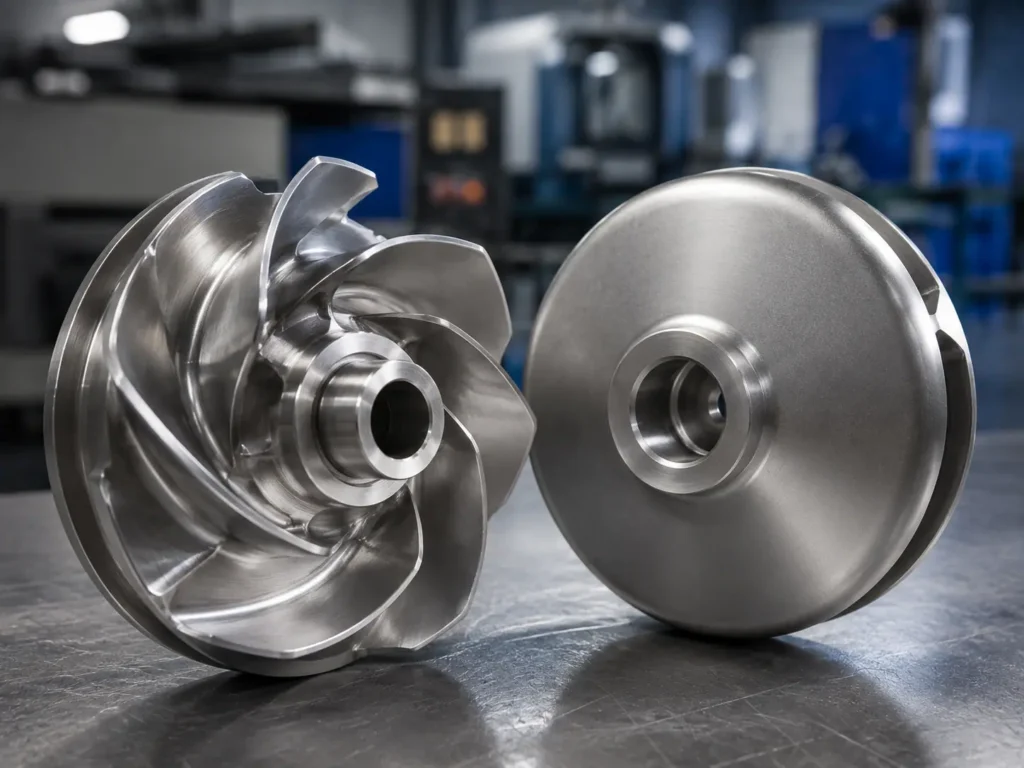
Pump casing material is commonly selected from cast iron, ductile iron, carbon steel, stainless steel, duplex stainless steel, bronze, or other approved alloys according to pressure, liquid chemistry, temperature, corrosion, abrasion, cost, and pump standards. The impeller does not always use the same material as the casing, but the two materials must be reviewed as a working pair.
For a custom impeller RFQ, buyers should provide the casing material, impeller material, shaft and wear-ring materials, liquid composition, temperature, solids, corrosion history, operating speed, and required material certificates. A stronger or more corrosion-resistant impeller material is not automatically a safe upgrade if galvanic interaction, clearance, mass, casting route, or mating-part wear has not been checked.
Matson manufactures custom industrial impellers from drawings, 3D files, samples, and specifications. This article uses pump casing material as context for impeller material and manufacturing review; it does not position Matson as a pump-casing supplier.
[Image placeholder: Add a real material-review image showing a pump impeller beside a casing section, with cast iron, stainless steel, bronze, wear-ring surfaces, material certificates, and corrosion or abrasion areas identified. Alt text: “Pump casing material and impeller material compatibility review”]
Common Pump Casing Materials
Material names in a sales description are not enough for production. “Cast iron,” “stainless steel,” and “bronze” each cover multiple grades with different chemistry, strength, corrosion behavior, castability, machinability, and documentation.
| Pump casing material | Typical review context | Impeller compatibility question |
|---|---|---|
| Gray cast iron | General industrial water and other services where the approved specification permits it. | Will the impeller, wear rings, shaft, and liquid create corrosion or wear concerns against the iron casing? |
| Ductile iron | Applications needing different mechanical properties from gray iron under the pump design. | Are coating, corrosion allowance, mating rings, and approved impeller material defined? |
| Carbon steel | Selected process, pressure, temperature, or fabricated/cast casing duties. | Does the impeller material create galvanic, corrosion, or differential-wear risk? |
| Austenitic stainless steel | Corrosive, clean, chemical, water, or hygienic-related services when the grade is suitable. | Which exact grade, chloride level, temperature, surface condition, and passivation requirements apply? |
| Duplex stainless steel | Selected chloride, seawater, chemical, or higher-strength duties under an approved specification. | Are grade, heat treatment, phase balance, welding, casting, machining, and certificate requirements controlled? |
| Bronze or copper alloy | Selected water, marine, seawater, or corrosion-related services. | Which bronze grade is approved, and how does it interact with shaft, rings, casing, and water chemistry? |
This table is not a universal selection chart. Final material approval belongs to the pump OEM, process engineer, or equipment owner.
Should the Casing and Impeller Use the Same Material?
Sometimes they do. Sometimes they should not. The correct pairing depends on the pump design and service.
Using the same nominal alloy can simplify corrosion compatibility and documentation, but different component functions may justify different materials. The casing handles pressure and contains the flow passage. The impeller rotates, sees centrifugal stress, transfers torque through the hub, and may experience different velocity, cavitation, erosion, and balance demands.
A material pairing review should cover:
- Liquid chemistry, pH, chlorides, oxidizing or reducing conditions
- Temperature and concentration
- Solids size, hardness, shape, and loading
- Flow velocity and local erosion areas
- Start-stop duty and operating speed
- Casing, impeller, shaft, sleeve, fastener, and wear-ring materials
- Coatings, linings, passivation, and surface treatment
- Electrical continuity and galvanic exposure
- Required life, inspection interval, and failure history
- Applicable buyer, OEM, or industry specification
The pump impeller material selection guide provides the broader comparison of stainless steel, duplex, bronze, carbon steel, and wear-resistant choices.
Galvanic Compatibility Needs the Actual Environment
When dissimilar metals are electrically connected in a conductive liquid, galvanic corrosion can accelerate attack on the less noble material. The risk is influenced by the material pair, electrolyte, area ratio, temperature, oxygen, deposits, coatings, and electrical connection.
Do not decide from a simplified galvanic-series chart alone. A small active metal area connected to a large more noble area can behave differently from the reverse arrangement. Coatings can also change the effective exposed area, especially after local damage.
For an impeller replacement, identify:
- Existing casing and impeller grades
- Shaft, sleeve, keys, nuts, rings, and fasteners
- Whether components are electrically connected
- Liquid conductivity, salinity, chloride, and temperature
- Existing corrosion location and pattern
- Coating condition and holiday damage
- Cathodic protection or other system controls
Changing only the impeller to stainless steel or bronze may shift corrosion to the casing, wear ring, shaft, or fastener. The equipment owner should approve the complete material combination.
Corrosion and Abrasion Can Point in Different Directions
A material that performs well in clean corrosive liquid may not be the best choice for abrasive slurry. A hard wear-resistant alloy may have limitations in a specific chemical environment. Coatings may improve selected surfaces but introduce thickness, adhesion, repair, balance, or clearance concerns.
| Observed condition | Possible material or system issue | RFQ evidence to send |
|---|---|---|
| Uniform wall or vane loss | General corrosion, erosion, or combined attack. | Liquid chemistry, temperature, material certificates, operating time, and thickness measurements. |
| Directional vane or casing wear | Abrasive solids, local velocity, recirculation, or off-design operation. | Solids data, duty point, photos, wear map, casing and impeller geometry. |
| Deep local pits | Pitting, deposits, chlorides, cavitation-like damage, or local coating failure. | Close-up photos, location, chemistry, cleaning history, and surface condition. |
| Attack near dissimilar-metal joints | Possible galvanic interaction or crevice condition. | Complete material list, area relationship, electrical contact, and liquid conductivity. |
| Rubbing and polished rings | Clearance, shaft movement, runout, thermal growth, or assembly problem rather than material alone. | Mating dimensions, clearance, shaft and bearing condition, runout, and operating history. |
Material substitution should not be used to hide a hydraulic, mechanical, or clearance problem.
Wear Rings May Need Their Own Material Pairing
The casing and impeller can each carry a replaceable wear ring, or the design may use one ring against a machined mating surface. Ring materials affect galling, corrosion, abrasion, machinability, thermal behavior, and service wear.
Buyers should specify:
- Casing ring material
- Impeller ring material
- Casing and impeller base materials
- Finished diameters and required assembled clearance
- Press fit, shrink fit, threaded, pinned, welded, or other retention method
- Hardness or differential-hardness requirement when approved
- Surface finish, roundness, runout, and inspection
- Whether rings are supplied fitted or separately
Do not copy a ring material from another pump solely because its diameter is similar. The wear ring in centrifugal pump article explains ring location, clearance, material, and machining checks.
Stainless Steel Requires an Exact Grade
“Stainless steel casing” and “stainless impeller” are incomplete descriptions. Austenitic, duplex, precipitation-hardening, and other stainless families behave differently. Even within one family, grade and heat treatment matter.
For casting or machining, send the exact material designation and the governing standard or buyer specification. State whether the project requires:
- Material certificate and heat traceability
- Chemical composition or mechanical-property records
- Positive material identification
- Solution treatment or other heat-treatment evidence
- Ferrite or phase-balance review where applicable
- Passivation, pickling, electropolishing, or other surface treatment
- Corrosion testing or additional inspection
Matson should not claim equivalence between grades without written buyer approval.
Bronze Is a Family, Not One Pump Material
Bronze pump components may use different copper alloys selected for water, marine, seawater, corrosion, casting, mechanical, or regulatory requirements. Tin bronze, aluminum bronze, nickel-aluminum bronze, and other copper alloys should not be treated as interchangeable.
For a bronze impeller used with a bronze, cast-iron, steel, or stainless casing, review the water chemistry, galvanic pairing, shaft and fastener materials, erosion, dezincification or selective-corrosion concerns, casting route, machining, and material standard.
Matson’s bronze pump impeller guide covers grade confirmation, marine and water context, casting, machining, sample risk, and RFQ data.
Coatings Change Dimensions and Maintenance
Casing linings and coatings can protect the base material, improve selected wear surfaces, or restore dimensions under an approved repair system. Impellers may also receive coatings for selected corrosion or abrasion duties.
The RFQ should state:
- Coating or lining material and approved supplier/system
- Surface preparation
- Finished thickness and tolerance
- Masked areas and uncoated fits
- Cure requirements
- Holiday, adhesion, thickness, or visual inspection
- Repair procedure
- Whether dimensions are before or after coating
- Whether the impeller is balanced before or after final coating
A thick coating near wear-ring, casing, vane-tip, or inlet areas can change clearance. Uneven coating on a rotating impeller can also affect balance.
A Failed Sample Needs a Material Investigation
When a used impeller is the manufacturing reference, photograph the damage before cleaning or repair. Record where material has been lost and whether the casing shows the same pattern.
Useful evidence includes:
- Original and proposed material grades
- Material certificates or PMI results
- Liquid composition, concentration, and temperature
- Solids and particle information
- Service time and operating condition
- Cavitation, vibration, or off-design history
- Casing, ring, shaft, and fastener condition
- Coating or previous repair history
- Close-up and overall damage photos
A scan can reproduce the worn shape accurately. It cannot identify the original dimension or correct material without additional evidence.
What Buyers Should Send for Quotation
For a material-compatible custom impeller RFQ, provide:
- Controlled impeller drawing and 3D model
- Exact casing, impeller, wear-ring, shaft, sleeve, and fastener materials
- Governing material standards and permitted equivalents
- Liquid chemistry, concentration, temperature, and solids
- Corrosion, erosion, cavitation, rubbing, and failure history
- Coating, passivation, heat treatment, and surface requirements
- Critical dimensions, clearances, bore, hub, and wear-ring interfaces
- Operating speed and dynamic-balancing requirement
- Material certificates, PMI, inspection, and traceability requirements
- Quantity, first article, repeat-order plan, marking, and packing
Matson’s impeller manufacturing capabilities include casting, CNC machining, surface treatment, dimensional inspection, dynamic balancing, material documents, and export packing for suitable projects.
Common Questions Buyers Ask
What materials are commonly used for pump casings?
Common materials include gray cast iron, ductile iron, carbon steel, stainless steel, duplex stainless steel, bronze, and other approved alloys. Selection depends on the pump design, pressure, liquid, temperature, corrosion, abrasion, and standards.
Should pump casing and impeller materials be the same?
Not always. They should be reviewed as a complete material pair with the shaft, wear rings, fasteners, liquid chemistry, temperature, solids, and galvanic conditions.
Can a stainless steel impeller be installed in a cast-iron casing?
It may be acceptable in a properly engineered application, but it is not an automatic upgrade. Galvanic interaction, exposed-area ratio, liquid conductivity, wear rings, clearances, shaft materials, and corrosion history require review.
Does Matson supply pump casings?
This article does not position Matson as a casing supplier. Matson focuses on custom industrial impellers and uses casing material information to review compatibility, fit, clearance, casting, machining, and documentation.
Can Matson change an impeller material from a sample?
Matson can evaluate a proposed material for manufacturing, but the pump OEM or engineering owner should approve the exact grade and compatibility with the casing, liquid, shaft, rings, operating speed, and service conditions.
Need a custom pump impeller reviewed against an existing casing material and process liquid? Send Matson the drawing, sample photos, complete material list, chemistry, temperature, solids, damage history, clearances, speed, balancing, quantity, and document requirements through the custom pump impeller quote page.