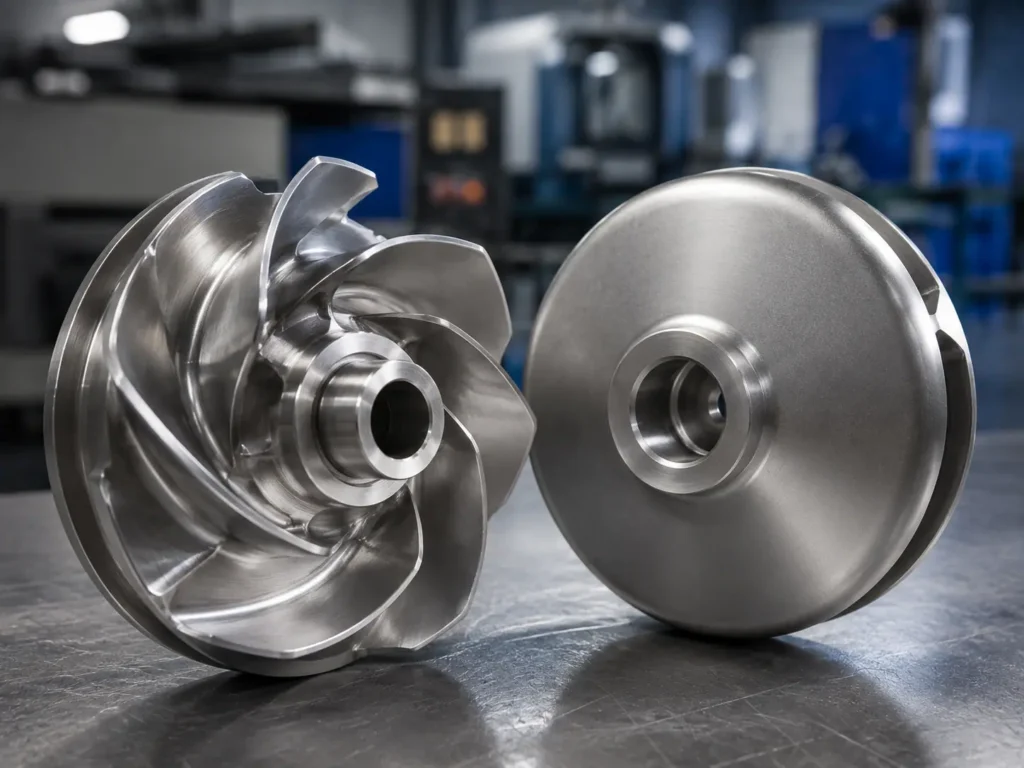
A bronze pump impeller is often considered for marine pumps, seawater pumps, cooling water pumps, and selected industrial water applications because many bronze and copper-alloy materials can offer useful corrosion resistance and good casting behavior. For buyers, the important point is that “bronze” is not one exact material. The alloy grade, seawater exposure, shaft and casing materials, casting standard, machining surfaces, and balancing requirement all need review before manufacturing.
Short answer: bronze can be a practical pump impeller material for marine, seawater, brackish water, cooling water, and some industrial water services, but it is not automatically better than stainless steel, duplex stainless, or other alloys. Buyers should confirm the bronze grade, corrosion condition, galvanic compatibility, pump speed, drawing dimensions, casting route, CNC machining, inspection, and documentation requirements before requesting a custom quote.
Matson manufactures custom pump impellers from drawings, 3D files, samples, and buyer specifications. This article is a material-support guide for bronze impellers; the main product and RFQ path should still point to Matson’s pump impeller manufacturing capability.
Bronze Is a Material Family, Not One Grade
Buyers often say “bronze impeller” when they mean several possible copper-alloy casting grades.
Some projects may use tin bronze, leaded bronze, aluminum bronze, nickel aluminum bronze, or other copper alloys. Each grade has different corrosion behavior, strength, casting characteristics, machinability, and compatibility with the pump shaft and casing.
That is why a useful RFQ should not stop at “make it bronze.” The drawing, old material, specification, water condition, and operating environment should identify the actual bronze grade or at least provide enough context for review.
For marine and seawater pumps, see Matson’s broader marine pump impeller capability page.
Where Bronze Pump Impellers Fit
Use this table as a first material review.
| Application condition | Why bronze may be considered | What buyers should confirm |
|---|---|---|
| Seawater cooling pump | Bronze alloys have a long history in many marine water systems. | Exact bronze grade, shaft material, casing material, chloride exposure, and galvanic risk. |
| Brackish water or coastal industrial water | Copper alloys may provide useful corrosion resistance in selected conditions. | Water chemistry, temperature, flow, fouling, solids, and certificate requirements. |
| Fresh water or cooling circulation | Bronze can be a stable cast-and-machined material option. | Pump speed, fit dimensions, casing material, cost target, and availability of equivalent grades. |
| Industrial wastewater with grit or chemicals | Bronze may or may not be suitable; corrosion and abrasion must be reviewed together. | pH, chloride, abrasive particles, old failure photos, and whether stainless or duplex is better. |
| High-abrasion slurry | Usually needs caution because wear resistance may dominate over corrosion. | Particle hardness, slurry density, wear history, and whether high-chrome or other hard alloys are specified. |
| Unknown sample replacement | A bronze-looking part may not reveal its actual alloy from appearance. | Material test, drawing note, old certificate, color is not enough, and worn dimensions must be checked. |
Marine and Seawater Corrosion Considerations
Bronze pump impellers are common in many marine and water pump discussions because copper alloys can form protective surface films in seawater and have a long service history in marine components. The Copper Development Association notes that copper alloys have been used in marine applications such as pumps, pump shafts, valves, fittings, ship propellers, and heat-exchanger parts.
Still, seawater service is not simple. Chloride, oxygen, temperature, biological fouling, stagnant zones, sand, flow velocity, and mixed-metal assemblies can change corrosion behavior.
Galvanic compatibility is especially important. A bronze impeller installed with a stainless shaft, cast iron casing, bronze casing, or different fasteners may behave differently depending on the electrochemical pairing and protection system. Buyers should tell the manufacturer the shaft material, casing material, and any cathodic protection context if known.
For a narrower seawater material discussion, see seawater pump impeller material selection.
Bronze vs Stainless and Duplex Stainless
Bronze is not automatically better than stainless steel. Stainless steel is not automatically better than bronze. The right answer depends on the liquid and the assembly.
Bronze can be practical in many marine water pump applications, especially when the whole pump assembly is designed around compatible materials. Stainless steel or 316L may fit some clean or moderate corrosion applications, but chloride pitting and crevice corrosion are concerns in seawater. Duplex and super duplex stainless can be reviewed for more severe chloride service, but they bring stricter casting, heat treatment, machining, inspection, and cost questions.
For buyers, the useful comparison is not “bronze vs stainless” in the abstract. It is:
- What liquid is being pumped?
- What alloy grade is specified?
- What are the shaft and casing materials?
- What failure pattern appeared on the old part?
- What certificates and inspection documents are required?
- Can the material be cast and machined to the drawing?
For a broader material framework, see pump impeller material selection.
Casting Standards and Alloy Specifications
If a bronze pump impeller is cast, the buyer should specify the material standard when possible.
ASTM B584 covers copper alloy sand castings for general applications. ASTM B148 covers aluminum-bronze sand castings. These standards can be useful references when the drawing or buyer specification requires a defined copper-alloy casting grade.
The standard alone is not the full production instruction. The RFQ should also confirm chemical composition, mechanical requirements, heat treatment if applicable, pressure or leakage relevance if any, machining surfaces, dimensional tolerance, certificate requirement, and whether a substitute grade is acceptable.
Do not rely on color to identify bronze. A material test or existing certificate is much better than visual judgement.
Manufacturing Review for Bronze Impellers
Bronze pump impellers are often cast and then finish machined. The critical manufacturing questions are practical:
- Can the geometry be cast cleanly?
- Which surfaces need CNC finish machining?
- What machining allowance is required?
- Which dimensions are functional fits?
- Does the part require balancing?
- What inspection documents should be included?
Typical finish-machined areas include the bore, hub height, keyway, mounting face, shaft fit, wear ring, outside diameter, and other casing-related surfaces. If the impeller is copied from a worn sample, the old bore, vane edges, and clearance surfaces may not show the original dimensions.
Matson’s impeller manufacturing capabilities include casting, CNC machining, surface treatment, dimensional inspection, dynamic balancing, and export packing when the project requirements are defined.
Balancing and Inspection
A bronze impeller is still a rotating component. If the pump speed, diameter, mass, or buyer specification requires balancing, the balancing grade should be stated before production.
ISO 21940-11 is commonly referenced for rigid-rotor balancing terminology and grades when a buyer specification requires it. The correct balancing requirement should come from the drawing, pump speed, impeller mass, and project specification.
Inspection can include material certificate, dimensional report, balancing report, hardness or mechanical data when required, and pre-shipment photos. Add these requirements to the RFQ before ordering, not after the casting has been made.
What Buyers Should Send for a Bronze Pump Impeller Quote
Send:
- Approved 2D drawing and 3D file if available
- Physical sample and clear photos if the drawing is incomplete
- Current material grade, old certificate, or material test result
- Required bronze, copper-alloy, ASTM, EN, or project specification
- Pump application: marine, seawater, brackish water, cooling water, wastewater, or industrial water
- Liquid chemistry, chloride, temperature, solids, sand, fouling, and corrosion condition
- Shaft material, casing material, fasteners, and galvanic compatibility concerns
- Outside diameter, bore, hub height, keyway, mounting face, and wear-ring dimensions
- Impeller type, vane count, rotation direction, inlet eye, and outlet width
- Pump speed, balancing requirement, runout requirement, and report requirement
- Photos of pitting, dezincification, corrosion, worn areas, cracks, or repaired surfaces
- Quantity, batch schedule, inspection documents, and packing requirements
If the buyer only says “bronze pump impeller,” the quote will be less reliable. The alloy and service condition decide whether bronze is the right direction.
Common Questions We Actually Get
Is bronze good for pump impellers?
Bronze can be a good material for many water, marine, seawater, and cooling pump impellers, but the exact alloy, liquid condition, shaft material, casing material, and casting requirement must be confirmed.
Is bronze better than stainless steel for seawater pump impellers?
Not always. Bronze is widely used in many seawater pump assemblies, while stainless, duplex, or super duplex may fit other conditions. The better choice depends on corrosion, galvanic compatibility, chloride, temperature, and project specification.
What information should I send for a custom bronze pump impeller quote?
Send the drawing or sample, bronze grade or old certificate, pump application, liquid condition, shaft and casing materials, dimensions, pump speed, quantity, balancing requirement, and inspection documents needed.
Can Matson manufacture bronze pump impellers from samples?
Yes. Matson can review sample-based manufacturing, but worn samples and unknown bronze grades should be checked carefully. Material testing or existing certificates make the quote more reliable.
Which ASTM standards are used for bronze impeller castings?
ASTM B584 may be referenced for copper alloy sand castings for general applications, and ASTM B148 may be referenced for aluminum-bronze sand castings when the project specification calls for them.
Send Us Your Drawing
Need a custom bronze pump impeller manufactured from a drawing or sample? Send Matson the drawing, sample photos, bronze grade or material certificate, pump application, liquid condition, shaft and casing materials, quantity, and balancing requirement through the contact page. We can review material, casting, machining, inspection, and documentation before quoting.
References
- ASTM: ASTM B584, Copper Alloy Sand Castings for General Applications
- ASTM: ASTM B148, Aluminum-Bronze Sand Castings
- Copper Development Association: Nickel aluminum bronze seawater corrosion discussion