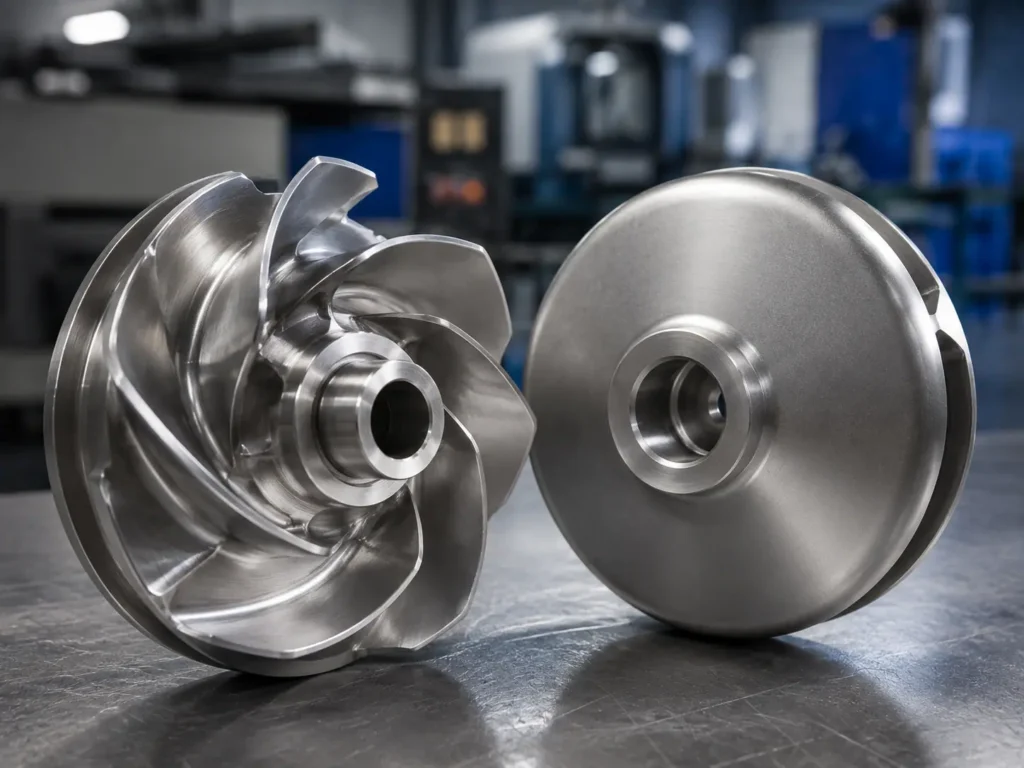
Impeller trimming in centrifugal pumps means reducing the impeller outside diameter to adjust pump performance. It is often discussed when a pump is producing too much head or flow for the system, but for custom impeller manufacturing the important point is narrower: the finished trim diameter must be confirmed before casting, CNC machining, balancing, and inspection.
Short answer: impeller trimming can change flow, head, power demand, efficiency, NPSH margin, vibration, and casing clearance. Matson can manufacture a centrifugal pump impeller to a specified trimmed diameter, but the pump OEM or engineering owner should confirm the hydraulic effect. A trimmed sample should not be copied blindly unless the buyer knows whether the diameter was intentionally modified.
Matson manufactures centrifugal pump impellers from drawings, samples, and project specifications. For an impeller trimming centrifugal pump project, we review the trim diameter as a manufacturing and RFQ detail, together with material, bore fit, wear-ring surfaces, CNC machining, inspection, and balancing.
What Is Impeller Trimming in a Centrifugal Pump?
Impeller trimming is the process of reducing the impeller outside diameter. In a centrifugal pump, the outside diameter is one of the dimensions that strongly affects the pump curve. A smaller finished diameter can reduce head and flow compared with the original full-size impeller.
That does not mean trimming is a casual machining step. Once material is removed from the outer diameter, the impeller geometry, vane outlet, balance condition, casing clearance, and pump performance relationship can change.
For a custom manufacturer, the key question is not “Should this pump be trimmed?” It is “What finished diameter, tolerance, and inspection requirement has the engineering owner approved?”
Why Trim Diameter Matters Before Manufacturing
Buyers often send a used impeller and ask for “same as sample.” That sounds simple until the sample has already been trimmed.
If the old impeller was cut down during previous service, the measured OD may not be the original design diameter. Copying that sample exactly may reproduce a modified pump curve. In some cases that is correct. In other cases it locks in an old field modification that nobody meant to repeat.
| Review point | Why it matters | What buyers should confirm |
|---|---|---|
| Original diameter | The original impeller OD may be different from the worn or trimmed sample. | Original drawing OD, full-size impeller data, or OEM reference if available. |
| Trimmed diameter | The final OD affects pump curve, casing clearance, machining, and balancing. | Approved trim diameter, tolerance, and whether the trim is intentional. |
| Vane outlet condition | Trimming can expose or change vane outlet geometry. | Photos of vane outlet, outlet width, vane edge condition, and finish requirement. |
| Casing relationship | OD and clearance must still match the pump casing and wear surfaces. | Casing drawing, volute relationship, wear-ring dimensions, and critical clearances. |
| Balance condition | Material removal changes mass distribution. | Pump speed, balancing grade, balance report need, and whether trimming happens before final balance. |
| Sample history | A sample may be worn, repaired, trimmed, or modified in the field. | Whether the sample is original, rebuilt, cut down, corroded, or unreliable. |
When the trim diameter is not known, the buyer should treat the sample as evidence, not as the final authority.
Impeller Trimming Is Not Just an OD Change
The outside diameter is easy to measure, so it gets most of the attention. But trimming also touches other manufacturing details.
The vane outlet may need deburring or controlled finishing. The shroud edge may need consistent machining. The balance condition should be checked after material removal. The relationship between the trimmed OD and wear-ring or casing surfaces should remain clear.
If the impeller is cast and then finish machined, the trim diameter should be planned before machining and balancing. Producing a full-size casting and then trimming may be normal in some projects, but it still needs allowance, setup, and inspection control.
For broader machining review, Matson’s CNC machined impeller article explains why OD, bore, hub, mounting face, keyway, and wear-ring surfaces should be treated as functional dimensions.
What About Impeller Diameter Formula or Size Chart?
Searches such as “centrifugal pump impeller diameter formula” or “centrifugal pump impeller size chart” often come from engineers trying to understand the pump curve. The basic affinity-law direction is widely known: changes in impeller diameter can affect flow, head, and power. But that is not enough for production approval.
A simple formula does not see the actual pump casing, suction condition, liquid, NPSH margin, wear ring, vane outlet, solids, corrosion, or vibration history. It also does not tell the manufacturer which surfaces need machining or which balancing grade is required.
For custom manufacturing, use formulas and charts as engineering context. Use the approved drawing, trim diameter, pump specification, or OEM instruction as the production requirement.
Manufacturing Risks After Trimming
Trimming creates a few practical risks that buyers should discuss before placing an order.
| Risk | What can happen | How to reduce it |
|---|---|---|
| Wrong performance assumption | The new impeller may not match the required duty point. | Confirm the pump curve and trim diameter with the pump OEM or engineering owner. |
| Copying a modified sample | A previous field trim may be repeated without knowing why it was done. | Compare sample OD with drawing, nameplate data, or historical pump records. |
| Uncontrolled edge finish | Rough cut edges can affect flow, wear, and balance. | Define machining, deburring, surface finish, and inspection points. |
| Balance shift | Uneven material removal can increase vibration. | Perform final balancing after trimming when the project requires it. |
| Clearance mismatch | Trimmed OD may change casing or wear surface relationship. | Check OD, casing clearance, wear-ring dimensions, and pump assembly data. |
This is why trim diameter belongs in the RFQ, not as a late note after the part is already cast or machined.
Material, Wear and Service Conditions
Trimming can expose new material surfaces at the vane outlet or shroud edge. In clean water service, the main concern may be dimensional control and balance. In slurry, wastewater, chemical, or seawater service, the exposed edge may also face wear or corrosion.
Material selection should therefore be reviewed together with the final diameter and application. Stainless steel, bronze, duplex stainless, carbon steel, alloy steel, and wear-resistant materials do not respond the same way to machining, polishing, corrosion, or abrasive service.
For material decisions, see Matson’s pump impeller material selection guide.
Balancing After Impeller Trimming
If an impeller rotates at meaningful speed, trimming should be discussed with balancing in mind. Material removal at the outside diameter changes the rotating mass distribution, and the effect becomes more important as diameter, speed, and mass increase.
ISO 21940-11 is commonly referenced for rigid-rotor balancing terminology and grades when the buyer specification requires a defined approach. The actual balancing requirement should come from the drawing, pump speed, impeller mass, operating condition, and buyer documentation requirement.
For a deeper buyer-focused explanation, see Matson’s pump impeller balancing article.
What Buyers Should Send for an RFQ
For an impeller trimming centrifugal pump project, send:
- Approved drawing or 3D file showing original OD and final trim diameter
- Physical sample photos if no drawing is available
- Whether the sample was previously trimmed, worn, repaired, or modified
- Finished impeller OD, trim tolerance, vane outlet width, and rotation direction
- Bore, hub height, keyway, mounting face, wear-ring dimensions, and casing clearance
- Material grade, liquid condition, solids, temperature, corrosion, or abrasion risk
- Pump speed, balance grade, balancing report requirement, and inspection points
- Quantity, batch schedule, export packing, and documentation needs
If the only known value is the measured OD of an old sample, say that clearly. A manufacturer can quote the part, but the buyer should confirm whether that OD is the intended trim diameter.
Common Questions We Actually Get
What is impeller trimming in a centrifugal pump?
Impeller trimming means reducing the impeller outside diameter to adjust pump performance. For manufacturing, the finished trim diameter should be clearly specified before machining, balancing, and inspection.
Can Matson decide the correct trim diameter?
Matson can manufacture to a specified trim diameter and review production risks. The pump OEM or engineering owner should confirm the hydraulic performance effect and final trim decision.
Is a centrifugal pump impeller size chart enough for manufacturing?
No. A size chart or formula can be useful context, but manufacturing should follow the approved drawing, pump specification, sample review, or OEM instruction.
Should balancing be done after trimming?
When balancing is required, final balancing should be considered after trimming because material removal changes mass distribution. The requirement depends on pump speed, diameter, mass, and buyer specification.
Can a trimmed sample be copied?
It can be reviewed, but the buyer should confirm whether the sample was intentionally trimmed or simply worn. Copying an unknown modified sample can repeat the wrong pump condition.
Send Us Your Drawing
Need a centrifugal pump impeller manufactured to a specified trim diameter? Send Matson the drawing, sample photos, final OD, material grade, pump speed, balancing requirement, quantity, and inspection needs through the contact page. We can review the casting, CNC machining, trimming, inspection, and balancing route before quoting.