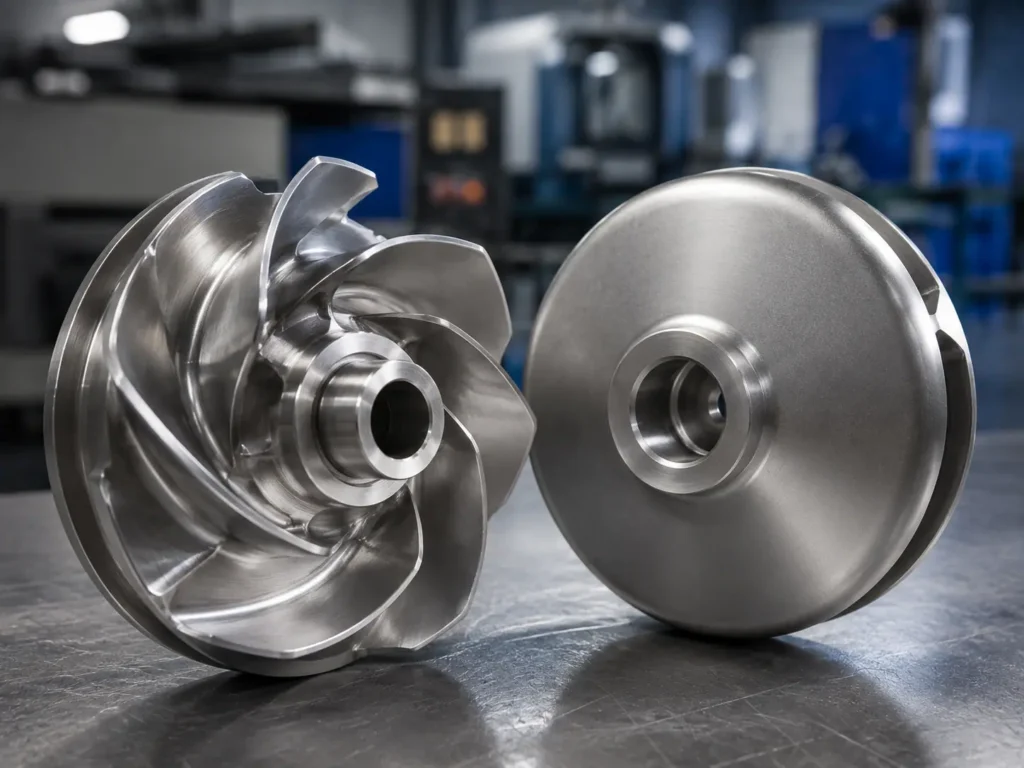
Centrifugal pump impeller rotation direction is the direction the impeller must turn inside the pump casing to move liquid as intended. For custom manufacturing, it is not a small label. If the rotation direction, vane hand, keyway orientation, or casing relationship is misunderstood, the new impeller may fit the shaft but perform poorly, rub, vibrate, or fail to match the pump.
Short answer: before manufacturing a centrifugal pump impeller, buyers should confirm rotation direction from the approved drawing, pump casing, shaft view, inlet eye, vane direction, and motor arrangement. Matson can manufacture to the specified rotation direction, but the pump OEM or engineering owner should confirm the final hydraulic arrangement when the drawing is incomplete.
Matson manufactures centrifugal pump impellers from drawings, samples, and project specifications. For a rotation-direction question, the safest RFQ includes photos from both sides of the sample, the pump casing orientation, and a clear note showing whether the direction is viewed from the motor side, suction side, or impeller front.
Why Rotation Direction Matters
A centrifugal pump impeller is not simply a round rotating part. The vanes are shaped to guide liquid from the inlet eye toward the outer diameter. If the impeller rotates the wrong way, the vane geometry is working against the intended flow path.
The result may be reduced head, low flow, high vibration, noise, heating, rubbing, poor efficiency, or repeated damage. In some cases the pump still moves some liquid, which can hide the mistake during a quick check. That does not mean the impeller is correct.
For manufacturing, the risk is more basic: a factory can machine a bore, keyway, hub, and OD accurately while still producing the wrong-hand impeller if the drawing or sample information is unclear.
Common Rotation-Direction Confusion
Rotation direction can be described from different viewpoints. That is where many RFQ mistakes begin.
| Question | Why it creates confusion | What buyers should confirm |
|---|---|---|
| Viewed from which side? | Clockwise from the motor side can look counterclockwise from the suction side. | State the viewing side clearly: motor side, coupling side, suction side, or impeller front. |
| Is the sample installed or loose? | A loose impeller photo may not show how it sits in the casing. | Send installed photos, casing photos, and mark the side facing the motor. |
| Are vane direction and shaft rotation both known? | Vane hand and motor rotation must match the pump design. | Provide vane direction, motor rotation, and pump assembly information. |
| Is the impeller symmetrical? | Some impellers look similar from both sides but have different inlet or shroud details. | Show front, back, bore, hub, inlet eye, and outlet width. |
| Was the sample modified? | Repair, trimming, or wear can make geometry harder to interpret. | Identify worn areas, repaired surfaces, and any prior modification. |
The practical rule is simple: do not write only “CW” or “CCW” unless the viewing direction is also stated.
Vane Direction, Casing and Pump Assembly
The vane direction should be checked with the pump casing, not from a single photo. The casing volute, suction opening, discharge position, shaft side, and motor direction all help confirm the intended rotation.
If a buyer sends only one front-view image, the manufacturer may see vane curve and general geometry, but not enough assembly context. A side photo may show hub height and bore. A back photo may show balance holes, shroud detail, or mounting features. Casing photos show how the impeller actually sits in the pump.
This is why Matson often asks for more than the outside diameter. The pump impeller design article explains the broader checklist: diameter, vane geometry, clearances, material, casing relationship, and balancing all need review together.
What Can Go Wrong Before Manufacturing
Rotation-direction mistakes usually appear before production, but the cost is paid later.
| Risk | What can happen | How to reduce it |
|---|---|---|
| Wrong-hand impeller | The part may fit the shaft but not match pump flow direction. | Confirm rotation from drawing, casing, motor side, and vane direction. |
| Wrong keyway or hub orientation | The impeller may assemble incorrectly or sit in the wrong axial position. | Define bore, keyway, hub face, sleeve, thread, and retaining details. |
| Misread sample photo | Front/back orientation may be reversed. | Mark photos with “motor side,” “suction side,” and rotation arrow. |
| Hidden wear or repair | Worn vane edges can make the original direction harder to judge. | Send clear photos of both sides and identify damaged areas. |
| Balance or runout issue | Correct rotation does not guarantee stable operation. | Confirm balancing grade, pump speed, runout, and inspection requirement. |
If the rotation direction is unclear, resolve it before quoting. Guessing at this stage is cheaper than remaking a finished impeller.
Rotation Direction and CNC Machining
Rotation direction also affects how the part is interpreted during machining review. A keyway, bore, hub face, retaining thread, balance hole, vane edge, or trimmed OD may have a functional relationship with the pump assembly.
For example, a sample may have a worn bore but a clear vane shape. Another sample may have a useful hub and keyway but damaged vane outlets. The manufacturer needs to know which features are reliable and which features must come from the drawing or casing.
Matson’s CNC machined impeller guide covers bore, hub, keyway, OD, wear-ring, and other functional surfaces after casting. Rotation direction should be included in the same review because it affects how the impeller is understood as an assembled rotating part.
Rotation Direction and Balancing
Balancing does not decide the hydraulic direction, but a finished impeller still needs stable rotation when the project requires it.
If the impeller has large diameter, meaningful speed, heavy mass, asymmetric geometry, or a buyer-specified balance grade, balancing should be discussed before production. The balance requirement should come from the drawing, pump speed, diameter, mass, and project specification.
For more detail, see Matson’s pump impeller balancing article.
How Buyers Should Mark Rotation Direction
For a better RFQ, mark the rotation direction in a way that removes guesswork:
- Add a rotation arrow on the drawing or photo
- State the viewing side: motor side, coupling side, suction side, or impeller front
- Photograph the impeller from front, back, side, bore, and hub
- Photograph the pump casing if available
- Mark inlet eye, outlet width, vane direction, and discharge side if known
- Confirm motor rotation and pump arrangement if the drawing is incomplete
- Identify worn, repaired, trimmed, or unreliable sample areas
If the project is based on a physical sample, do not assume the person measuring the sample knows how it was installed. Mark it before shipping or photographing.
What Buyers Should Send for RFQ
For a centrifugal pump impeller rotation direction review, send:
- Approved 2D drawing and 3D model if available
- Rotation arrow and viewing direction
- Photos from motor side, suction side, front, back, side, bore, and hub
- Pump casing photos or assembly drawing when available
- Bore, hub height, keyway, mounting face, OD, inlet eye, and outlet width
- Wear-ring dimensions, casing clearances, and shaft fit details
- Material grade, fluid condition, solids, temperature, and corrosion or wear risk
- Pump speed, balancing grade, runout requirement, and report requirement
- Quantity, batch schedule, packing, and documentation needs
If there is a conflict between the old sample and the drawing, the buyer should clarify which source controls production.
Common Questions We Actually Get
How do I know centrifugal pump impeller rotation direction?
Check the approved drawing, pump casing, motor direction, vane direction, and viewing side. A clockwise or counterclockwise note is incomplete unless the viewing direction is stated.
Can a centrifugal pump run with the impeller rotating the wrong direction?
It may move some liquid, but performance can be poor and the pump may suffer vibration, noise, heating, low flow, or damage. The pump OEM or engineering owner should confirm the correct rotation.
Is vane direction the same as motor rotation?
They are related but not the same description. Vane hand, motor rotation, casing arrangement, and viewing side must match the pump design.
Can Matson confirm rotation direction from a sample?
Matson can review sample photos and geometry, but the safest confirmation comes from the drawing, pump casing, installation photos, and clear rotation markings.
What should I mark on the drawing?
Mark the rotation arrow, viewing side, motor side, suction side, inlet eye, outlet width, vane direction, bore, keyway, and any critical casing-clearance surfaces.
Send Us Your Drawing
Need a centrifugal pump impeller manufactured from a drawing or sample? Send Matson the drawing, sample photos, rotation arrow, viewing direction, material grade, pump speed, balancing requirement, quantity, and inspection needs through the contact page. We can review the casting, CNC machining, rotation-direction notes, inspection, and balancing route before quoting.