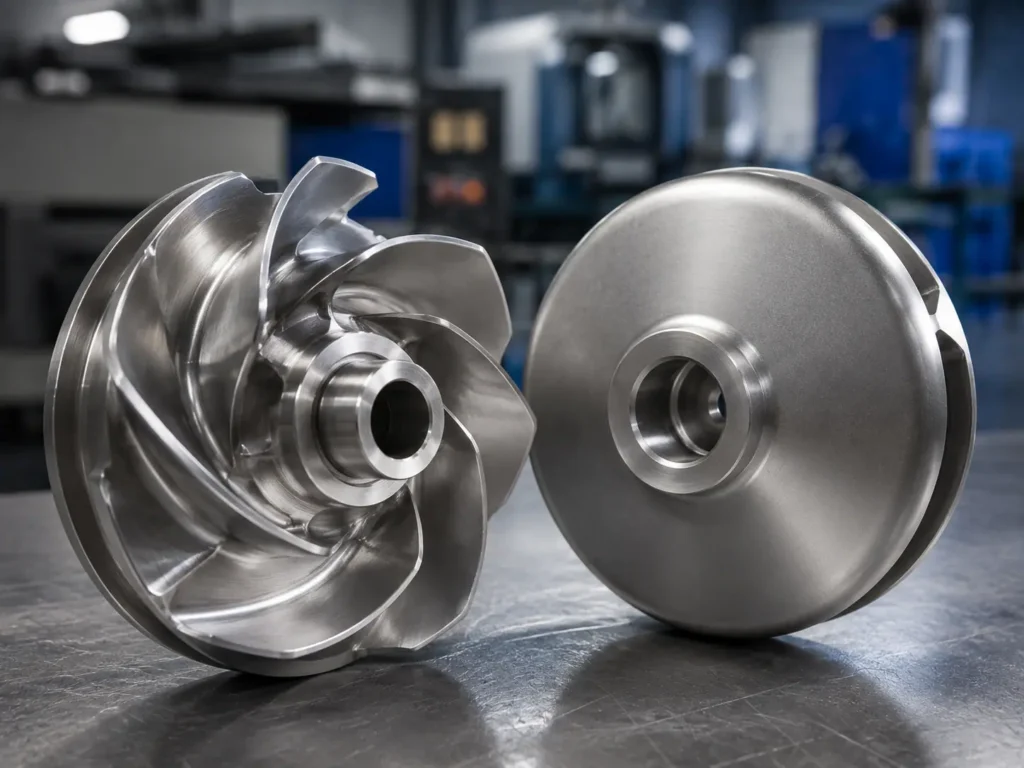
A closed impeller centrifugal pump uses an impeller with vanes enclosed between front and back shrouds. For industrial buyers sourcing a custom impeller, the important manufacturing questions are fit, clearance, casting quality, machining datums, material, and balancing. A closed impeller can suit clean-liquid centrifugal pump service, but even a small error at the bore, hub, wear ring, or casing relationship can create assembly or operating problems.
Short answer: before manufacturing a closed impeller for a centrifugal pump, buyers should confirm the approved drawing, finished outside diameter, bore and shaft fit, hub height, mounting face, keyway, wear-ring dimensions, casing clearances, rotation direction, pump speed, material grade, and balancing requirement. Matson manufactures from drawings, samples, and specifications; final hydraulic selection remains with the pump OEM or engineering owner.
Matson’s custom pump impeller work covers drawing-based and sample-based industrial projects. For this type of RFQ, clear assembly and fit information is more useful than a broad request for a “closed centrifugal impeller.”
This article is deliberately narrower than Matson’s guide to closed impeller pump applications. That guide helps buyers decide where a closed design fits. Here, the focus is manufacturing and RFQ review after a closed centrifugal impeller has already been specified.
Fit Starts at the Shaft Interface
The outside shape gets attention, but many manufacturing problems begin at the center of the impeller.
The bore, shaft fit, keyway, hub height, mounting face, thread, taper, sleeve relationship, and retaining method control how the impeller installs and transmits torque. A correct outside diameter does not help if the bore is wrong or the hub positions the impeller incorrectly inside the casing.
Buyers should identify the functional datum on the drawing. If dimensions are measured from different surfaces without a clear datum, the individual numbers may look acceptable while the assembled position is wrong.
For a sample-based quotation, check whether the bore is worn, repaired, sleeved, corroded, or enlarged. Copying a damaged shaft interface directly can reproduce the failure.
Clearance Review for Closed Centrifugal Impellers
Clearance is not one generic dimension. A closed impeller centrifugal pump may involve several relationships that must match the pump design.
| Fit or clearance item | Why it matters | What buyers should send |
|---|---|---|
| Bore and shaft fit | Controls assembly, concentricity, torque transfer, and runout. | Bore tolerance, shaft size, fit class, keyway or taper details, and inspection method. |
| Hub height and mounting face | Positions the impeller axially inside the casing. | Datum surface, hub height, mounting dimensions, and assembly drawing if available. |
| Wear-ring or seal clearance | Affects leakage, rubbing risk, efficiency, and service wear. | Finished diameters, mating-part dimensions, specified clearance, and worn-part photos. |
| Outside diameter and casing clearance | Wrong OD or trim diameter can affect fit and pump performance. | Finished OD, trim requirement, casing relationship, and whether the sample has worn down. |
| Front and back shroud relationship | Changes axial position, leakage paths, and rubbing risk. | Shroud thickness, back-face dimensions, clearance surfaces, and pump section drawing. |
| Runout and balance | Errors can create vibration, seal load, and bearing problems. | Runout requirement, pump speed, balancing grade, and report requirement. |
The manufacturer should not invent these clearances. They should come from the approved drawing, pump assembly information, OEM specification, or a controlled engineering review.
Why Closed Geometry Changes Manufacturing Review
Closed impellers have vane passages enclosed between two shrouds. The structure can support efficient clean-liquid operation, but it also makes manufacturing and inspection less forgiving.
Internal passages can be harder to inspect, clean, and finish than exposed vanes. Casting cores, wax patterns, feeding, shrinkage control, section thickness, and passage accessibility all need review before production. A defect hidden inside a closed passage is harder to see than damage on an open impeller.
The drawing should clearly define vane count, rotation direction, inlet eye, outlet width, shroud geometry, and any critical internal dimensions. A few external measurements and photographs are rarely enough to reproduce the original hydraulic geometry reliably.
For broader geometry and manufacturing questions, see Matson’s pump impeller design factors article.
Casting and CNC Finish Machining
Many closed centrifugal pump impellers are produced as cast blanks and then finish machined at functional interfaces. The suitable casting route depends on material, size, quantity, section thickness, vane passage complexity, surface requirement, and drawing tolerance.
Investment casting may be reviewed for selected complex or precision geometries. Sand casting may be practical for larger impellers or other suitable designs. Neither route removes the need for machining allowance, dimensional inspection, and a defined datum strategy.
Typical finish-machined areas include:
- Bore and shaft interface
- Hub and mounting face
- Keyway, taper, thread, or retaining features
- Wear-ring and seal surfaces
- Inlet eye or outside diameter when specified
- Clearance and assembly interfaces
The buyer should mark which dimensions are critical and which surfaces may remain as-cast. Treating every surface as equally important makes the quotation vague; failing to identify functional surfaces creates a more serious risk.
Matson’s impeller manufacturing capabilities include casting, CNC machining, surface treatment, dimensional inspection, dynamic balancing, and export packing when project requirements are defined.
Material, Surface and Inspection Requirements
Material should match the approved drawing and operating environment. Stainless steel, duplex stainless, bronze, carbon steel, alloy steel, and other project-specified cast materials each bring different casting, machining, corrosion, and inspection questions.
For chemical or seawater service, buyers may need material certificates, grade verification, passivation, corrosion-related testing, or surface-finish requirements. For general water service, dimensional fit and material confirmation may be the main concerns. Final requirements should be stated in the RFQ rather than assumed after production.
Inspection points should be agreed before the order. These may include bore size, hub height, mounting face, runout, OD, wear-ring dimensions, keyway, material certificate, dimensional report, and balancing data. If an internal passage requires a special inspection method, state that before quoting.
Balancing and Runout
A closed impeller is a rotating component, and uneven casting or machining can affect balance. The required balancing grade should come from the drawing, pump speed, impeller diameter, mass, and project specification.
ISO 21940-11 is commonly referenced for rigid-rotor balancing terminology and grades when the buyer specification calls for it. That does not mean one balancing grade fits every centrifugal pump impeller. The buyer should also specify whether a balance report is required and whether related hardware is included during balancing.
Runout and balance are related but not interchangeable. An impeller can have acceptable mass balance but still have a bore, mounting face, or wear-ring surface that runs incorrectly because of machining or setup error.
For a deeper explanation, see pump impeller balancing.
What Buyers Should Send for a Reliable RFQ
Send the following before requesting a closed impeller centrifugal pump quotation:
- Approved 2D drawing and 3D model if available
- Pump assembly or section drawing showing the casing relationship
- Physical sample and clear photos if drawing data is incomplete
- Finished OD, trim diameter, inlet eye, outlet width, and rotation direction
- Bore, shaft fit, hub height, mounting face, keyway, taper, thread, and retaining details
- Wear-ring dimensions, mating-part dimensions, and specified clearances
- Material grade, material certificate, heat treatment, and surface-finish requirements
- Pump speed, impeller mass, balancing grade, runout requirement, and report requirement
- Critical dimensions, datum surfaces, inspection method, and dimensional-report format
- Quantity, batch schedule, packaging, and export documentation needs
- Worn, repaired, or unreliable areas on any physical sample
If a sample is worn, do not ask the factory to copy every measurement. Mark which dimensions are trustworthy and which must come from the drawing or mating components.
Common Questions We Actually Get
What should buyers confirm before manufacturing a closed impeller centrifugal pump part?
Confirm the drawing, bore and shaft fit, hub height, mounting face, wear-ring dimensions, casing clearances, OD, rotation, material, pump speed, runout, and balancing requirement.
Why is clearance important for a closed centrifugal pump impeller?
Clearance affects fit, leakage, rubbing risk, wear, and pump operation. The correct values should come from the pump drawing, OEM specification, or engineering owner.
Can Matson reproduce a closed centrifugal impeller from a worn sample?
Matson can review sample-based manufacturing, but worn bores, wear rings, shrouds, and outside diameters should not be copied blindly. Drawings and mating-part dimensions make the review safer.
Which surfaces normally need CNC finish machining?
Common finish-machined surfaces include the bore, hub, mounting face, keyway, taper, thread, wear-ring areas, and other critical fit or clearance interfaces defined by the drawing.
Does Matson determine the final hydraulic clearance?
No. Matson can manufacture and inspect to defined requirements, while final hydraulic geometry and clearance selection should remain with the pump OEM or engineering owner.
Send Us Your Drawing
Need a closed centrifugal pump impeller manufactured from a drawing or sample? Send Matson the drawing, assembly details, material grade, critical fits, clearances, pump speed, quantity, and balancing requirement through the contact page. We can review the casting, machining, inspection, and balancing route before quoting.