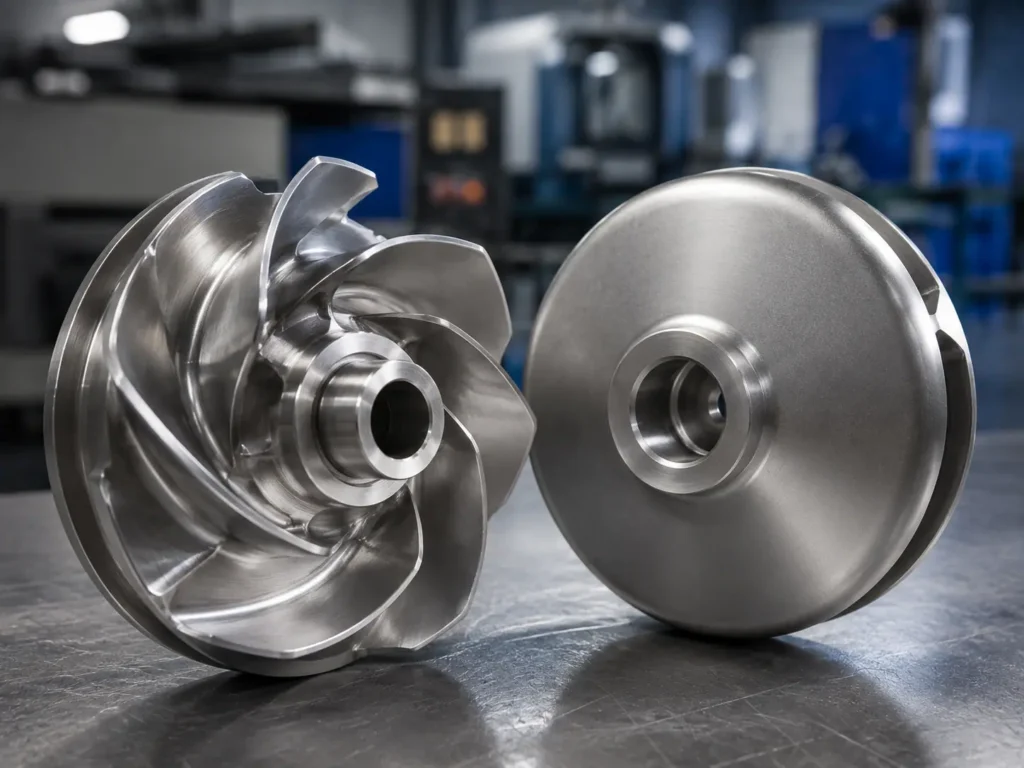
Impeller tip speed in a slurry pump is the linear speed at the outside diameter of the impeller. It is calculated from impeller diameter and rotational speed, but in slurry service the number should not be treated as a simple “higher is better” performance target. Tip speed affects wear, solids impact, vibration risk, material selection, and whether the impeller can be manufactured and balanced reliably.
Short answer: the common impeller tip speed formula is tip speed = pi x impeller diameter x rotational speed. In SI units, use V = pi x D x N / 60, where V is tip speed in m/s, D is impeller outside diameter in meters, and N is speed in rpm. For slurry pumps, buyers should discuss tip speed together with solids, particle size, slurry density, material, impeller geometry, pump speed, casting route, CNC machining, and balancing.
Matson manufactures custom slurry pump impellers from drawings, samples, and specifications. For a slurry pump impeller used in mining, tailings, mineral processing, sludge, or abrasive media, tip speed is useful context for manufacturing review. Final hydraulic selection should remain with the pump OEM or engineering owner.
Impeller Tip Speed Formula
The basic formula is:
V = pi x D x N / 60
Where:
V= impeller tip speed in meters per secondD= impeller outside diameter in metersN= rotational speed in revolutions per minutepi= 3.1416
For inch or foot units, keep the units consistent:
V(ft/min) = pi x D(ft) x N(rpm)V(ft/s) = pi x D(ft) x N(rpm) / 60
Example: if a slurry pump impeller has a finished outside diameter of 0.45 m and runs at 1450 rpm, the approximate tip speed is:
V = 3.1416 x 0.45 x 1450 / 60 = 34.2 m/s
That number is not a manufacturing approval by itself. It is a conversation starter for wear, material, balance, and process route.
Why Tip Speed Matters More in Slurry Pumps
In clean water, tip speed is mostly discussed around pump performance, efficiency, cavitation, and mechanical limits. In slurry service, solids make the question more severe.
Hard particles do not politely follow the drawing. They strike, slide, rebound, and concentrate in wear zones. Higher local velocity can increase abrasive wear, especially where particles hit vane leading edges, shroud surfaces, outlet areas, and clearance surfaces. If corrosion is also present, erosion-corrosion can make wear faster.
The Hydraulic Institute’s ANSI/HI 12.1-12.6 slurry pump standard covers centrifugal slurry pump definition, design, application, installation, operation, maintenance, and testing, and notes that slurry service differs from clear water because solids alter pump performance and wear wet-end parts. That is the right mindset for tip speed: it belongs inside a slurry-specific review, not a clean-water shortcut.
Tip Speed Review Checklist for Buyers
Use this table before asking a manufacturer to quote a slurry pump impeller from a drawing or sample.
| Review item | Why it matters | What buyers should send |
|---|---|---|
| Finished impeller diameter | Tip speed is calculated from the final outside diameter, not a rough estimate. | Drawing OD, measured OD, trim diameter, and whether the sample is worn. |
| Rotational speed | RPM changes tip speed directly and affects balance, stress, and vibration. | Pump speed, motor speed, VFD range, and normal operating condition. |
| Slurry condition | Solids turn velocity into wear and impact risk. | Solids percentage, particle size, particle hardness, slurry density, and settling risk. |
| Material | High tip speed with abrasive solids may need stronger wear review. | Existing material, required grade, high-chrome or alloy requirement, and certificates. |
| Impeller geometry | Vane type, passage width, and shrouds affect where solids contact the part. | Vane count, passage width, inlet eye, outlet width, shroud details, and rotation direction. |
| Manufacturing route | Casting, CNC machining, and balancing must fit the diameter and speed. | Casting route, machining allowance, critical surfaces, balancing grade, and inspection points. |
| Wear history | Existing damage helps identify whether velocity, material, clearance, or operation is the problem. | Photos of worn vanes, cracked areas, pitting, enlarged clearances, and failure interval. |
Tip Speed Is Not the Same as Pump Performance
Buyers sometimes ask for a higher-speed or larger-diameter impeller because they want more flow or head. That should be handled carefully.
Changing diameter or speed changes tip speed, but it also affects pump curve, power, NPSH margin, cavitation risk, shaft load, bearing load, casing clearance, and wear behavior. A manufacturer can review whether a drawing is practical to cast, machine, inspect, and balance. It should not guess the final hydraulic design from a tip speed calculation alone.
ISO 9906:2012 is a useful reference for rotodynamic pump hydraulic performance acceptance tests, but it is mainly for acceptance testing and can be applied to liquids behaving as clean, cold water. Slurry applications need additional slurry-specific engineering review because solids change performance and wear.
For a broader design review, see Matson’s article on slurry pump impeller design.
Material and Wear Considerations
Tip speed is one reason material discussions become serious in mining and abrasive service.
High-chrome white iron, hard alloy materials, duplex stainless, stainless steel, and other materials may be discussed depending on abrasion, impact, corrosion, temperature, and service life target. A material that survives low-speed slurry service may not last the same way at a higher tip speed with hard particles.
ASTM A532 may be referenced when high-chromium abrasion-resistant cast iron grades are specified. That does not mean high-chrome is always right. Impact risk, machining surfaces, section thickness, heat treatment, and the drawing still need review.
For material detail, see slurry pump impeller material.
Manufacturing and Balancing Notes
Tip speed also changes the manufacturing conversation.
A large impeller at moderate rpm can have high tip speed. A smaller impeller at high rpm can also have high tip speed. In both cases, the factory should check the finished diameter, bore, hub, mounting face, keyway, wear ring, machining datum, and balancing requirement.
If the impeller is cast, CNC finish machining is often needed after casting. The bore, hub, mounting face, OD, keyway, and clearance surfaces may need controlled machining and inspection. See CNC machined impeller for a deeper machining review.
Pump impeller balancing should be discussed before production when speed, diameter, or mass makes vibration important. ISO 21940-11 is commonly used as a reference for rigid-rotor balancing terminology and grades when a buyer specification requires it. The actual balancing grade should come from the drawing, pump speed, impeller mass, and project requirement.
What Buyers Should Send for Tip Speed Review
A useful RFQ should include:
- Finished impeller outside diameter
- Pump speed in rpm and VFD range if used
- Pump application: mining, tailings, mineral processing, dredging, sludge, or abrasive media
- Flow, head, duty point, and pump curve if available
- Slurry density, solids concentration, particle size, and particle hardness
- Material grade or previous material
- Vane count, rotation direction, inlet eye, outlet width, and passage details
- Bore, hub height, keyway, mounting face, wear ring, and critical clearances
- Current wear pattern or failure interval
- Casting, CNC machining, balancing, and inspection requirements
- Quantity, batch plan, and export packing requirement
If the buyer only knows diameter and rpm, send those first, but do not treat the tip speed number as enough for production. The slurry condition decides whether that number is acceptable.
Common Questions We Actually Get
What is the impeller tip speed formula for a slurry pump?
The basic formula is V = pi x D x N / 60, where V is tip speed in m/s, D is impeller outside diameter in meters, and N is rotational speed in rpm.
Why does tip speed matter in slurry pumps?
Tip speed matters because abrasive particles, pump speed, impeller diameter, and material all affect wear, impact, vibration, and service life in slurry applications.
Does higher tip speed mean better slurry pump performance?
Not by itself. Higher tip speed may change pump performance, but it can also increase wear, power demand, cavitation risk, vibration, and mechanical load. Pump OEM or engineering review is needed.
What information should I send before manufacturing a slurry pump impeller?
Send the drawing or sample, finished diameter, pump rpm, slurry condition, solids data, material, key dimensions, quantity, balancing requirement, and worn-area photos.
Can Matson calculate slurry pump performance from tip speed?
Matson can use tip speed as manufacturing context, but final pump performance and hydraulic design should be confirmed by the pump OEM or engineering owner.
Send Us Your Drawing
Need a slurry pump impeller manufactured from a drawing or sample? Send Matson the impeller diameter, pump speed, drawing, sample photos, slurry condition, material grade, quantity, and balancing requirement through the contact page. We can review material, casting, CNC machining, inspection, and balancing factors before quoting.