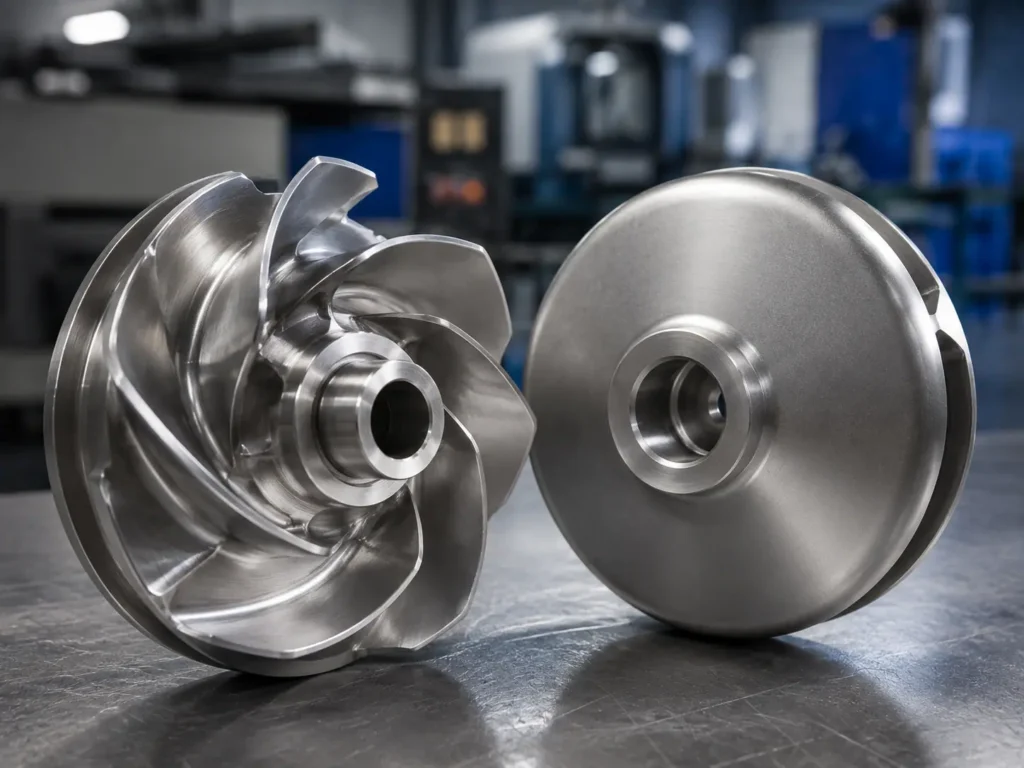
Slurry pump impeller material is chosen for wear, impact, corrosion, pump speed, solids condition, and expected service life. In mining and abrasive service, the wrong material can fail quickly even when the impeller shape looks correct.
Short answer: high-chrome white iron and hard alloy materials are often considered for abrasive slurry pump impellers. Duplex stainless or other corrosion-resistant alloys may be discussed when corrosion is also part of the service. The final choice should be confirmed against slurry concentration, particle size, hardness, impact condition, liquid chemistry, drawing, and manufacturing route.
Matson manufactures custom pump impellers from drawings, samples, and project specifications. For a slurry pump impeller used in mining, tailings, sludge, or abrasive media, material selection should be reviewed before quoting the next batch.
Why Slurry Pump Material Is Different
Slurry is not clean water with a few particles. In mining and tailings service, the liquid can carry hard solids, sand, mineral particles, sludge, and corrosive chemistry. The impeller does not only push liquid; it is attacked by moving abrasive media.
That changes the material discussion.
A stainless steel pump impeller that performs well in clean water may wear too quickly in mineral slurry. A hard alloy that resists abrasion may be less suitable if impact or corrosion dominates. A material that looks good on a specification sheet can still be wrong if the actual slurry condition is different from the RFQ.
This is why slurry pump impeller material should not be selected from the material name alone. The service condition matters more.
Common Material Options
The table below is a first filter, not a final material recommendation. Final selection should be checked against the drawing, slurry condition, casting route, machining requirement, and buyer specification.
| Material family | Typical use | Why buyers consider it | What to confirm |
|---|---|---|---|
| High-chrome white iron | Abrasive slurry, tailings, mineral processing | Strong abrasion resistance in many severe wear conditions | Impact risk, section thickness, casting feasibility, machining limits |
| Hard alloy steel | Mining sludge, abrasive media, heavy-duty service | Wear resistance with strength depending on grade and treatment | Hardness, toughness, heat treatment, final machining requirement |
| Duplex stainless steel | Slurry with corrosion plus wear concern | Corrosion resistance and strength in demanding liquid | Chloride, pH, temperature, solids, cost, casting route |
| 316 / 316L stainless steel | Milder slurry or corrosive process liquid with lower abrasion | Useful corrosion resistance and good manufacturing behavior | Whether abrasion is too severe for stainless alone |
| Carbon steel or alloy steel | General industrial slurry where corrosion is limited | Strength and cost balance in selected applications | Coating, wear allowance, particle hardness, service life target |
If the buyer already has a specified grade, that grade should be quoted. If the buyer only knows “wear-resistant material,” more application data is needed before a serious recommendation.
Abrasion, Impact, and Corrosion
Three questions decide most slurry material calls:
- How abrasive is the slurry? Particle hardness, size, velocity, and concentration all matter. Fine sand and sharp mineral particles do not wear the same way.
- Is there impact? Large particles or unstable flow add impact load. A very hard material may resist sliding wear but still crack under heavy impact.
- Is corrosion in the mix? Mining water, process chemicals, chloride, pH, and temperature change the answer. When corrosion attacks the surface first, abrasive particles strip the weakened metal faster.
In real projects, the failure is often mixed: abrasion plus corrosion, or abrasion plus vibration, or abrasion plus cavitation. If the old impeller failed early, review the failure pattern before copying the same material again.
When High-Chrome Material Makes Sense
High-chrome white iron is often discussed for abrasive slurry and mining service because it can offer strong wear resistance. It is especially relevant where sliding abrasion is the main problem.
That does not mean high-chrome is always the answer. Buyers should confirm the impact condition, casting thickness, machining limits, and final geometry before choosing it. High-hardness materials can also affect how much CNC finish machining is practical after casting.
For a high-chrome or hard alloy impeller, the RFQ should include the drawing, slurry condition, expected service life, and any machining or balancing requirement. If the buyer sends only a worn sample, the factory may not know the original vane profile or wall thickness.
Material Choice and Impeller Type
Material choice changes with the impeller structure.
A closed impeller in abrasive slurry may face internal passage wear that is harder to inspect. An open or semi-open impeller may be easier to clean and inspect, but exposed vanes can still wear quickly. A vortex impeller may help with clogging risk, but material must still handle the actual solids and abrasion.
For type selection, see the guide to pump impeller types. For material selection across water, chemical, marine, and slurry conditions, see pump impeller material selection.
The practical decision is not “open or closed” alone. It is type plus material plus working condition plus manufacturing route.
Casting and Machining Considerations
Many slurry pump impellers are cast and then finish machined. The material affects both steps.
Hard wear-resistant materials may be more difficult to machine. The casting route needs enough allowance for functional surfaces, but not so much that machining becomes inefficient or risky. Bore, hub height, mounting face, keyway, and critical interfaces still need control.
For more detail on casting routes, see pump impeller casting. For the broader production route, Matson’s impeller manufacturing page covers casting, CNC machining, surface treatment, dynamic balancing, and inspection.
If the drawing has a balancing requirement, include it in the RFQ. Heavy slurry impellers, high-speed service, or uneven wear history may need balancing review before shipment.
What Buyers Should Send for Review
For a useful material review, send:
- 2D drawing or 3D file
- Physical sample or clear photos if no drawing exists
- Current material grade, if known
- Slurry concentration or solids content
- Particle size and particle hardness, if available
- Liquid chemistry, pH, chloride, or corrosion condition
- Pump speed, impeller diameter, and application
- Expected service life or current failure interval
- Quantity and batch schedule
- Machining, inspection, and balancing requirements
- Photos of worn areas if the current impeller failed early
If the sample is worn, do not assume it still shows the original dimensions. Measure the bore, hub height, mounting surfaces, vane thickness, and critical clearances before copying it.
When to Change Material
Changing slurry pump impeller material makes sense when the failure pattern shows that the current grade cannot handle the real service condition.
Review material when:
- Wear appears much earlier than expected
- The impeller loses vane thickness quickly
- Corrosion and abrasion appear together
- The pump duty or slurry condition changed
- A worn sample is being used for repeat production
- The buyer wants longer service life for recurring batches
Do not change material blindly. If the real problem is pump operation, cavitation, wrong clearance, or unstable flow, material change alone may only delay the next failure. For failure-related symptoms, the article on pump impeller cavitation can help separate hydraulic damage from material wear.
Common Questions We Actually Get
What is the best material for a slurry pump impeller?
There is no single best material. The right choice tracks the real service condition — abrasion, impact, corrosion, temperature, and target service life. High-chrome white iron, hard alloy steel, and duplex stainless each win in different combinations of those factors.
Is stainless steel good for slurry pump impellers?
Stainless steel can be useful when corrosion is important and abrasion is moderate. In highly abrasive mining slurry, stainless steel may wear too quickly unless the working condition supports that choice.
Why is high-chrome used for slurry pump impellers?
High-chrome white iron is often used because it can resist severe abrasive wear in mining, tailings, and mineral-processing slurry. Impact condition and machining limits should still be checked.
Can Matson manufacture slurry pump impellers from a sample?
Yes. Matson can review physical samples, photos, drawings, and dimensions for custom slurry pump impeller manufacturing. A worn sample should be measured carefully because original geometry may be lost.
What information is needed for a slurry impeller quote?
Send the drawing or sample, material grade, slurry condition, solids, particle size, pump speed, quantity, and any inspection or balancing requirement. Photos of the worn part are helpful for material review.
Send Us Your Drawing
Need help reviewing material for a slurry pump impeller project? Send Matson your drawing, sample photos, material grade, slurry condition, quantity, and application details through the contact page. We can review material, casting, machining, inspection, and balancing requirements before quoting.