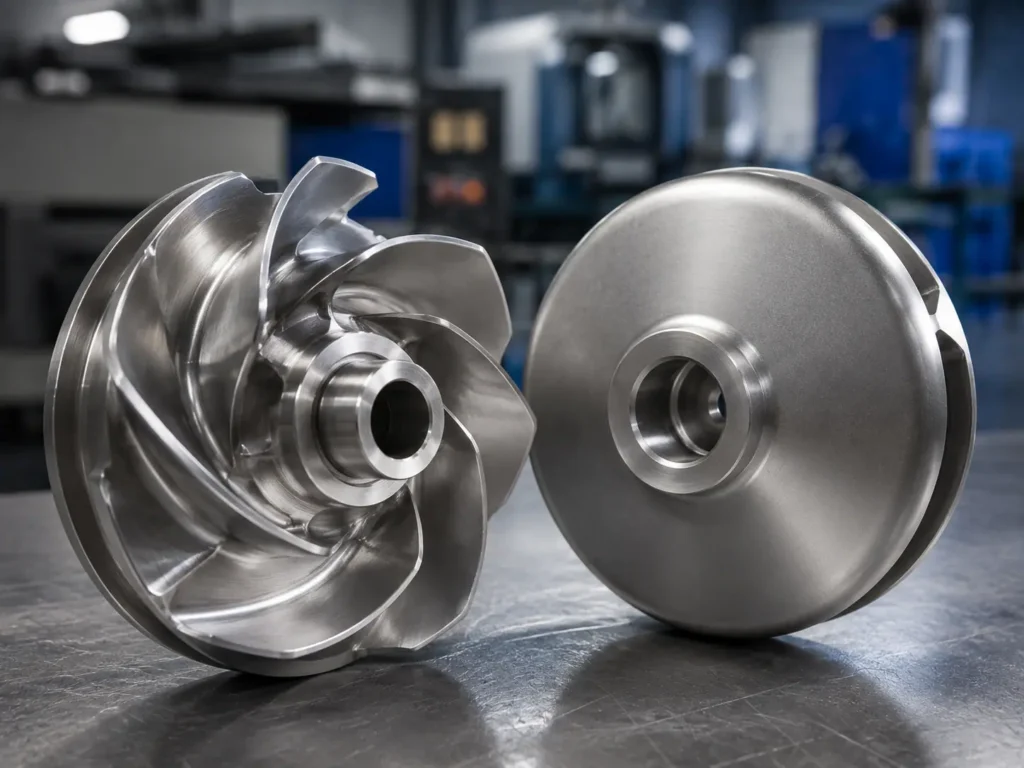
A pump impeller is the rotating part inside a pump that transfers energy from the shaft to the liquid. In an industrial centrifugal pump, the impeller uses vanes to move liquid from the inlet eye toward the outlet, helping create flow and pressure for water, wastewater, chemical, marine, mining, and process applications.
Short answer: if the motor is the power source, the pump impeller is the part that actually works on the liquid. For industrial buyers, the important question is not only “what is a pump impeller?” It is also whether the impeller type, material, dimensions, balancing requirement, and manufacturing route match the pump application.
Matson manufactures custom pump impellers from drawings, samples, and specifications for industrial pump OEMs, distributors, and equipment builders. This guide explains the basic function of a pump impeller and what buyers should check before requesting a custom quote.
What a Pump Impeller Does
A pump impeller receives torque from the pump shaft. As it rotates, its vanes guide the liquid outward. In a centrifugal pump, liquid enters near the center of the impeller, often called the eye, and leaves at the outer diameter. The pump casing then helps convert part of that velocity into pressure.
That simple explanation is useful, but it leaves out the purchasing details that matter in real projects. Two impellers can look similar in photos and still perform differently because of diameter, vane shape, outlet width, material, clearance, surface condition, and fit with the pump casing.
For a buyer, a pump impeller should be treated as both a hydraulic component and a manufactured rotating part. It has to move the liquid, fit the pump, resist wear or corrosion, and run with acceptable vibration.
Pump Impeller Basics for Buyers
Use this table to separate the impeller from the surrounding pump parts and to understand what should be checked before custom manufacturing.
| Item | Basic role | What buyers should confirm |
|---|---|---|
| Impeller | Rotating part with vanes that transfers energy to the liquid. | Type, diameter, vane shape, bore, hub, rotation direction, material, balancing requirement. |
| Pump shaft | Transmits power from the driver to the impeller. | Shaft size, fit, keyway, mounting method, and whether the impeller sample is worn at the bore. |
| Pump casing | Houses the impeller and directs the liquid leaving the impeller. | Casing style, volute or diffuser relationship, clearances, and whether the new impeller matches the casing. |
| Wear ring or clearance surface | Controls leakage and clearance around some impeller designs. | Wear ring dimensions, running clearance, repair history, and whether the mating surface is damaged. |
| Material | Determines resistance to corrosion, abrasion, temperature, and service condition. | Fluid chemistry, solids, pH, chloride, temperature, previous material, and required certificate. |
| Balancing | Helps reduce vibration and load on bearings and seals. | Operating speed, impeller mass, balancing grade, and whether a balancing report is required. |
Main Types of Pump Impellers
The word “impeller” does not describe one single shape. Industrial pumps use different impeller designs depending on the liquid and duty condition.
A closed impeller has front and back shrouds around the vanes. It is often used for cleaner liquids where efficiency matters and solids are limited.
An open impeller has exposed vanes. It can be easier to clean and inspect, but clearance and wear are important.
A semi-open impeller has one shroud and one open side. It is common in process and wastewater applications where some solids or service variation may be present.
A vortex impeller is designed to create a vortex in the pump casing and reduce direct contact with solids. It can be useful in wastewater and solids-handling applications, although efficiency and clearance still need review.
A slurry impeller is built around abrasion, section thickness, wear area, and material selection. For mining or abrasive service, material can matter as much as geometry.
For a deeper comparison, see Matson’s guide to pump impeller types. If the project is specifically wastewater or solids handling, the vortex pump impeller page explains when a vortex-style pump is usually considered.
Why Material Matters
A pump impeller is not selected by shape alone. Material affects service life, casting behavior, machining, corrosion resistance, abrasion resistance, and cost.
Stainless steel is common in clean water, process water, and some corrosive environments. Duplex stainless steel may be considered when chloride or corrosion risk is higher. Bronze or brass can appear in water and marine-related service. Carbon steel and alloy steel may be used where strength, cost, or wear requirements fit the application.
The buyer should not only say “stainless steel impeller” and stop there. A good RFQ should identify the exact material grade if known, the liquid condition, temperature, pH, chloride level, solids, and whether material certificates are required.
For a fuller material discussion, use the pump impeller material selection guide.
What Buyers Should Check Before Requesting a Quote
For a standard industrial replacement or custom manufacturing project, the factory needs more than a product name. A buyer should first confirm what the impeller is supposed to do, what pump it fits, and what condition it will run in.
Start with the pump application: clean water, wastewater, chemical process liquid, seawater, slurry, mine dewatering, cooling water, or another industrial service. Then confirm whether the pump handles solids, fibers, abrasive particles, corrosive liquid, or temperature variation.
Next, check the physical information. A drawing is best. If there is no drawing, send a physical sample, clear photos, and careful measurements. The outside diameter alone is not enough. Matson normally needs details such as bore, hub height, keyway, mounting face, vane count, vane direction, inlet eye, outlet width, shroud shape, wear ring dimensions, and any critical clearances.
If the existing impeller is worn, say so. Worn vane edges, enlarged clearances, corrosion pits, damaged bores, and repaired surfaces can hide the original geometry. A sample can be helpful, but it should not be treated as perfect evidence unless the wear condition is understood.
Pump Impeller Design Versus Manufacturing
Many buyers ask whether a manufacturer can “design an impeller.” The answer depends on what they mean.
If the project needs a new hydraulic design, the pump OEM or engineering owner should control the pump curve, duty point, casing relationship, efficiency target, and performance testing requirement. If the project needs custom manufacturing from an approved drawing or sample, the manufacturer can review casting feasibility, machining surfaces, material, dimensional inspection, balancing, and production risks.
That distinction protects the buyer. A small change in impeller diameter, outlet width, vane angle, or casing clearance can affect flow, head, efficiency, cavitation, vibration, and wear. For this reason, Matson discusses pump impeller design as a buyer review topic, not as a blank-check promise to redesign every pump.
Manufacturing and Balancing Considerations
Once the impeller type, material, and dimensions are known, the discussion becomes a manufacturing review.
Cast pump impellers may require pattern or tooling review, machining allowance, dimensional inspection, surface finishing, and sometimes heat treatment or passivation depending on the material and specification. CNC machining is important around the bore, hub, mounting face, keyway, wear ring, and other fit surfaces.
Balancing should also be considered before production, especially for larger diameter, higher speed, or heavier rotating parts. When a project specifies balancing, buyers may refer to ISO 21940-11 for rigid-rotor balancing terminology and grades, but the actual requirement should come from the drawing, pump speed, impeller size, mass, and buyer specification.
Matson’s impeller manufacturing process can cover casting, CNC machining, surface treatment, dynamic balancing, dimensional inspection, and export packing when these requirements are defined in the project.
What Information Should You Send for a Custom Pump Impeller Quote?
For a practical quote, send the following information when available:
- 2D drawing, 3D file, or physical sample
- Clear photos from the front, back, side, bore, hub, and damaged areas
- Pump application and liquid condition
- Flow, head, speed, and duty point if known
- Material grade or previous material
- Outside diameter, bore, hub height, keyway, and mounting dimensions
- Vane count, rotation direction, inlet eye, outlet width, and shroud details
- Wear ring, clearance, or casing-fit information
- Surface finish, coating, passivation, or polishing requirement
- Balancing grade or balancing report requirement
- Quantity, batch expectation, and target delivery schedule
If you do not have everything, send what you have. A clear sample photo and honest application information are still better than a short message that only says “pump impeller price.”
Common Questions We Actually Get
What is a pump impeller?
A pump impeller is the rotating vaned component inside a pump that transfers energy from the shaft to the liquid, helping create flow and pressure.
What does a pump impeller do?
It moves liquid through the pump. In a centrifugal pump, liquid enters near the center of the impeller and is pushed outward by the rotating vanes before the casing directs the flow.
What are the main types of pump impellers?
Common industrial types include closed, open, semi-open, vortex, mixed-flow, and slurry pump impellers. The right choice depends on liquid condition, solids, efficiency target, casing design, and wear risk.
What information should I send for a custom pump impeller quote?
Send the drawing or sample, pump application, liquid condition, material, dimensions, rotation direction, speed, quantity, and any balancing or inspection requirement.
Can Matson manufacture pump impellers from drawings or samples?
Yes. Matson manufactures custom pump impellers from drawings, 3D files, physical samples, and detailed specifications for industrial pump projects. The final hydraulic design should still be confirmed by the pump OEM or engineering owner when performance changes are involved.
Send Us Your Drawing
Need a custom pump impeller for an industrial pump project? Send Matson your drawing, sample photos, material grade, application, liquid condition, quantity, and balancing requirement through the contact page. We can review the manufacturing route, material, machining points, inspection needs, and quote basis before production.