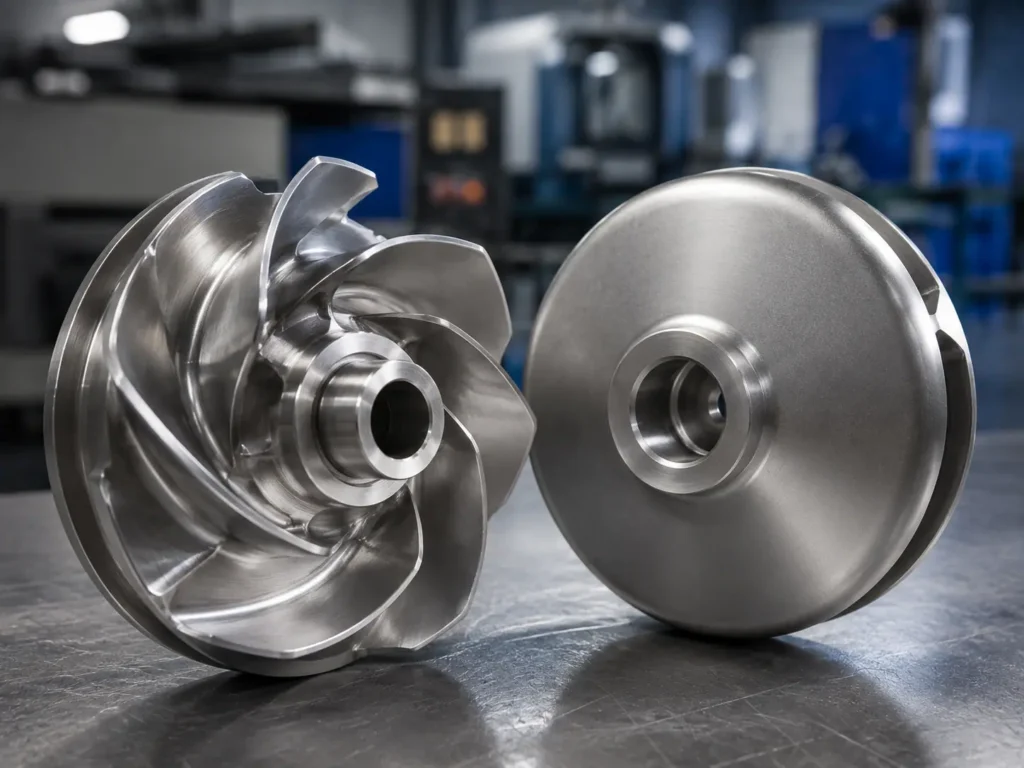
Pump casing types include volute casings, diffuser or vaned casings, single and double volutes, axially split casings, radially split casings, and selected double-casing arrangements. Each casing structure controls how the impeller sits inside the pump, where liquid enters and leaves, which stationary surfaces establish clearance, and which dimensions a custom impeller must match.
For an impeller RFQ, the casing type matters because outside diameter alone does not define fit. Buyers should also confirm the impeller eye, axial width, hub position, rotation direction, wear-ring or wear-plate interfaces, casing or diffuser clearances, shaft location, and the condition of the mating stationary parts.
Matson manufactures custom industrial impellers from drawings, 3D files, samples, and specifications. Matson is not positioning itself as a pump-casing supplier in this article. The purpose is to help OEM buyers and sourcing teams send enough casing-related information for a reliable impeller manufacturing review.
[Image placeholder: Add a real pump section drawing and inspection image showing a centrifugal pump impeller inside a volute casing, with the eye, OD, axial position, wear-ring surfaces, cutwater, and casing clearance marked. Alt text: “Pump casing types and centrifugal pump impeller fit dimensions”]
Main Pump Casing Types
The casing name describes more than the pump’s outside shape. It affects the flow path, assembly method, pressure containment, shaft arrangement, and impeller-to-stationary-part relationship.
| Pump casing type | Basic structure | Impeller RFQ concern |
|---|---|---|
| Single volute casing | A spiral passage collects flow from the impeller and leads it toward the discharge. | Impeller OD, width, cutwater relationship, rotation, axial position, and casing clearance. |
| Double volute casing | The casing divides the collecting passage into two volute regions. | Correct impeller position, outlet geometry, rotation, OD, and relationship to both volute passages. |
| Diffuser or vaned casing | Stationary diffuser vanes surround the impeller and guide flow before the casing passage. | Impeller outlet diameter and width, vane-to-diffuser alignment, radial gap, and axial location. |
| Axially split casing | The casing separates along a plane generally parallel to the shaft. | Impeller width, dual wear-ring surfaces, shaft centerline, split-line assembly, and double-suction symmetry where applicable. |
| Radially split casing | The casing separates across a plane generally perpendicular to the shaft. | Axial stack, cover or casing fit, wear-ring surfaces, hub location, and assembly access. |
| Double casing or barrel arrangement | An inner pump casing or diffuser assembly sits inside an outer pressure-containing casing. | Impeller fit belongs to the inner hydraulic assembly; section drawings and stage-specific data are essential. |
These categories can overlap. A pump may be double-suction, axially split, and double-volute at the same time. Buyers should send the actual pump section drawing rather than relying on one catalog term.
Volute Casing and Impeller Fit
A volute casing uses an expanding spiral passage to collect liquid leaving the impeller. The impeller must sit in the correct radial and axial position relative to the casing inlet, cutwater, wear-ring areas, and side clearances.
For a custom impeller, confirm:
- Finished impeller outside diameter
- Impeller outlet width and axial envelope
- Eye diameter and inlet position
- Rotation direction with viewing side
- Cutwater or tongue relationship where specified
- Front and back side clearances
- Casing or impeller wear-ring diameters
- Hub, bore, keyway, mounting face, and shaft position
- Gasket or cover stack affecting axial location
The casing should not be treated as a simple empty shell. A small axial-position error can move the eye away from the inlet or change front and back clearances. A wrong OD can create rubbing risk or an incorrect relationship with the cutwater.
The pump casing and impeller fit page provides the conversion-focused checklist for casing dimensions, clearance, drawings, and sample review.
Diffuser Casing Needs Outlet-to-Vane Information
In a diffuser pump, stationary diffuser vanes receive flow after it leaves the impeller. The impeller outlet and diffuser inlet must retain the approved radial and axial relationship.
A buyer asking for a new impeller should include the diffuser drawing or reliable measurements for:
- Impeller exit diameter and width
- Diffuser inlet diameter
- Radial gap between impeller and diffuser
- Axial alignment of the flow passages
- Vane count and relative orientation when relevant to assembly
- Stage number for multistage equipment
- Shaft, spacer, sleeve, and stack-up dimensions
- Wear rings, bushes, or balance-device interfaces
Do not manufacture a multistage impeller from OD and bore alone. Two stages in the same pump family may use similar-looking but non-interchangeable impellers.
Axially Split Casing Often Requires Both Sides of the Impeller
Axially split casing pumps are common in higher-flow industrial water and other services. Many use double-suction impellers, although casing split and suction arrangement are separate design choices.
For a double-suction impeller, buyers should verify both inlet eyes, central hub or shaft connection, overall width, two wear-ring surfaces, symmetry, vane passages, and shaft-center position. Uneven wear on one side should not automatically become the model for both sides.
The casing split line also matters during assembly inspection. Gasket thickness, ring fit, casing distortion, and bearing or shaft position can influence the measured clearance. If a new impeller is made against worn casing rings, the restored impeller dimensions may still produce excessive leakage clearance.
Matson’s double-suction impeller guide covers symmetry, dual inlet eyes, wear-ring surfaces, machining, and balancing in more detail.
Single Volute vs Double Volute Is Not an Impeller Shortcut
A double-volute casing is designed with two collecting passages intended to manage the pressure distribution around the impeller more evenly under the approved pump design. That does not mean any impeller of the correct diameter can be installed in either a single- or double-volute pump.
The buyer still needs the approved impeller geometry, rotation, outlet width, vane profile, shaft interface, and axial position. If the casing changes but the impeller appears similar, obtain OEM or engineering confirmation before assuming interchangeability.
Matson should reproduce or manufacture the approved rotating part, not redesign the casing-volute system from photographs.
Wear Rings and Wear Plates Are Part of the Casing Relationship
Pump clearances may be controlled by replaceable casing wear rings, impeller wear rings, both sets of rings, a front wear plate, a back plate, a cover, or machined casing surfaces. The RFQ should identify where each component belongs.
| Stationary interface | Impeller dimension to confirm | Common mistake |
|---|---|---|
| Casing wear ring | Impeller ring or sealing diameter, roundness, runout, and required assembled clearance. | Copying a worn impeller diameter without measuring the casing ring. |
| Front wear plate | Open or semi-open vane-tip position, axial height, and front clearance. | Using worn vane height as the original drawing dimension. |
| Rear cover or backplate | Back clearance, hub face, rear vane or shroud position, and axial stack. | Ignoring gasket, cover, sleeve, or shaft-shoulder effects. |
| Diffuser inlet | Impeller exit diameter, width, axial location, and radial gap. | Treating the diffuser as if it were a general volute clearance. |
| Casing inlet | Eye diameter, eye axial position, inlet profile, and concentricity. | Checking only OD while the impeller eye sits incorrectly. |
See the wear ring in centrifugal pump article for ring location, material, machining, and clearance review.
A Worn Casing Can Make a Good Sample Misleading
When an old impeller arrives without a drawing, buyers often assume the sample contains every required dimension. It does not show the original casing condition.
Check for:
- Rubbing marks on shrouds, OD, or vane tips
- Worn or loose casing rings
- Scored impeller ring surfaces
- Enlarged or repaired casing bores
- Gasket changes and cover machining
- Corrosion, erosion, or previous weld repair
- Shaft movement, bearing wear, or incorrect axial setting
- Different wear on the front and back sides
- Evidence that the old impeller was trimmed or ground
Photograph the sample together with the casing, cover, diffuser, wear plate, and rings when possible. Mark which dimensions are trusted and which require engineering restoration.
Pump Casing Material Is Not Automatically the Impeller Material
Cast iron, ductile iron, carbon steel, stainless steel, duplex stainless, bronze, and other materials can appear in pump casings. The impeller may use the same material or a different approved grade.
Material pairing should consider corrosion, galvanic compatibility, abrasion, temperature, liquid chemistry, solids, strength, castability, machinability, and the pump owner’s specification. A stainless impeller inside a different casing material is not automatically an upgrade. It can change corrosion behavior, clearances, mass, balance, and service expectations.
The buyer should specify the exact impeller material and required certificate. Do not ask the manufacturer to infer it solely from the casing.
What Buyers Should Send for an Impeller Quote
A useful casing-related RFQ includes:
- Pump type and casing arrangement
- Complete pump section drawing
- Controlled impeller drawing and 3D model when available
- Photos of the casing, cover, diffuser, wear rings, and sample
- Finished impeller OD, eye, width, bore, keyway, and hub dimensions
- Shaft, sleeve, spacer, gasket, and axial stack information
- Front, back, radial, wear-ring, or diffuser clearances
- Rotation direction with viewing side
- Material, liquid, solids, temperature, corrosion, and abrasion conditions
- Operating speed and dynamic-balancing requirement
- Worn, repaired, rubbed, or unreliable sample areas
- Quantity, inspection plan, documents, marking, and packing
Matson’s impeller manufacturing capabilities include casting, CNC machining, surface treatment, dimensional inspection, dynamic balancing, and export packing for suitable drawing- or sample-based projects.
Common Questions Buyers Ask
What are the main pump casing types?
Common types include single-volute, double-volute, diffuser or vaned, axially split, radially split, and double-casing or barrel arrangements. A pump can combine more than one of these classifications.
How does pump casing type affect impeller manufacturing?
It defines the impeller’s relationship to the inlet, cutwater, diffuser, wear rings, wear plates, covers, axial stack, and casing clearances. Those dimensions must be included in the RFQ.
Can an impeller be copied without the pump casing drawing?
It can be reviewed from a sample, but the risk is higher. Worn casing rings, cover changes, diffuser position, shaft movement, and incorrect old clearances may not be visible from the impeller alone.
Does Matson manufacture pump casings?
This article does not position Matson as a pump-casing supplier. Matson focuses on custom industrial impeller manufacturing and uses casing information to review impeller fit, clearance, machining, and inspection requirements.
Is the same impeller suitable for single- and double-volute casings?
Do not assume so. Even if OD and bore are similar, the approved vane geometry, rotation, outlet width, axial position, and casing relationship must be confirmed by the pump OEM or engineering owner.
Need a custom pump impeller reviewed against a volute, diffuser, split casing, wear ring, or wear plate? Send Matson the pump section drawing, casing and sample photos, mating dimensions, clearances, material, speed, balancing requirement, quantity, and inspection needs through the custom pump impeller quote page.