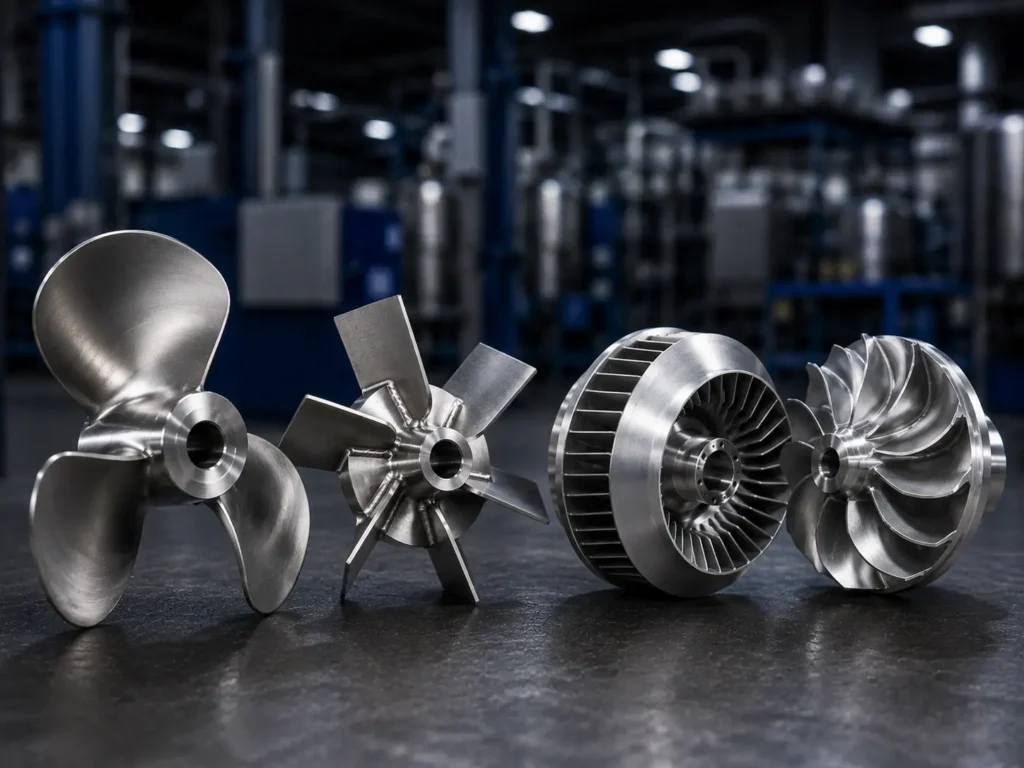
The difference between fan and impeller is the difference between an air-moving machine and its rotating aerodynamic component. An impeller transfers mechanical energy to the air; the fan combines that component with the supporting and airflow-guiding arrangement needed for its intended operation. In an RFQ, do not use the two names as interchangeable supply descriptions. State whether you need a bare wheel, a defined rotor assembly or a complete fan package, and list the included parts.
Fan vs impeller: the short answer
In industrial fan terminology, the impeller is the rotating bladed component. It is often called a fan wheel. The fan is the machine or defined assembly in which that component operates. The shaft, bearings, supporting structure, inlet arrangement, housing where used, and drive package need their own scope definition.
The definitions in ANSI/AMCA 208-18 distinguish the fan from its impeller and describe how integrated or packaged drive components enter the fan definition. This dated document is cited for terminology, not as a claim that it is the current governing edition for your contract.
That distinction does not mean every fan order includes a motor, control panel, ductwork and installation. Technical definitions and commercial supply boundaries are different questions. The quotation and bill of materials must identify what is included, excluded and supplied by others.
| Comparison | Impeller or fan wheel | Fan or fan package | RFQ implication |
|---|---|---|---|
| What it describes | Rotating aerodynamic component | Air-moving machine or defined equipment assembly | Specify the supply boundary rather than the name alone |
| Typical geometry information | Blade profile, diameter, inlet eye, hub and shaft connection | Wheel plus arrangement, supports, inlets, outlets and other included equipment | Send the component drawing and relevant assembly interfaces |
| Drive components | Not automatically included | Included only as specified in the package | List motor, transmission and controls individually |
| Acceptance evidence | Agreed material, dimensional, joining, surface and balance records | Agreed assembly checks and performance evidence for the stated configuration | Separate component inspection from fan-system qualification |
| Procurement responsibility | Manufacture the released component to its approved requirements | Supply and validate the contracted equipment scope | Identify the design, integration and commissioning owners |
For suitable custom fan and blower impellers, Matson’s starting point is the approved component drawing, material, interfaces and inspection requirements. A wheel quotation should not be interpreted as an offer for an unspecified complete fan installation.
Three supply descriptions that should not be confused
A bare wheel
A bare-wheel order normally concerns the defined impeller component, but even this wording needs clarification. Does the wheel drawing include a fixed hub? Is a removable bushing included? Are fasteners, keys or other attachment parts supplied? Is a protective finish part of the accepted condition?
List the items explicitly. A supplier can quote the same outside diameter and blade count while excluding a hub accessory another quotation includes. The prices then describe different deliverables, not necessarily different manufacturing efficiency.
A rotor or wheel-and-shaft assembly
An assembly request adds defined rotating parts and their relationships. Identify the shaft, connection, axial location, attachment hardware and any other included items. Do not assume the word “rotor” means the same collection of parts for every OEM.
The acceptance plan also changes. If balancing applies to an assembly, identify which parts are present, how the assembly is configured and what condition the report represents. A bare-wheel balance record does not automatically cover a later assembly with additional components.
A complete fan package
A complete package needs a contractual parts list and operating specification. Housing or plenum arrangement, motor, bearings, base, guards, transmission, controls and accessories must be identified as included or excluded according to the actual design.
Installation and commissioning are separate scope items unless the contract includes them. So are ductwork, electrical connections, site supports and control-system integration. “Complete fan” should not be used to leave these interfaces unresolved until delivery.
A wheel can be part of several fan arrangements
Centrifugal and axial arrangements use different airflow paths and component geometries. A centrifugal wheel is not defined solely by its diameter, and an axial blade assembly is not interchangeable with any other rotor that moves air along a shaft.
Some arrangements use a scroll housing; others operate in a plenum or another defined surrounding structure. Therefore, “fan” does not always mean a wheel inside the same kind of casing. The installed arrangement and the approved design determine which supporting and airflow-guiding elements matter.
Single-inlet and double-inlet descriptions likewise concern the arrangement and interfaces, not simply a different sales name. The shaft location, hub projection, inlet access and assembly envelope need to match the approved configuration.
The separate centrifugal fan type guide explains blade families and common configurations. This article addresses the machine-versus-component supply boundary; it does not repeat the full taxonomy or select a fan type for an unspecified duty.
Is a propeller also an impeller?
In some industrial contexts, a propeller-style rotor is an axial-flow impeller. That is a terminology overlap between rotating components, not the same comparison as fan versus impeller.
Our propeller versus impeller guide covers that distinction across equipment contexts. For a fan RFQ, the immediate question remains practical: which component or assembly does the drawing define, and which surrounding parts are the buyer’s responsibility?
Do not use a photograph of an open-bladed rotor as proof that the requested scope is a complete axial fan. The image may not show the supporting structure, drive, guards or other contracted parts. A labelled assembly drawing is a better scope document than an unqualified product name.
A wheel drawing is not a complete fan performance specification
Airflow, pressure, absorbed power and sound data must relate to a defined configuration and operating condition. A wheel diameter and rotational speed do not provide a complete performance curve. Neither does a material certificate or a dimensional inspection report.
If your OEM supplies an approved wheel design, identify who retains responsibility for its aerodynamic selection and performance validation. If someone proposes changing the wheel profile, width, inlet geometry or installed arrangement, establish the approval and qualification route before manufacturing begins.
AMCA’s system-effect discussion explains why installation conditions can affect fan performance. That supports a clear procurement boundary: component conformance and installed-system behavior require different evidence. A correctly made wheel does not independently verify every surrounding installation condition.
Keep the duty basis consistent
Where performance evidence is required, state airflow units, pressure definition, gas conditions and relevant operating range. Identify the configuration represented by the data. Do not compare a static-pressure requirement with an unexplained total-pressure value or ignore differences in the density basis.
This is not an instruction to redesign the system from a blog article. It is a request for traceable information from the responsible equipment engineer. The component supplier needs the approved requirements that affect the manufacturing order.
Efficiency belongs to a defined boundary
Wheel aerodynamic performance, fan shaft power and electrical input are not interchangeable measurements. A quotation using an efficiency figure needs its definition, operating point and included losses. “High-efficiency impeller” without that basis is not enough to compare complete packages.
For a wheel-only order, require the agreed component acceptance evidence. For equipment performance, require the contractually specified validation from the responsible party. Do not transfer a rating from a different fan arrangement or treat a new wheel’s surface appearance as proof of energy performance.
Where unclear scope creates purchasing problems
The following are illustrative RFQ situations, not customer cases. Each shows how a short description can conceal a substantial supply or acceptance difference.
| RFQ wording | What remains unclear | Better clarification |
|---|---|---|
| “Quote one fan, drawing attached” | The drawing may show only a wheel | Identify the wheel-only or equipment BOM and exclusions |
| “Supply the same impeller with motor” | Motor interface, supports, controls and integration responsibility | Provide a released assembly scope and approved motor/interface requirements |
| “Match the old fan performance” | Original curve, test basis, installation and current duty | Define the required evidence and the party responsible for validation |
| “Balanced rotor required” | Which rotating parts and acceptance condition are covered | List the assembly configuration, balance requirement and report scope |
| “Make to sample” | Worn geometry and missing original features | Mark damage and obtain approval for reconstructed dimensions |
If you are comparing suppliers, normalize those scope items first. A lower wheel-only quotation is not evidence of a cheaper complete fan. Likewise, an equipment quote containing commissioning work should not be compared directly with a component manufacturing price.
What the wheel manufacturer needs to control
The released design should identify the blade profile, count, orientation, finished diameter, width and relevant inlet/shroud features. Define the hub, bore, keyway or other shaft connection, seating faces and any controlled geometric relationships.
Rotation direction needs a reference view. “Clockwise” without a viewing side can be misinterpreted when the same component is photographed from opposite sides. Preserve the drawing’s orientation conventions in inspection and assembly records.
Specify material grade and required condition, surface treatment and inspection scope. If the wheel is fabricated, identify approved joining and inspection requirements. If cast and machined, distinguish accepted starting geometry from machined functional interfaces. There is no universal tolerance suitable for every fan wheel.
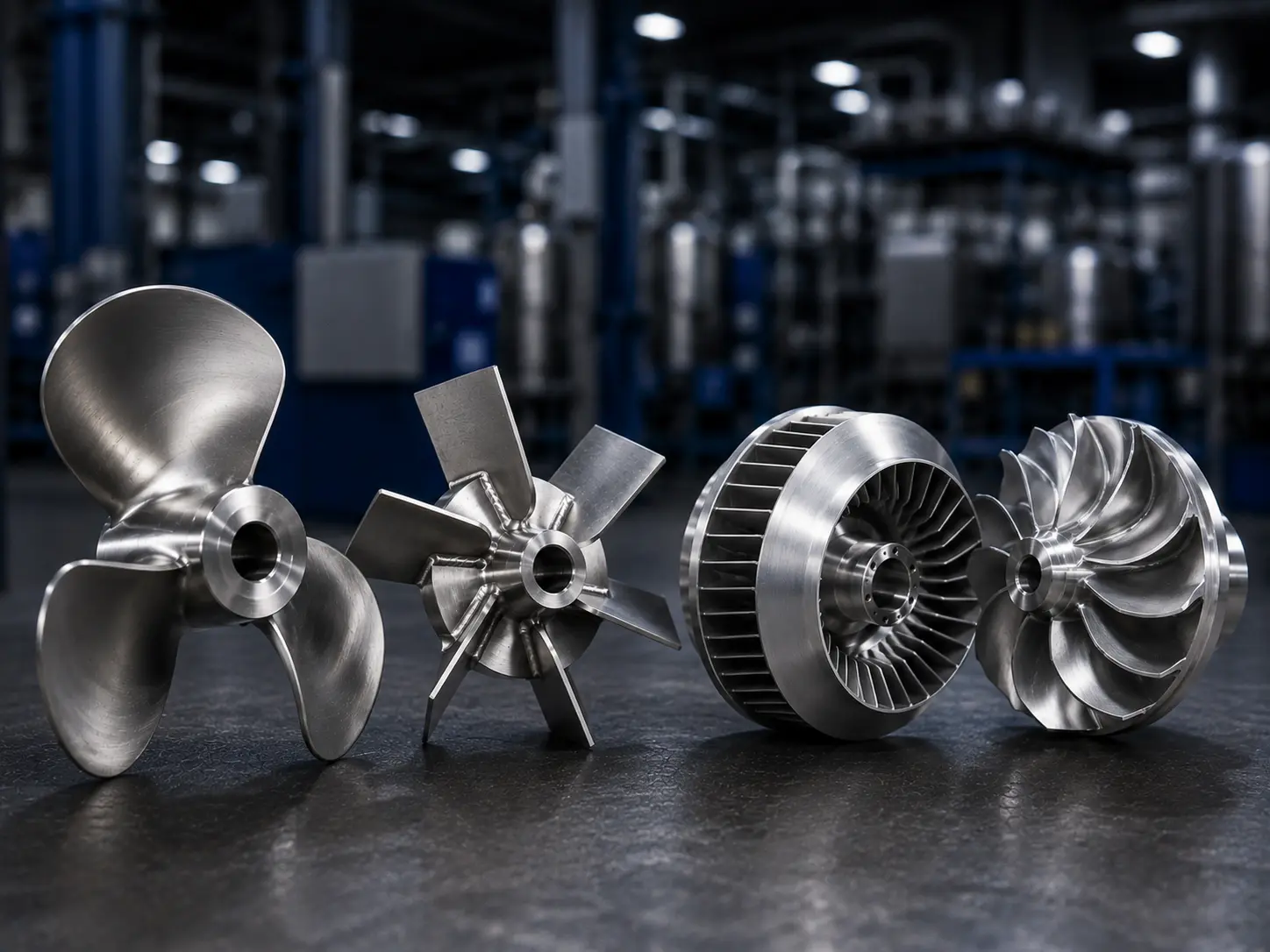
For suitable projects, Matson’s impeller manufacturing capabilities support a drawing-based review of casting, machining, finishing, balancing and inspection requirements. The production route should follow the approved component rather than an assumption that every fan wheel is made the same way.
Before release, agree the first-article evidence and the handling of drawing/model conflicts. A model revision should not silently replace the approved drawing or change a controlled interface. For repeat orders, retain the accepted baseline and identify which changes require customer authorization.
Confirm these items before sending the RFQ
| Scope item | What to state | Why it matters |
|---|---|---|
| Supply level | Bare wheel, specified rotor assembly or listed fan package | Prevents unlike quotations and missing parts |
| Included and excluded parts | Hub accessories, shaft, motor, bearings, housing, guards and controls as applicable | Defines the actual BOM and buyer-supplied interfaces |
| Controlled geometry | Revision-matched drawing/model, rotation view, shaft connection and assembly envelope | Establishes fit and repeatable manufacture |
| Service context | Gas composition, temperature, dust, corrosion exposure and approved operating conditions | Supports material and production-scope review |
| Acceptance | Component reports, balance configuration, assembly tests and separate performance obligations | Connects each claim with the correct evidence |
| Responsibility and quantity | Design approver, integrator, commissioning owner, sample/batch quantity and change process | Prevents unresolved engineering work being hidden inside a component order |
If only a sample exists, mark worn, repaired or distorted features and state which dimensions remain uncertain. A manufacturing review can identify missing information; it should not quietly convert incomplete evidence into a guarantee of interchangeability or restored fan performance.
Questions to settle before ordering
What is the main difference between fan and impeller?
In fan terminology, the impeller is the rotating aerodynamic component, while the fan is the machine or defined assembly that uses it to move air. The commercial package still needs an explicit parts list. State whether you want a wheel only, a rotor assembly or complete equipment, and identify the included drive, support, airflow-guiding and control components rather than relying on the product name.
Does buying a fan always include a motor?
No. Motor inclusion depends on the agreed supply scope and configuration. A quotation may cover a fan without a driver, a motorized assembly or a broader equipment package. List the motor, transmission, controls and installation responsibilities separately. Do not assume that the word complete settles every electrical or mechanical interface; check the BOM, exclusions and approval responsibilities before issuing the purchase order.
Are fan wheel and impeller the same thing?
Fan wheel commonly means the rotating impeller, but supplier and OEM terminology can vary. Confirm what the drawing includes, particularly the hub, removable bushing, shaft attachment and any additional rotating parts. A wheel drawing and a rotor-assembly drawing may describe different deliverables. Use part numbers, revisions and an explicit BOM to resolve the scope instead of treating similar names as proof of equivalence.
Can an impeller alone guarantee the required airflow and pressure?
No. Performance evidence must represent the defined fan configuration and operating conditions. Wheel geometry matters, but the inlet, surrounding arrangement, speed and installation also need an approved basis. A component dimensional report does not replace fan-performance qualification. Identify who owns the selected design and who must provide the contractual curve, test or other acceptance evidence before attributing equipment performance to the component supplier.
Is a plug fan an exception to the machine-versus-component distinction?
No. It is an arrangement in which the surrounding plenum and installation matter, rather than proof that the wheel alone is a complete installation. Specify the actual assembly, supports, drive and interfaces. Do not assume performance from another housing arrangement transfers unchanged. The distinction remains useful: identify the rotating component separately from the complete equipment and installed system whose performance is being accepted.
Can a wheel-only balance report cover the complete rotor assembly?
Not automatically. The report applies to the configuration and acceptance condition it identifies. Adding a shaft, coupling or other rotating parts can change the relevant assembly. Specify whether balancing concerns the bare wheel or the agreed rotor, including permitted correction locations and required records. Balance acceptance also does not replace dimensional, material or joining inspection, and it does not establish complete-fan aerodynamic performance.
What should you send for a custom impeller quotation?
Send the released drawing or model, material specification, quantity, surface requirements, shaft connection and relevant assembly interfaces. State the rotation viewing side and inspection or balance requirements. Include the operating context needed for the review. If only a used sample exists, identify worn or repaired areas and who approves reconstructed dimensions. Make the requested supply level explicit so the quotation describes the intended component.
Does Matson supply the complete fan when quoting an impeller?
Do not assume so. Matson’s scope here is suitable custom industrial impeller manufacture from approved drawings, samples and specifications. A component quotation should state its included parts, production route and acceptance requirements. Complete-fan selection, motor/control integration, installation and system qualification require separately confirmed responsibilities. Ask for written scope clarification before treating a wheel price as an offer for a complete fan package.
Final Thoughts
The useful distinction is not just vocabulary: it defines what you receive and which evidence supports acceptance. Specify the wheel, assembly or equipment scope before comparing prices, then assign geometry, performance and integration responsibilities explicitly. Matson can review suitable drawing-based fan impeller projects. Send your drawing and RFQ with the parts list, material, quantity, interfaces and inspection requirements so the quotation addresses a clearly controlled manufacturing deliverable.