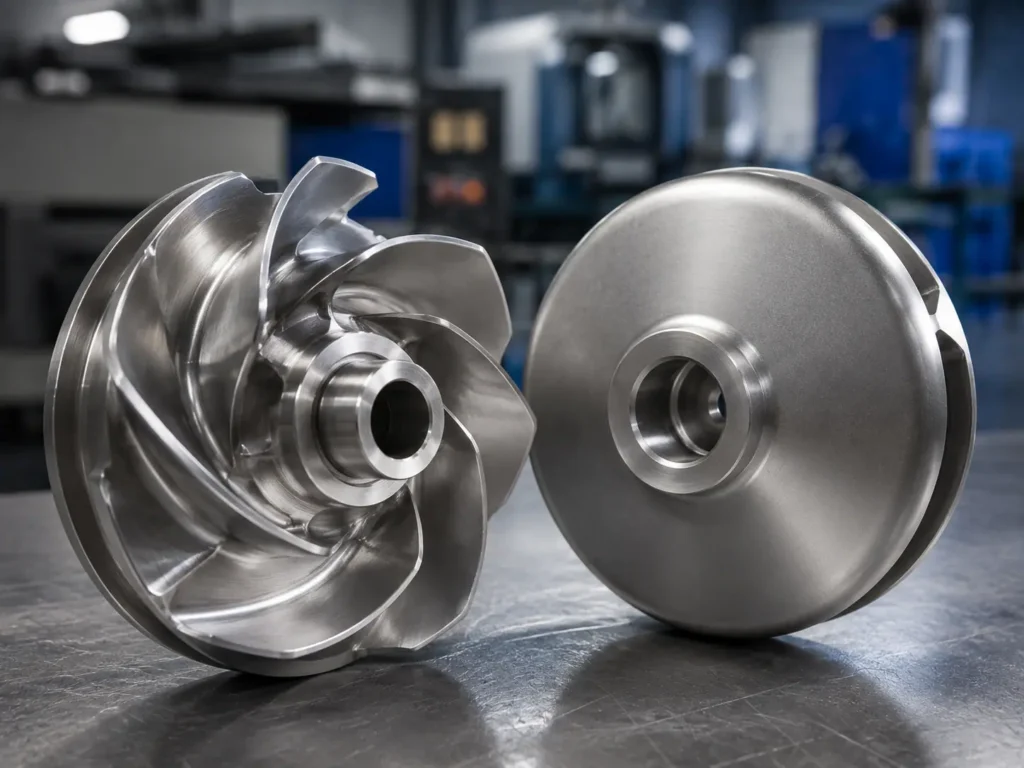
The main types of centrifugal fans are forward-curved, backward-oriented and radial designs. A practical wheel comparison separates six common configurations: forward-curved, backward-inclined flat blade, backward-curved, airfoil, radial blade and radial-tip. Choose a shortlist from the airstream, required airflow and pressure, operating range, and maintenance conditions. Before ordering a custom wheel, confirm the selected fan’s performance and freeze its geometry; a blade-type name alone is not a manufacturing specification.
Three blade families, six common wheel configurations
A centrifugal fan draws air into the wheel near its axis and discharges it outward through the blade passages. The housing or surrounding plenum then guides the flow. The wheel is one part of the fan: bearings, shaft, motor, inlet, housing, drive and installation also affect the result.
The number of “types” changes with the classification. A short list groups blades by their orientation: forward, backward or radial. A more useful industrial comparison distinguishes the flat, curved and airfoil forms within the backward-oriented family, and separates radial-tip from straight radial blades. These are six common configurations, not a claim that every manufacturer’s catalogue uses the same six categories. The AMCA-hosted Selecting the Right Fan presentation lists these six configurations together.
Keep this distinction in your purchase documents. “Backward inclined” sometimes names the entire backward-oriented family; in a specific drawing it can mean a flat, single-thickness blade. Ask for the profile rather than accepting the label as proof of shape.
Centrifugal fan types: comparison table
Use this table to identify questions for the fan designer. It does not replace the selected model’s pressure, power and sound data.
| Wheel configuration | Distinguishing feature | Starting application context | Main selection check |
|---|---|---|---|
| Forward-curved | Blade tips turn with rotation, often in a closely spaced multi-blade wheel | Compact clean-air ventilation and packaged air-handling equipment | Power demand across the operating range, passage fouling and housing compatibility |
| Backward-inclined flat blade | Single-thickness blades lean away from rotation | Ventilation and process-air duties where efficiency matters | Actual duty efficiency, permissible contamination and stable operating region |
| Backward-curved | Single-thickness blades curve away from rotation | Clean air and selected industrial process duties | Approved curve, deposits or erosion, and exact blade/inlet geometry |
| Airfoil | Backward-oriented blades have an aerodynamic cross-section | Clean-air duties with a strong operating-energy objective | Profile integrity and whether moisture or particles are permitted by the design |
| Radial blade | Blades extend radially toward the wheel perimeter | Selected dirty-air, particulate and material-handling duties | Particle characteristics, wear, power demand and maintenance access |
| Radial-tip | Blade geometry becomes radial at the outlet tip | Selected process duties needing a combination of aerodynamic and particulate-handling characteristics | Complete blade profile, actual contamination limits and model-specific performance |
These are starting contexts, not automatic approvals. A wheel downstream of a sound filter sees a different airstream from one carrying material directly. A failure or bypass condition can change that exposure. Treat contamination as a stated operating condition, not something implied by the name of the plant.
What each wheel type means in practice
Forward-curved: check the operating range, not just compact size
Forward-curved wheels have blade tips swept in the direction of rotation. Their closely spaced passages are familiar in compact ventilation equipment. The practical restriction is that a favourable layout at one duty does not establish motor capacity at every airflow. Greenheck’s make-up-air comparison contrasts forward-curved behaviour with the non-overloading power characteristic of backward-oriented fans.
If you specify this form, ask for shaft-power demand at the expected high-flow case as well as the normal duty. Record any clean-air restriction. Do not transfer a wheel into another scroll merely because its outside diameter and bore match.
Backward-inclined and backward-curved: related, but not identical drawings
A flat backward-inclined blade and a backward-curved blade belong to the same broad orientation family. Their profiles are different. Flat blades use an inclined single-thickness section; curved blades follow a specified contour. Greenheck also identifies flat, curved and airfoil blade styles within the backward-inclined family.
For procurement, “backward” is therefore an incomplete description. The approved model must define the contour, blade position, inlet and outlet geometry, and rotation reference. Treat a supplier’s suggested profile simplification as a design change requiring approval, even if the proposed part looks similar in a photograph.
Airfoil: protect the profile and check the airstream restriction
Airfoil blades use an aerodynamic cross-section rather than a simple sheet-like section. Some constructions have hollow interiors; do not assume that every airfoil wheel is hollow or that every hollow design has the same moisture resistance. The New York Blower wheel-type explanation highlights clean, dry air as the normal starting point for its airfoil discussion, with special considerations needed for other exposures.
When you compare quotes, the profile, leading edge and trailing edge must remain controlled features. An attractive surface finish is not evidence that the manufactured blade reproduces the approved aerodynamic section.
Radial blade: material handling still requires a defined material
Straight radial wheels are relevant to selected dusty or particulate-laden industrial duties. Open-looking passages and robust construction do not mean that any powder, fibre or particle size is acceptable. Radial configurations also include different backplate, shroud and reinforcement arrangements; the generic name does not settle those details.
Specify what actually passes through the fan: concentration, particle size range, abrasiveness, moisture and tendency to adhere. A dust extractor on the filtered side is not automatically a material-conveying fan. Make the normal exposure and foreseeable abnormal exposure separate review items.
Radial-tip: the outlet direction does not define the entire blade
A radial-tip blade ends with a radial orientation, while its inner profile differs from a fully radial blade. The NYB-hosted World Cement rotor discussion distinguishes straight radial and radial-tip forms alongside backward-curved and airfoil rotors.
Request the complete contour when sourcing this wheel. Reproducing only its radial outlet tip can lose the intended passage geometry. Do not treat radial-tip as a promise of self-cleaning operation, a universal efficiency improvement or permission to carry an unspecified dust load.
Do not mix blade types with fan arrangements
Several other names describe the assembly, not a seventh or eighth blade profile.
- SWSI: single-width, single-inlet. Air enters from one side of the wheel. The inlet, hub and support arrangement must match the selected assembly.
- DWDI: double-width, double-inlet. Air enters from both sides. The two-sided inlet geometry and shaft/support interfaces need their own drawing; “double inlet” does not simply authorise doubling an existing wheel’s width.
- Scroll-housed fan. A scroll collects and directs the wheel discharge. Its relationship to the inlet and wheel is part of the fan design.
- Plug or plenum fan. The surrounding chamber participates in the installation arrangement. A wheel qualified in a scroll should not be assumed to deliver the same installed result without that scroll.
- Direct or belt drive. This describes power transmission. It does not identify blade curvature. The separate direct-drive versus belt-drive comparison covers that decision.
Rotation also needs a reference view. Write “clockwise viewed from the inlet” or the actual drawing-defined reference, rather than sending an unqualified clockwise arrow. A photograph viewed from the opposite side reverses the apparent direction.
Start selection with the airstream and duty
1. Describe the gas before choosing a wheel
Record gas composition, normal and maximum temperature, moisture or condensation, corrosion exposure, and entrained material. For solids, give particle characteristics and loading, not just “dusty air.” Note sticky deposits, fibres, intermittent carryover and the intended cleaning access.
For a filtered process, state which side of the collector contains the fan and what happens if the filter is damaged or bypassed. This prevents a clean-side wheel from being specified as though it could tolerate unrestricted dirty-side service.
2. Define flow and pressure on the same basis
Give the required airflow with units and the temperature/density basis used for selection. Specify whether the requirement is static pressure or total pressure, and where the pressure is referenced. Do not compare two quotations with different pressure or density bases as though their duty points were identical.
Include the expected low, normal and high operating cases. A single rated point hides the effects of dampers, process changes, clean versus loaded filters, and variable-speed control.
3. Review the selected model’s whole operating envelope
Ask the fan supplier for the performance, power and sound information for the proposed assembly. Confirm stable operation and the applicable speed limits over the intended control range. The AMCA-hosted selection presentation illustrates how clean and loaded filters can change a fan’s operating conditions; a normal-duty point is not the whole selection.
A backward-oriented wheel’s non-overloading power curve does not make it stall-proof, unlimited in speed, or safe with any motor. Separate power capacity, aerodynamic stability and mechanical acceptance. Each needs its own evidence.
4. Freeze the design before asking for a production quote
Once the equipment engineer approves the fan selection, issue the controlled wheel drawing and relevant assembly interfaces. If you are still comparing blade families, request an engineering selection from the complete-fan supplier. If you are sourcing a specified wheel, ask the manufacturer to quote that approved configuration.
Our manufacturing recommendation is straightforward: do not ask several wheel suppliers to infer different designs from the same airflow sentence, then compare their prices as equivalent offers. Establish the design baseline first. Otherwise the cheapest quotation might cover a different wheel, interface or inspection scope.
Application shortlist and the condition that changes it
| Application situation | Useful comparison to request | Condition that can change the shortlist | Evidence needed before approval |
|---|---|---|---|
| Clean-air AHU or ventilation assembly | Forward-curved versus suitable backward-oriented options | Available space, operating hours, pressure duty and control range | Comparable duty curves, input-power basis, sound and installation arrangement |
| Fan on the clean side of a dust collector | Suitable backward-oriented options against process alternatives | Filter carryover, loaded-filter resistance and failure exposure | Normal/abnormal airstream statement and full operating-envelope review |
| Fan carrying particles directly | Approved radial or radial-tip designs; other types only with demonstrated suitability | Abrasiveness, loading, particle size, moisture and adhesion | Material-handling limits, wear provisions and accessible inspection surfaces |
| Drying or hot process-air equipment | Wheel types supported by the approved thermal/mechanical design | Temperature at the wheel, transients, expansion and deposits | Material grade, allowable speed, clearance and thermal review |
| Corrosive or moisture-laden exhaust | Designs supported for the stated gas and condensation conditions | Chemistry, trapped moisture, corrosion and cleaning method | Material/joint/surface specification and complete-fan compatibility |
For the component manufacturing scope in air-handling equipment, see Matson’s HVAC fan and blower impellers. Application names alone do not certify a wheel for corrosive, hot or particulate service.
Combustible dust, flammable gases and hazardous-area requirements need specialist review of the complete assembly and applicable project requirements. A metal choice or surface coating alone does not establish a safe fan system.
From an approved wheel type to a manufacturable drawing
The aerodynamic selection and the manufacturing release are separate approvals. Preserve the selected geometry while defining how it will be made and inspected.
Geometry and fit. Confirm outside diameter, wheel width, inlet geometry, blade profile and position, shrouds or backplate, hub, bore, keyway or locking interface, and axial location. Identify critical datums and applicable runout requirements. Do not publish or accept a generic clearance value without the equipment drawing.
Construction route. State whether the approved part is fabricated, cast or machined, and identify permitted joints or weld details. A casting-for-fabrication substitution is a proposed change, not merely a purchasing preference. The route must preserve the approved geometry and mechanical requirements.
Material and finish. Name the grade and required condition, not only “steel” or “stainless.” Identify coating coverage, masking and any controlled final dimensions. Temperature and corrosion information should reach the material reviewer before a substitute grade is offered.
Balance and inspection. Specify the governing balance requirement, balancing condition, relevant speed and report scope. State whether the wheel is checked alone or with defined attached parts. Dimensional inspection and dynamic balancing answer different questions: neither one substitutes for complete-fan performance validation.
Sample condition. If you send a used sample, mark worn, repaired, coated or distorted areas. Ask the engineering owner to resolve the intended geometry before production. A worn blade edge should not silently become the approved profile for a new batch.
Matson’s impeller manufacturing capabilities cover drawing-based process and quality review. Confirm the route and acceptance criteria for the actual project rather than assuming every wheel type has an identical production plan.
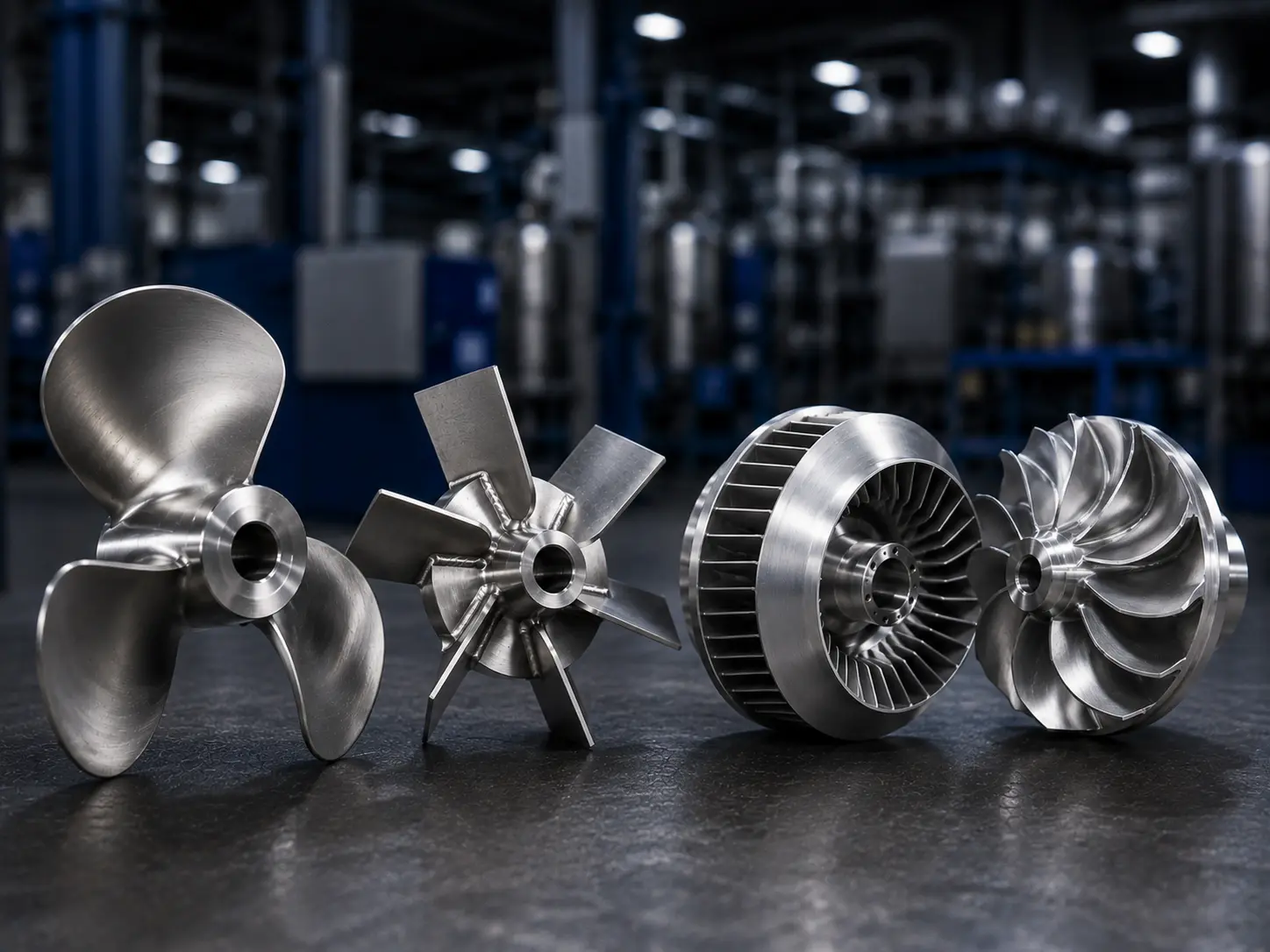
Product-form reference in a workshop setting. The two wheels on the right illustrate different passage and shroud forms; the other components are not a six-type centrifugal fan comparison. This image does not establish alloy, approved rotation, balancing results or fan performance.
How Matson supports custom fan-wheel sourcing
Matson manufactures custom industrial fan and blower impellers from drawings, models, samples and project specifications. Suitable inquiries concern the wheel component, its material and interfaces, dimensional inspection, balancing requirements and repeat-order control. The equipment designer retains responsibility for fan selection, motor/control selection, aerodynamic performance and installed-system acceptance.
For a quotation, start with the custom fan and blower impellers product page and send:
- Controlled 2D drawing and available 3D model, including revision and rotation reference;
- Approved wheel configuration, application and relevant operating-speed information;
- Material grade, temperature, gas exposure and particulate conditions;
- Shaft/inlet interfaces and critical dimensional acceptance requirements;
- Joint, finish, inspection and balancing requirements;
- Sample, pilot or production quantity, plus expected repeat-order needs.
A photo starts the discussion. It does not establish an approved blade profile, alloy, dimensional tolerance or fan-performance guarantee.
Common Questions
How many types of centrifugal fans should a specification list?
A useful overview has three broad orientation families and six common wheel configurations. The backward-oriented family includes flat backward-inclined, backward-curved and airfoil forms; forward-curved, radial blade and radial-tip complete the comparison. This is a practical classification, not a universal catalogue rule. In your specification, list the approved profile and drawing revision rather than requiring a supplier to interpret a fixed number of “types.”
Are backward-inclined and backward-curved wheels interchangeable?
No. The names are related, and backward-inclined sometimes describes a broader family, but a flat inclined blade and a curved blade have different geometry. Matching outside diameter and shaft bore does not prove matching pressure, power or housing behaviour. If a supplier proposes changing between them, obtain the equipment designer’s approval and revised performance and interface requirements before authorising the manufacturing drawing.
Which wheel should be considered for a dust collector?
Determine whether the fan sees filtered air or carries dust directly. Then state normal carryover, particle loading, abrasion, moisture and filter-failure exposure. A clean-side arrangement can have a different shortlist from a material-handling duty, even in the same plant. Ask the fan supplier to check both clean-filter and loaded-filter operating conditions. Do not select a radial wheel solely because the equipment is called a dust collector.
Does an airfoil wheel guarantee the lowest electricity cost?
No. Its profile can support efficient operation in a suitable selection, but energy use must be compared at the required duty and across operating hours and control conditions. Include the selected assembly, drive and electrical-input basis in the comparison. A wheel’s peak efficiency does not describe every operating point, and fouling or incompatible installation can undermine the expected benefit. Request comparable model-specific selection data.
Can changing wheel material make any fan suitable for hot or corrosive air?
No. Material is one part of the review. Blade and joint strength, allowable speed, thermal expansion, clearances, shaft interfaces, coatings and the rest of the fan assembly also matter. Corrosive gas and condensation can affect surfaces and joints differently. Send the actual temperature range and gas exposure to the equipment designer and component supplier, and approve the construction requirements before accepting a material substitution.
What is the minimum information for a custom centrifugal fan-wheel RFQ?
Send the approved drawing or model, blade configuration, rotation reference, hub/bore and inlet interfaces, material grade, quantity, operating conditions and required inspection/balance criteria. If only a sample is available, add photographs and identify wear or previous repairs. State that the inquiry is for the wheel component. Airflow and pressure alone are insufficient for a manufacturing quote because they do not define the geometry or assembly fit.
Final Thoughts
Start with the airstream and duty, compare the appropriate wheel families, then verify the selected fan’s complete operating range. Once that decision is approved, preserve the geometry in a controlled drawing and define material, interfaces, inspection and balancing. Matson can review suitable custom fan-wheel manufacturing requirements; a clear design baseline makes quotations more comparable and prevents a blade-type label from becoming an uncontrolled production assumption.
Send your approved wheel drawing for review
Contact Matson for a custom fan-wheel quotation with your drawing or model, material grade, quantity, operating conditions and inspection requirements. If you have only a sample, include inlet-side and drive-side photographs and mark worn or modified features so the manufacturing review starts from the right evidence.