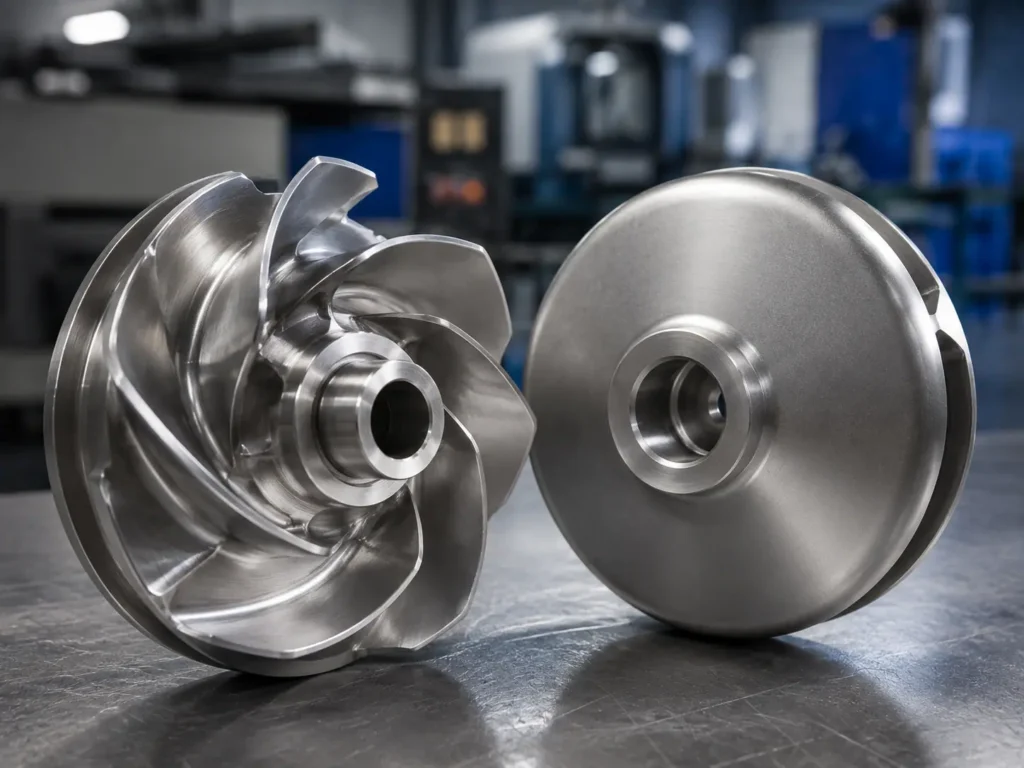
OEM buyers should confirm dynamic balancing requirements before a custom impeller is manufactured, not after the finished part is packed. The key points are the impeller type, operating speed, diameter, mass, balance grade if specified, whether the impeller is balanced alone or as an assembly, what report is needed, and which correction methods are acceptable for the material and application.
Short answer: dynamic balancing for custom impellers is a manufacturing and sourcing control item. A buyer should not simply write “balance required” in an RFQ. The better RFQ says what the impeller is used in, how fast it runs, which drawing or sample controls the geometry, whether ISO 21940 or another project standard is referenced, and whether a balancing report must be supplied with the shipment.
Matson manufactures custom impellers for pumps, fans, blowers, mixers, agitators, compressors, and non-standard industrial equipment. Dynamic balancing can be reviewed as part of impeller manufacturing together with casting, CNC machining, surface treatment, dimensional inspection, material documentation, and export packing when the project requirement is defined.
[Image placeholder: Add a real factory image showing a custom industrial impeller mounted on a dynamic balancing machine with drawing, inspection record, and correction marks visible. Alt text: “Dynamic balancing for custom impellers with inspection report and balancing machine”]
What OEM Buyers Should Confirm First
Dynamic balancing only makes sense when the requirement is connected to the real rotating part. A small low-speed agitator blade, a large pump impeller, a fabricated blower wheel, and a compressor-style impeller do not all need the same conversation.
Start with the operating context. Then confirm whether the drawing already specifies a balance requirement. If the drawing is silent, ask the equipment owner, pump builder, fan OEM, mixer OEM, or engineering team whether a balance grade or report is required.
| Confirmation item | Why it matters | What buyers should send |
|---|---|---|
| Equipment type | A pump, blower, mixer, compressor, and custom rotor can have different balance risk. | Pump, fan, blower, mixer, agitator, compressor, or equipment description. |
| Operating speed | Unbalance force rises quickly with speed, so RPM is not a small detail. | Normal RPM, maximum RPM, VFD range, or speed from the equipment drawing. |
| Diameter and mass | Larger and heavier impellers usually need more careful balance review. | Outside diameter, width, approximate weight, hub size, and material. |
| Balance grade or standard | The manufacturer should not guess the acceptance level. | Specified grade, ISO 21940 reference if used, customer standard, or note that it is unknown. |
| Balancing report | Reports must be planned before production and shipment. | Required report format, data fields, language, drawing number, and batch reference. |
| Assembly condition | Some parts are balanced alone; others must be considered with shaft, hub, coupling, or mounting hardware. | Whether balancing applies to the impeller only or the rotating assembly. |
Static Balance, Dynamic Balance, and Assembly Balance
Buyers often use “balancing” as one broad word. That is where RFQs become risky.
Static balancing checks heavy spots in a simple way and may be suitable for some lower-speed or narrow parts when the project allows it. Dynamic balancing checks the rotating part under a more relevant condition and is often needed for larger, heavier, faster, or wider impellers. Assembly balancing treats the impeller together with related rotating components when the equipment specification requires it.
For many custom industrial impellers, dynamic balancing is the safest topic to raise during quotation. It does not mean every part needs the same grade. It means the buyer and manufacturer should decide the requirement before machining, correction, inspection, and reporting are complete.
ISO 21940 is commonly referenced for balancing terminology and balance quality context. The important word is context. A standard reference does not replace the buyer’s equipment requirement, operating speed, rotor mass, geometry, fixture condition, and acceptance rule.
Which Impellers Need More Careful Balance Review?
The balancing risk changes by impeller type and service condition. This is why a custom impeller supplier should ask about the application instead of quoting from diameter alone.
| Impeller type | Balancing concern | Useful internal reference |
|---|---|---|
| Pump impeller | Bore fit, hub height, wear surfaces, trimmed diameter, vane damage, and service vibration. | pump impeller balancing |
| Fan or blower impeller | Weld distortion, blade spacing, wheel width, RPM, correction weights, and runout. | blower wheel balancing |
| Mixer or agitator impeller | Shaft connection, blade symmetry, welded structure, runout, and process speed. | mixer impeller manufacturer |
| Compressor or blower-type impeller | Higher speed, tight fit, material control, and conservative project review. | custom compressor impeller |
| Non-standard custom impeller | Unknown geometry, sample condition, special mounting, and unclear acceptance rule. | custom industrial impeller |
Pump impellers often need balance review when speed, diameter, mass, clearance, wear history, or buyer documentation makes vibration risk important. Fan and blower wheels often need a deeper balance discussion because wheel diameter, blade geometry, welded construction, and RPM can punish small mass differences. Mixer and agitator impellers vary widely; a slow anchor impeller and a faster dispersion impeller should not be treated the same.
For selected compressor or blower-type impellers, keep the discussion conservative. Matson can review selected OEM projects based on drawing, material, tolerance, and balancing requirements, but high-speed turbomachinery should be handled only when the project evidence supports it.
Why Balancing Must Be Planned Before Production
Balancing is often near the end of the manufacturing route, but the requirement should be known near the beginning.
Casting allowance, CNC machining sequence, keyway machining, surface treatment, coating, passivation, final trimming, and correction method can all affect balance. If the buyer requests a balancing report after shipment, the manufacturer may not be able to reproduce the same test condition, correction record, or acceptance data.
The practical sequence is usually:
- Confirm drawing, sample, material, application, speed, and quantity.
- Decide whether dynamic balancing is required.
- Confirm balance grade, report format, and whether the impeller is balanced alone or as an assembly.
- Finish critical machining such as bore, hub, mounting face, keyway, OD, and fit surfaces.
- Perform final balancing or balance verification according to the agreed requirement.
- Keep the balancing report with dimensional inspection, material certificate, photos, and packing records when required.
For document planning, see Matson’s guide to custom impeller manufacturing documents.
What a Balancing Report Should Clarify
A balancing report should be useful to the buyer’s quality team, not just a generic paper attached to the shipment.
The report may include the part name, drawing number, material or batch reference, balancing machine reference, correction plane, target grade or acceptance rule, residual unbalance data when recorded, date, operator, and inspection note. If the buyer needs a specific format, language, customer code, or batch traceability, that requirement belongs in the RFQ.
Do not assume the manufacturer will automatically include every data field. Some projects only need production confirmation. Some OEM projects need formal documentation. Some distributor projects need reports that can be forwarded to the end customer. The document package should match the project risk and commercial requirement.
Sample-Based Projects Need Extra Caution
Dynamic balancing becomes tricky when the buyer sends only a worn sample.
An old impeller may already be out of balance because of cavitation pitting, abrasive wear, corrosion, broken vane edges, repair welding, bent blades, damaged keyway, enlarged bore, or missing correction weights. If the sample is copied blindly, the new impeller may reproduce a damaged condition rather than the original design.
For sample-based RFQs, send photos of the front, back, side, bore, hub, keyway, vane passages, damaged areas, previous repair marks, and any existing balance weights or correction marks. If a drawing or old inspection report exists, send it too. The drawing should control the intended geometry whenever possible.
Matson’s article on custom impeller from drawing or sample explains how to separate sample evidence from original production requirements.
RFQ Checklist for Dynamic Balancing
Before asking a custom impeller manufacturer for a price, prepare the balancing information together with the normal RFQ data.
Useful RFQ details include:
- 2D drawing, 3D file, or physical sample photos
- Equipment type: pump, fan, blower, mixer, compressor, or custom industrial equipment
- Operating RPM, maximum RPM, or speed range
- Outside diameter, width, bore, hub height, keyway, mounting face, and shaft connection
- Material grade, heat treatment, coating, passivation, or surface-finish requirement
- Whether the impeller is balanced alone or with related rotating hardware
- Balance grade, project standard, or buyer specification if known
- Whether a balancing report is required
- Existing vibration, bearing, seal, noise, cracking, or field-failure history
- Quantity, first batch, repeat order plan, packing requirement, and export destination
For recurring programs, connect the balance requirement with OEM impeller supply. Repeat orders need stable drawing revision, inspection points, balancing records, and packing notes, not only one successful first sample.
Common Questions Buyers Ask
What should OEM buyers confirm for dynamic balancing of custom impellers?
Confirm the impeller type, operating RPM, diameter, mass, drawing revision, balance grade or standard if specified, whether a balancing report is needed, and whether the impeller is balanced alone or as an assembly.
Does every custom impeller need dynamic balancing?
No. The need depends on speed, diameter, mass, geometry, equipment type, vibration risk, and buyer specification. Large, fast, heavy, welded, cast-and-machined, or OEM-documented impellers deserve closer review.
When should balancing be done during manufacturing?
Final balancing is usually tied to the finished condition after critical machining and geometry control. The requirement should still be confirmed before production so the process route and report can be planned.
Can a manufacturer choose the balance grade for me?
A manufacturer can help review the part, but the balance grade should come from the drawing, equipment specification, OEM requirement, or engineering owner. Guessing one grade for every custom impeller is not reliable.
What should I send to Matson for a dynamic balancing RFQ?
Send the drawing or sample photos, equipment type, RPM, dimensions, material grade, quantity, balance grade if known, report requirement, application condition, and any vibration or failure history through the custom impeller quote page.