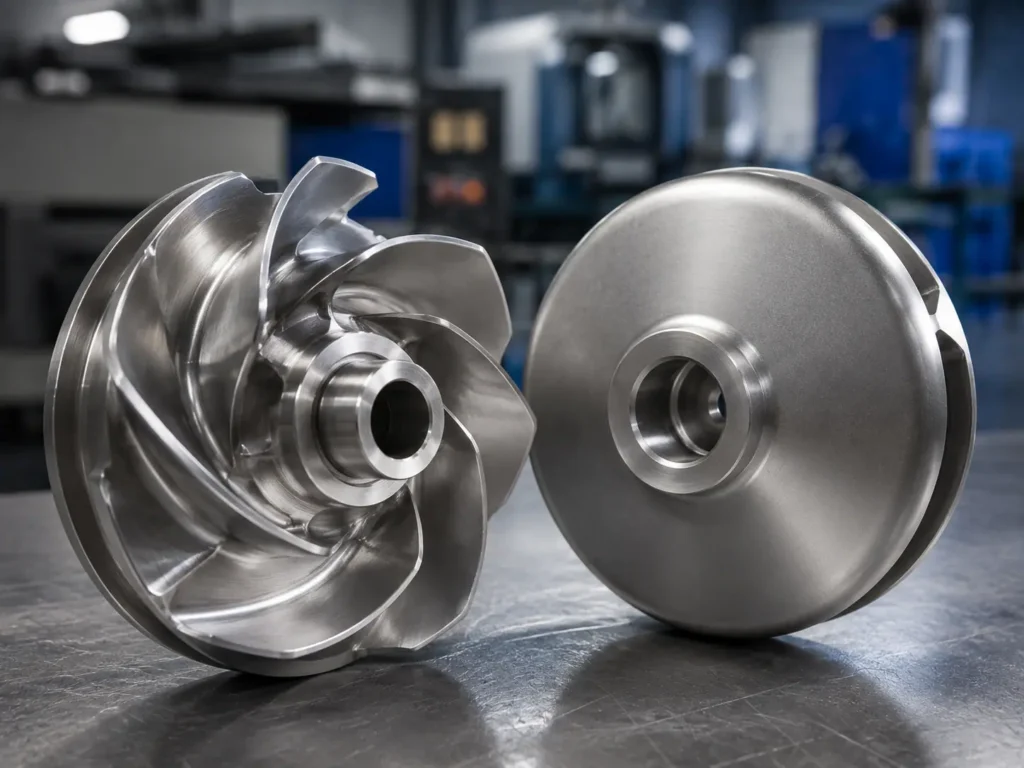
Buyers looking for a custom fan and blower impeller manufacturer China should check more than price, factory size, and delivery time. A reliable RFQ should define the fan or blower type, wheel geometry, drawing or sample condition, material, operating speed, airflow environment, dynamic balancing requirement, inspection documents, and repeat-order plan before the supplier quotes the part.
Short answer: choose a custom fan and blower impeller manufacturer in China by checking whether the supplier can review drawings or samples, understand industrial fan wheel geometry, control blade, hub, bore, weld, and balance details, provide material and inspection records, and support OEM repeat batches. Do not treat a fan or blower impeller as a generic metal wheel.
Matson’s fan and blower impellers page is the main product page for custom fan wheels and blower impellers. This article is a buyer checklist for RFQ preparation and supplier review, especially when the sourcing question is “Can a China supplier manufacture this industrial fan or blower impeller correctly from my drawing or sample?”
[Image placeholder: Add a real factory image showing a custom fan or blower impeller beside a drawing, calipers, balancing report, and inspection tools on a workshop table. Alt text: “Custom fan and blower impeller manufacturer China RFQ checklist with drawing sample and balancing report”]
What Kind of Fan or Blower Impeller Are You Sourcing?
The first sourcing risk is terminology. Buyers may say fan wheel, blower wheel, centrifugal fan impeller, industrial blower impeller, HVAC blower wheel, backward curved impeller, forward curved impeller, radial blade impeller, or airfoil fan impeller. Those phrases are related, but they do not describe the same geometry.
For a manufacturer, the useful question is not just “Can you make a blower impeller?” It is “Can you manufacture this specified wheel to the drawing, speed, material, balance, and inspection requirement?”
| Buyer wording | What the supplier should clarify | Why it matters |
|---|---|---|
| Custom fan impeller | Fan type, wheel diameter, blade form, shaft fit, and casing relationship. | Fan wheels can use very different blade geometry and balance requirements. |
| Custom blower impeller | Centrifugal blower type, inlet width, outlet width, hub, bore, and operating RPM. | Blower wheels often run at speed where balance and weld control matter. |
| Industrial fan wheel | Application, air condition, temperature, dust, corrosion, and material grade. | HVAC, process air, dust collection, and chemical exhaust are not the same duty. |
| Backward or forward curved impeller | Blade direction, blade count, rotation view, inlet side, and drawing reference. | Wrong-hand or wrong-blade geometry can fit the shaft but fail in the fan assembly. |
| Sample-based blower wheel | Whether the sample is bent, worn, repaired, corroded, or missing balance weights. | A damaged sample should not become the production master without review. |
This article is for industrial metal fan and blower impellers. It is not aimed at snow blower parts, leaf blower parts, appliance blower wheels, furnace repair, automotive blower motors, or retail replacement kits.
RFQ Checklist for Fan and Blower Impellers from China
A weak RFQ says, “Please quote this blower wheel,” with one photo and an outside diameter. That is not enough for custom manufacturing.
A useful RFQ should let the manufacturer review fit, material, process route, weld or casting risk, balance, inspection, and packing. Buyers should prepare:
- 2D drawing, 3D file, or physical sample
- Wheel type: backward-curved, forward-curved, radial blade, airfoil, centrifugal blower, HVAC blower, or custom fan wheel
- Outside diameter, wheel width, inlet diameter, outlet width, bore, hub height, keyway, mounting face, bolt pattern, and shaft fit
- Blade count, blade angle, blade profile, rotation direction, and viewing side
- Material grade: carbon steel, stainless steel, aluminum, alloy steel, heat-resistant steel, or buyer-specified material
- Operating speed, motor or blower model, and whether overspeed or proof testing is specified
- Application environment: HVAC, process air, drying, dust collection, combustion air, chemical exhaust, wastewater ventilation, or industrial OEM equipment
- Temperature, dust, moisture, corrosion, chemical vapor, abrasive particles, coating, or surface-treatment needs
- Dynamic balancing grade, balancing report requirement, and whether the wheel is balanced alone or as an assembly
- Quantity, first sample plan, repeat batch forecast, packing, labeling, and export document needs
For broader custom projects, Matson’s guide to custom impeller from drawing or sample explains why worn samples, missing dimensions, and old repair marks should be reviewed before production.
What Makes Fan and Blower Impellers Different from Pump Impellers?
Fan and blower impellers are rotating parts like pump impellers, but the sourcing checks are not identical. A pump impeller RFQ often focuses on liquid condition, solids, corrosion, casing clearance, wear surfaces, and hydraulic fit. A fan or blower impeller RFQ usually puts more pressure on blade form, weld distortion, wheel width, inlet geometry, operating speed, airflow condition, and balance.
That difference matters when comparing suppliers. A shop that can cast a pump impeller may not automatically understand a fabricated fan wheel. A sheet-metal fabricator may understand welding, but still need proper machining, balance, and inspection control for an OEM blower wheel. The buyer should check the full route, not just one process.
Matson manufactures custom fan wheels and blower impellers from drawings, 3D files, samples, and project specifications. Final airflow performance, fan curve, efficiency, motor selection, and noise guarantee should remain with the fan OEM, blower designer, or engineering owner. Matson’s role is manufacturing review: material, fabrication or casting route, CNC machining, dimensional inspection, dynamic balancing, documentation, and export packing.
Supplier Capability Checklist
Before approving a custom fan or blower impeller quote, buyers should ask how the supplier will control the part. “We can make it” is not a process plan.
| Capability | Why it matters for fan and blower impellers | Buyer question |
|---|---|---|
| Drawing and sample review | Blade direction, rotation view, bore, hub, and inlet side can be misread from photos. | Which drawing revision or sample features will control production? |
| Fabrication or casting route | Welded, cast, machined, and combined routes create different tolerance and balance risks. | Which route fits the wheel geometry, material, quantity, and inspection requirement? |
| CNC machining | Bore, hub, keyway, mounting face, and critical fit surfaces often need finish machining. | Which surfaces will be machined and measured? |
| Weld and distortion control | Uneven welds or heat distortion can change runout, blade position, and balance. | How will welding sequence, fixture, runout, and final geometry be checked? |
| Dynamic balancing | Fan and blower wheels can vibrate badly when mass distribution is uneven. | What balance grade, speed, correction method, and report are required? |
| Material and surface treatment | Dust, corrosion, heat, humidity, and chemical exhaust affect material and coating choice. | What material certificate, coating, painting, passivation, or inspection record is needed? |
| Export and repeat supply | OEM buyers need consistent batches, protected machined surfaces, and clear packing labels. | How will approved samples, revision control, packing, and repeat-order records be managed? |
Matson’s impeller manufacturing work can include casting, CNC machining, fabrication review, surface treatment, dimensional inspection, dynamic balancing, material documentation, and export packing when project requirements are defined.
Dynamic Balancing Is Not a Small Detail
For industrial fan and blower impellers, dynamic balancing should be discussed early. A wheel can look correct, fit the shaft, and still create vibration if the mass distribution is wrong. The risk increases with larger diameter, higher speed, welded construction, wide wheels, heavy hubs, repaired samples, or continuous-duty equipment.
ISO 21940-11 is commonly referenced for rigid-rotor balancing terminology and balance quality grades, but the actual requirement should come from the equipment specification, wheel diameter, mass, RPM, service condition, and buyer requirement. Do not assume one balance grade fits every blower wheel.
The buyer should state whether a balancing report is required, whether balancing should be done on the impeller alone or with related mounting hardware, and whether the existing equipment has vibration history. For a deeper checklist, see Matson’s article on blower wheel balancing.
How to Compare a China Supplier Before Ordering
The safest comparison is practical. Do not choose only by the lowest quotation. Ask whether the supplier can explain:
- Which wheel type they understand from the drawing or sample
- Which data is missing before a reliable quote
- Whether the sample has bent blades, old welds, worn bore, missing balance weights, corrosion, or rubbing marks
- Which manufacturing route is quoted
- Which dimensions will be inspected before shipment
- Which material grade and certificate will be supplied
- Whether dynamic balancing is included or quoted separately
- Whether pre-shipment photos, inspection reports, and balancing reports are available
- How the first sample will be approved before repeat production
- How drawing revisions, packing labels, and batch records will be managed
For industrial OEM buyers, distributor programs, and repeat orders, the supplier should also understand change control. A successful first sample is useful, but repeat supply depends on the approved drawing, material record, inspection standard, balance requirement, packing method, and communication process. Matson’s article on OEM impeller supply from China covers repeat-order checks in more detail.
When Matson Is a Good Fit
Matson is a good fit when the buyer needs custom industrial fan and blower impellers made from drawings, 3D files, samples, or project specifications. Good-fit projects include centrifugal blower impellers, industrial fan wheels, HVAC blower wheels, backward-curved wheels, forward-curved wheels, radial blade wheels, airfoil fan impellers, and selected process-air or OEM equipment impellers.
Matson is not a retail source for snow blower wheels, leaf blower parts, appliance blower wheels, furnace repair parts, automotive blower motors, or brand-specific replacement kits. That distinction keeps the article aligned with B2B manufacturing and avoids low-quality traffic.
Common Questions Buyers Ask
How do I choose a custom fan and blower impeller manufacturer in China?
Choose a supplier that can review drawings or samples, understand fan and blower wheel geometry, control material and manufacturing route, machine critical fit surfaces, discuss dynamic balancing, provide inspection documents, and support repeat OEM orders.
What should I send for a custom fan or blower impeller RFQ?
Send the drawing or sample, wheel type, blade geometry, diameter, width, bore, hub, material, RPM, airflow environment, balance requirement, report requirement, quantity, and photos of worn or damaged areas.
Can a blower impeller be manufactured from only a sample?
Sometimes, but the sample must be reviewed carefully. Bent blades, old welds, worn bores, corrosion, missing balance weights, and rubbing marks should be identified before the sample is used as the production reference.
Is dynamic balancing required for every fan wheel?
Not every small or low-speed fan wheel needs the same balancing requirement, but industrial fan and blower impellers should always have balancing reviewed. Diameter, speed, mass, width, welding, and service condition decide the final requirement.
What is the difference between a fan impeller supplier and a manufacturer?
A supplier may source or trade the part. A manufacturer should be able to discuss drawing review, production route, machining, welding or casting control, inspection, balancing, documentation, and repeat-batch consistency.
Need a custom fan or blower impeller manufactured from a drawing or sample? Send Matson the wheel drawing, sample photos, blade type, material grade, operating speed, application environment, balance requirement, inspection needs, quantity, and repeat-order plan through the custom impeller quote page. We can review manufacturing, machining, material, inspection, balancing, and documentation requirements before quoting.