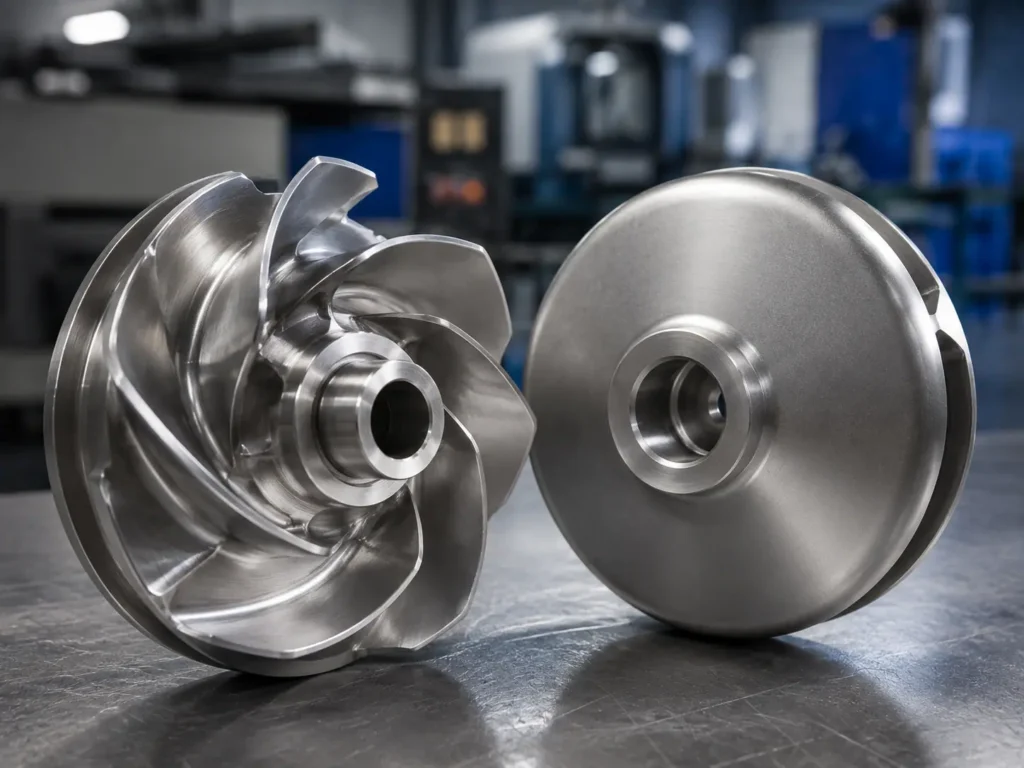
Slurry pump impeller design is the review of impeller type, vane geometry, passage size, wear allowance, material, clearances, balancing, and manufacturing route for pumps handling abrasive solids. In mining, tailings, mineral processing, dredging, and other abrasive media, a slurry impeller has to move liquid and solids while resisting wear, impact, corrosion, vibration, and clogging risk.
Short answer: slurry pump impeller design should start from the slurry condition, not from the impeller drawing alone. Buyers should confirm solids content, particle size, particle hardness, pump speed, flow, head, material, expected wear pattern, casting route, machining interfaces, and balancing requirement before ordering a custom slurry pump impeller.
Matson manufactures custom pump impellers from drawings, samples, and specifications. For a slurry pump impeller used in mining or abrasive media, Matson can review manufacturing feasibility, material, casting, CNC machining, inspection, and balancing factors. Final hydraulic design and pump performance targets should remain with the pump OEM or engineering owner.
Slurry Impeller Design Starts With the Media
Clean water pump logic does not transfer directly to slurry service. Slurry carries solid particles through the pump. Those particles hit, slide, bounce, settle, and concentrate in different areas of the impeller and casing.
That is why the first design question is not only “closed, open, or semi-open?” It is: what exactly is the pump moving?
For a mining project, the buyer should identify the solids concentration, particle size range, particle hardness, slurry density, pH, chloride or chemical condition, operating temperature, and whether the flow is steady or intermittent. Large sharp particles, fine abrasive sand, tailings, and corrosive slurry do not damage an impeller in the same way.
If the existing impeller failed early, the wear pattern matters. Uniform thinning, localized groove wear, cracked vanes, enlarged clearances, cavitation-like pitting, and corrosion-assisted wear all point to different review questions.
Design Considerations Buyers Should Check
Use this table as a practical engineering review checklist before quoting a custom slurry pump impeller. It is not a replacement for pump hydraulic design, but it helps buyers send the right information to the manufacturer.
| Design consideration | Why it matters in slurry service | What buyers should confirm |
|---|---|---|
| Solids condition | Particle size, hardness, and concentration drive wear rate and passage requirements. | Solids percentage, particle size distribution, particle hardness, slurry density, and whether solids settle. |
| Impeller type | Closed, open, semi-open, recessed, and slurry-style designs handle solids and wear differently. | Pump casing type, cleanout needs, clogging risk, efficiency target, and existing design. |
| Vane geometry | Vane count, angle, thickness, and passage width affect flow, wear concentration, and casting complexity. | Vane count, rotation direction, inlet eye, outlet width, blade thickness, and worn areas. |
| Wear allowance | Abrasive media can remove material from vanes, shrouds, and clearance surfaces. | Target service life, previous failure interval, wall thickness, wear ring surfaces, and replaceable wear parts. |
| Material | Hardness, toughness, corrosion resistance, and casting behavior affect actual service life. | Specified grade, high-chrome or alloy requirement, slurry chemistry, impact risk, and certificates. |
| Clearances and fit | Wrong clearance can reduce efficiency, increase recirculation, or accelerate wear. | Bore, hub height, mounting face, keyway, wear ring, casing clearance, and shaft fit. |
| Manufacturing route | Thick sections, hard alloys, and complex passages affect casting, machining, and inspection. | Casting method, machining allowance, inspection points, surface finish, heat treatment, and tolerance needs. |
| Balancing | Heavy slurry impellers and uneven wear can create vibration and bearing load. | Operating speed, diameter, mass, balancing grade, and report requirement. |
Impeller Type Is Only the First Filter
Slurry pumps may use open, semi-open, closed, recessed, or purpose-built slurry impeller forms. The right choice depends on the pump casing, solids, efficiency target, clogging risk, and maintenance approach.
An open or semi-open impeller can make inspection and cleaning easier, but clearances become important. A closed impeller may improve efficiency in some conditions, but internal passage wear can be harder to see. A recessed or vortex-style design may reduce direct contact with some solids, but it is not automatically the best answer for every abrasive duty.
For general type comparison, Matson’s pump impeller types guide is the broader starting point. This article is narrower: it looks at slurry design decisions after the buyer already knows the pump is handling abrasive media.
Vane Geometry and Passage Size
In slurry service, vane geometry is not only about efficiency. It also affects how solids move through the impeller and where wear concentrates.
Buyers should review vane count, vane thickness, inlet eye size, outlet width, shroud shape, rotation direction, and passage width. If the passage is too narrow for the solids, clogging and local wear become more likely. If the geometry is copied from a worn sample, the original vane edge, blade profile, and passage size may already be lost.
For custom manufacturing, the safest RFQ includes a drawing. If the buyer only has a sample, take photos from the inlet, outlet, front, back, side, bore, and worn areas. Mark rotation direction and measure bore, hub height, mounting face, outside diameter, inlet eye, outlet width, and critical clearance surfaces.
Wear Allowance and Failure Pattern
Slurry impeller design should include wear thinking from the start. This does not mean making every section as thick as possible. Extra material can affect weight, balance, casting quality, machining, and pump performance.
The better question is where the impeller actually wears.
If the front shroud wears first, check suction-side conditions and recirculation. If vane tips wear quickly, review clearance, solids velocity, and casing relationship. If the back side shows damage, check back clearance and leakage paths. If the impeller cracks, impact, casting section change, material toughness, or previous repair history may be involved.
When the current impeller has failed, buyers should send photos of the worn areas instead of only asking for the same part again. Repeat manufacturing is much safer when the factory knows which surfaces are functional, which surfaces are worn, and which dimensions should not be copied from the damaged sample.
Material and Design Work Together
Material selection is part of slurry pump impeller design, but it should not take over the whole discussion.
High-chrome white iron is often discussed for abrasive mining slurry. ASTM A532 may be referenced when high-chromium abrasion-resistant cast iron grades are specified. Duplex stainless, stainless steel, alloy steel, or other cast materials may be discussed when corrosion, impact, machinability, or buyer specifications require a different route.
The design still has to match the material. Hard materials can be difficult to machine after casting. Thin sections may be risky in some casting routes. Thick sections can create feeding, shrinkage, weight, and balance questions. If the drawing requires tight bore, hub, keyway, or wear-ring surfaces, the casting and machining plan should be checked before price is confirmed.
For deeper material detail, use the article on slurry pump impeller material.
Casting, Machining, and Inspection Review
A slurry impeller may look like one part, but manufacturing it usually involves several decisions: casting route, tooling or pattern review, heat treatment if required, machining allowance, CNC finishing, dimensional inspection, surface finishing, and balancing.
Complex vane passages and thick wear sections can make casting more difficult. Hard alloys can make machining slower. Critical fit areas such as the bore, hub, mounting face, keyway, wear ring, and shaft interface must still be controlled even when the impeller body is heavy and wear-focused.
Matson’s impeller manufacturing capability covers casting, CNC machining, surface treatment, dynamic balancing, dimensional inspection, and export packing when the project requirements are defined. If the project is drawing-based or sample-based, include inspection points in the RFQ instead of leaving them until after production.
For casting-specific details, see pump impeller casting.
Balancing and Vibration Risk
Slurry impellers can be heavy, and slurry wear is rarely perfectly even. That makes balancing important for many projects.
A new impeller should be reviewed against operating speed, diameter, mass, pump duty, and the buyer’s balancing requirement. ISO 21940-11 is a common reference for rigid-rotor balancing terminology and grades when a project specifies a balancing class. The actual balancing target should come from the drawing, pump data, and buyer specification.
If the old impeller shows uneven wear, vibration, cracked vanes, or repeated bearing and seal problems, send that information with the quote request. The root cause may be material, flow, operation, alignment, cavitation, or balance, and a new casting alone may not solve it.
For a deeper explanation, see pump impeller balancing.
What Buyers Should Send for a Slurry Impeller Design Review
A useful RFQ for slurry pump impeller design review should include:
- 2D drawing, 3D file, or physical sample
- Clear photos of the front, back, side, bore, vanes, inlet eye, outlet, and worn areas
- Pump application: mining, tailings, mineral processing, dredging, sludge, or other slurry service
- Flow, head, pump speed, and duty point if available
- Slurry concentration, particle size, particle hardness, and slurry density
- Liquid chemistry, pH, chloride, temperature, and corrosion condition
- Existing material grade or required material standard
- Outside diameter, bore, hub height, keyway, mounting face, and clearance dimensions
- Vane count, rotation direction, passage width, and shroud details
- Current failure interval or expected service life
- Casting, CNC machining, inspection, and balancing requirements
- Quantity, batch plan, and export packing requirement
If the project is a repeat order from an approved drawing, say that clearly. If the project is a redesign because the current impeller wears too quickly, say that too. Those two RFQs should not be treated the same way.
Common Questions We Actually Get
What is slurry pump impeller design?
Slurry pump impeller design is the review of impeller type, vane geometry, passage size, wear allowance, material, clearances, manufacturing route, and balancing for pumps that handle abrasive solids.
What design factors matter most for abrasive slurry?
The most important factors are solids condition, particle size, particle hardness, impeller type, vane geometry, wear pattern, material, clearances, casting feasibility, machining interfaces, and balancing requirement.
Can a manufacturer redesign a slurry pump impeller for longer wear life?
A manufacturer can review manufacturing, material, wear, casting, machining, and balancing factors. Full hydraulic redesign should be controlled by the pump OEM or engineering owner because performance depends on the pump casing, speed, duty point, and system condition.
What information should I send for a custom slurry pump impeller quote?
Send the drawing or sample, pump application, slurry condition, solids data, material grade, dimensions, speed, quantity, worn-area photos, and any inspection or balancing requirement.
Can Matson manufacture slurry pump impellers from worn samples?
Yes, Matson can review worn samples and photos for custom manufacturing. The buyer should identify worn surfaces clearly because copying a damaged sample without checking original dimensions can create fit, clearance, or performance problems.
Send Us Your Drawing
Need a manufacturing review for a slurry pump impeller design? Send Matson your drawing, sample photos, slurry condition, material grade, worn-area photos, pump speed, quantity, and balancing requirement through the contact page. We can review material, casting, machining, inspection, and balancing factors before quoting.