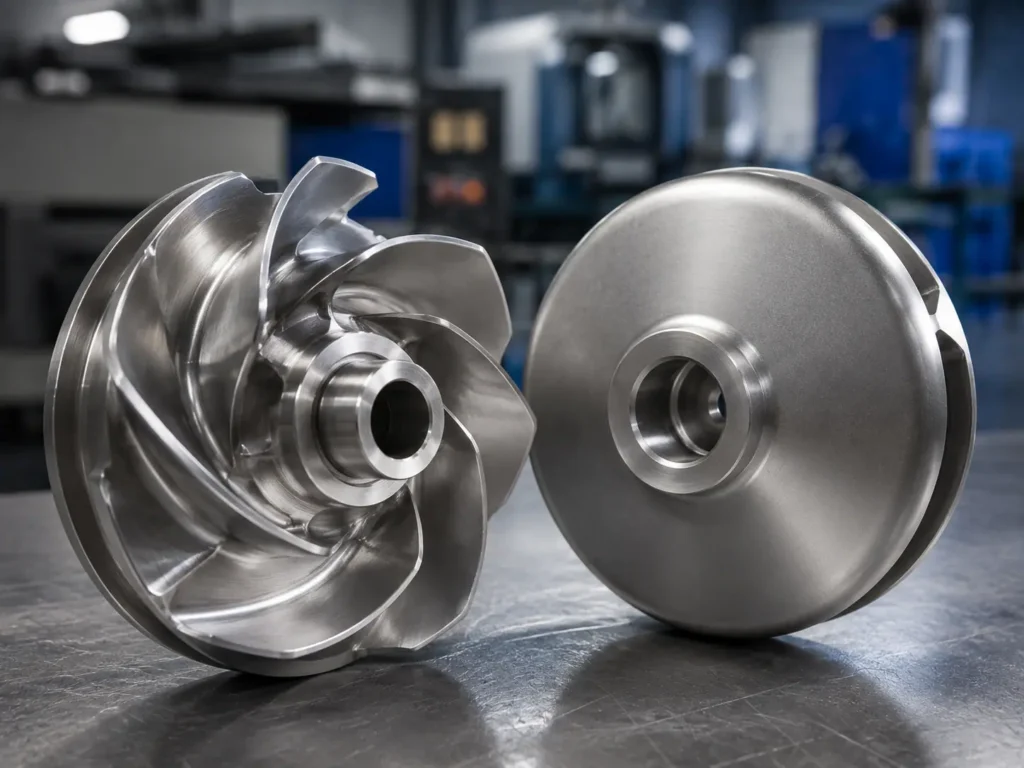
Pump impeller casting is the manufacturing route used when an impeller shape is better produced as a cast blank before CNC finish machining, inspection, surface treatment, and balancing. For industrial pump buyers, the important question is not only “can it be cast?” The better question is which casting method, machining allowance, material, and quality checks fit the drawing and working condition.
Short answer: investment casting is often useful for smaller or more detailed pump impellers, while sand casting is often used for larger or simpler geometries. CNC finish machining is still needed for the bore, hub, mounting face, key dimensions, and other critical interfaces. Final choice depends on drawing, material, size, tolerance, quantity, and application.
Matson manufactures custom pump impellers from drawings, 3D files, samples, and project specifications. For a custom pump impeller, casting should be reviewed together with machining, material, balancing, inspection, and export packing rather than treated as a standalone process.
When Casting Makes Sense for Pump Impellers
Many pump impellers have curved vanes, hub geometry, shrouds, and internal flow passages that are not economical to machine completely from solid stock. Casting creates the near-net shape first. Machining then controls the dimensions that must fit the shaft, casing, and pump assembly.
Casting is often considered when:
- The impeller has curved or complex vane geometry
- The part has a closed, semi-open, vortex, mixed-flow, or slurry-style shape
- The material is suitable for casting
- Quantity supports tooling or pattern work
- The drawing allows practical machining allowance
- The buyer needs repeated batches from the same geometry
For one-off prototype work, casting may still make sense, but tooling, lead time, and sample validation should be discussed before quoting. For some simple shapes, CNC machining or another route may be more practical.
Investment Casting vs Sand Casting
Investment casting and sand casting can both produce pump impellers. They are not interchangeable choices. The right route depends on size, geometry, surface expectation, material, quantity, and post-casting machining.
| Casting route | Good fit | Buyer benefit | What to confirm before quoting |
|---|---|---|---|
| Investment casting | Smaller or more detailed impellers, stainless steel parts, finer geometry. | Better detail control and smoother cast surface than many sand casting routes. | Part size, material grade, wall thickness, tooling, machining allowance, quantity. |
| Sand casting | Larger pump impellers, heavier sections, simpler or larger geometries. | Practical route for large cast impellers and lower tooling complexity in many cases. | Pattern, casting tolerance, section thickness, machining allowance, surface requirement. |
| Cast blank plus CNC finish machining | Most industrial cast pump impeller projects. | Combines near-net casting with controlled bore, hub, mounting face, and key dimensions. | Machining datum, tolerance, balance requirement, inspection points, drawing revision. |
If a buyer only asks for “cast impeller price,” the quotation will be weak. A useful quote needs the drawing, material, size, tolerance, quantity, and finishing requirement.
Why CNC Finish Machining Still Matters
A cast pump impeller is not normally finished straight from the mold.
Critical areas usually need machining: bore, hub height, mounting face, keyway, shaft fit, sealing surfaces, OD, and sometimes vane edges or other functional surfaces. The casting route creates the shape. CNC finish machining makes the part fit the pump.
This is where many RFQs go wrong. A buyer may send a photo of an old impeller and ask for a casting quote, but the photo does not show:
- Bore size
- Hub height
- Mounting face flatness
- Keyway detail
- Critical clearance
- Machining datum
- Balance requirement
- Original vane thickness if the part is worn
For this reason, pump impeller casting should be planned as casting plus machining plus inspection. Matson’s impeller manufacturing capability page covers casting, CNC machining, surface treatment, dynamic balancing, and inspection as one production route.
Material Choice and Casting Route
Material selection affects the casting route. Stainless steel, duplex stainless, bronze, carbon steel, alloy steel, and high-chrome or hard alloy materials do not behave the same during casting, machining, surface treatment, or balancing.
For clean water or mild service, stainless steel or bronze may be practical. For chemical liquid, 316L, duplex, or another corrosion-resistant material may be discussed. For slurry and mining service, high-chrome or hard alloy materials may become more relevant.
Material choice should be confirmed against the liquid, temperature, solids, corrosion, and service life target. The article on pump impeller material selection is a useful companion before finalizing a casting RFQ.
One practical point: a material that looks good for corrosion may not be easy to machine after casting. A material that resists wear may create limits on finishing details. That is why material, casting, and machining should be reviewed together.
Common Casting Problems Buyers Should Prevent
Most casting problems are easier to prevent before production than to fix afterward.
Common risks include:
- Missing machining allowance
- Wrong or unclear datum reference
- Worn sample copied without restoring original geometry
- Material grade not confirmed
- Wall thickness too thin for the casting route
- Vane passages difficult to clean or inspect
- Surface finish expectation not matched to casting method
- Balance requirement added after production
- Quantity too small for the tooling route selected
The most dangerous RFQ is a single photo with “same as this.” It may be enough for first discussion, but not for final production. A worn sample can hide the original vane profile, bore, clearance, or wall thickness.
Casting for Different Pump Impeller Types
Different pump impeller types create different manufacturing questions.
A closed pump impeller may need careful review of shrouds, internal passages, bore, and balance. An open impeller may be easier to inspect but still needs vane geometry and mounting surfaces controlled. A semi-open impeller needs one-side clearance and machined interfaces checked. A vortex impeller may need solids-handling geometry and material review. A slurry pump impeller may bring wear-resistant material and section thickness into the discussion.
The casting route should follow the drawing and application, not the name of the impeller alone.
Inspection and Balancing After Casting
After casting and CNC machining, the impeller still needs inspection. Depending on the project, this can include dimensional checks, material verification, surface review, and balancing.
Balancing deserves early discussion. A cast impeller with uneven material distribution, heavy sections, or high-speed service may need dynamic balancing before shipment. If the buyer needs a report, that requirement should be stated in the RFQ.
For more detail, see the article on pump impeller balancing.
What to Send for a Pump Impeller Casting RFQ
For a faster and cleaner quote, send:
- 2D drawing or 3D file
- Physical sample or clear photos if no drawing exists
- Material grade or operating liquid
- Outside diameter, bore, hub height, and key mounting dimensions
- Impeller type and pump application
- Quantity, pilot run, or annual batch plan
- Surface finish requirement
- CNC machining tolerance requirements
- Dynamic balancing requirement
- Inspection, material certificate, or report requirement
- Photos of worn or failed parts if this is a replacement project
If you do not know the best casting route, say so. A good manufacturing review should compare investment casting, sand casting, machining allowance, and inspection needs before locking the quotation.
Manufacturing Review Before Production
Pump impeller casting is not just foundry work. It is a full manufacturing route: casting, heat treatment when required, CNC finish machining, surface finishing, inspection, balancing, and export packing.
For industrial pump OEMs, distributors, and equipment builders, the best result comes when the drawing, material, quantity, and documentation requirements are clear before production begins.
If the part is a normal pump impeller, the main product page is the right commercial destination. If the project involves unusual geometry, sample reproduction, or non-standard equipment, Matson can also review it as a drawing-based custom impeller project.
Send drawings, material requirements, sample photos, and batch details through the contact page for a practical manufacturing review.
Common Questions We Actually Get
What is pump impeller casting?
Pump impeller casting is the process of producing an impeller blank by casting, then finishing critical dimensions through CNC machining, inspection, surface treatment, and balancing when required.
Is investment casting or sand casting better for pump impellers?
Neither is always better. Investment casting often fits smaller or more detailed parts, while sand casting often fits larger or heavier impellers. The choice depends on size, material, geometry, tolerance, and quantity.
Does a cast pump impeller still need CNC machining?
Yes, in most industrial projects. Bore, hub, mounting face, keyway, sealing surfaces, OD, and other critical dimensions often need CNC finish machining after casting.
Can Matson cast pump impellers from a sample?
Matson can review physical samples and photos, but a worn sample should be measured carefully. If the original dimensions are hidden by wear, a drawing or confirmed dimensions are needed for safer production.
Should balancing be included in a pump impeller casting quote?
If the pump speed, diameter, mass, or buyer specification requires it, balancing should be discussed before production. Add the balancing requirement and report format to the RFQ when needed.
Send Us Your Drawing
Need a cast and CNC machined pump impeller from a drawing or sample? Send Matson your drawing, material grade, quantity, pump application, machining tolerance, and balancing requirement. We can review whether investment casting, sand casting, and CNC finish machining fit the project before quoting.