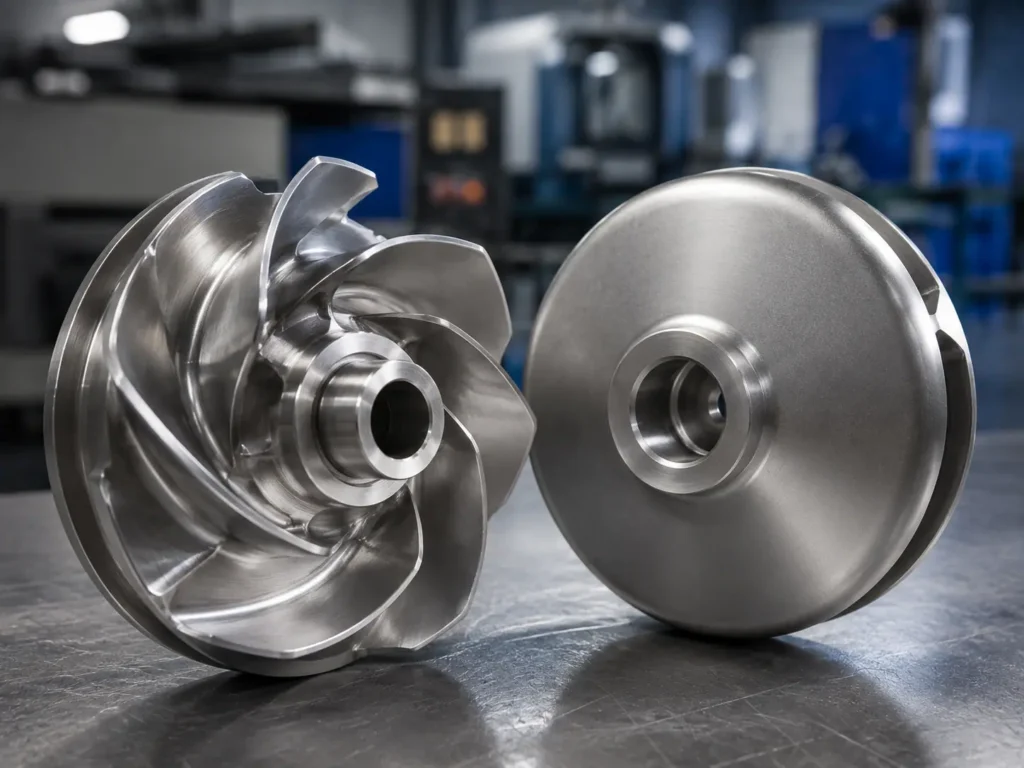
Impeller heat treatment requirements should define the material grade and starting condition, applicable specification, treatment type, process sequence, required properties, distortion controls, test method, sampling, traceability, and report scope. There is no universal heat-treatment cycle for every impeller.
The correct route depends on whether the impeller is cast, fabricated, forged, or machined from stock; its alloy and section thickness; welding history; final dimensions; coating; balance requirement; and operating duty. The approved drawing or purchase specification must control the final material condition. Furnace settings and acceptance limits should come from the applicable material specification or qualified process, not from a generic temperature chart.
Matson can review heat-treatment requirements as part of suitable custom impeller manufacturing projects. The exact process route, supplier capability, inspection plan, and records should be confirmed for each drawing and material before quotation.
[Image placeholder: Add a real factory quality image showing cast impellers before and after heat treatment with furnace batch records, hardness test locations, and finish-machined surfaces marked. Alt text: “Impeller heat treatment requirements with batch records and hardness inspection”]
Start With the Required Final Material Condition
An RFQ that says only “heat treat after casting” is incomplete. It does not identify why treatment is needed, which specification applies, what final condition is required, or how the result will be accepted.
The drawing should state the exact material designation and condition. For example, a cast stainless steel, duplex stainless steel, carbon steel, alloy steel, bronze, aluminum, or wear-resistant alloy can require a very different route. Even two grades in the same material family may have different solution treatment, aging, tempering, stress-relief, cooling, hardness, or testing requirements.
Heat treatment should support an approved engineering purpose, such as:
- Developing the mechanical properties required by the material specification
- Controlling hardness or wear response
- Reducing residual stress before precision machining
- Restoring or controlling material condition after welding
- Improving microstructural uniformity where the specification requires it
- Preparing the component for subsequent machining or surface treatment
Material selection remains a separate decision. Buyers who are still choosing an alloy should first review the pump impeller material selection guide. Heat treatment cannot make an unsuitable base alloy correct for every corrosive, abrasive, high-temperature, or high-stress application.
Match the Treatment to the Material and Manufacturing Route
Different treatment names describe different objectives. The following table is an RFQ framework, not a substitute for the governing material specification.
| Treatment or condition | Typical manufacturing purpose | Main buyer inputs | Important control risk |
|---|---|---|---|
| Stress relief | Reduce residual stress after casting, welding, or rough machining before critical finishing | Material, previous processes, critical dimensions, sequence, approved procedure | An unsuitable cycle can change properties, scale the surface, or distort the part |
| Solution treatment | Establish the specified solution-treated condition for applicable stainless, duplex, aluminum, or other alloys | Exact grade, product form, specification, section thickness, cooling method, acceptance tests | Temperature uniformity and cooling can affect properties, corrosion behavior, and distortion |
| Aging or precipitation hardening | Develop the required strength or hardness in applicable age-hardenable alloys | Starting condition, required final condition, qualified cycle, hardness or mechanical-property limits | Underaging, overaging, mixed starting condition, or repeated cycles can change results |
| Quench and temper | Develop specified strength, toughness, or hardness in applicable steels | Steel grade, section size, required properties, quench method, temper condition, test plan | Cracking, uneven hardness, decarburization, and distortion require process control |
| Annealing or normalizing | Modify hardness, machinability, grain structure, or condition for applicable alloys and routes | Exact material, purpose, specification, prior history, subsequent treatment | A generic callout may conflict with the final property requirement |
| Post-weld heat treatment | Meet an approved welded-assembly procedure or control residual stress and properties where applicable | Base and filler materials, weld procedure, thickness, service code, final dimensions | Not every alloy or assembly should receive the same post-weld treatment |
If the buyer permits more than one route, the drawing should still define one common final acceptance condition. A supplier should not choose between materially different conditions only on the basis of cost or furnace availability.
Cast, Fabricated, and Machined Impellers Need Different Planning
For a cast impeller, heat treatment can occur after shakeout and initial cleaning, after preliminary inspection, or at another defined stage in the foundry route. The plan should consider casting section changes, hub mass, shrouds, blade geometry, feeders that have been removed, casting repairs, and the possibility of distortion during heating and cooling.
For a fabricated impeller, blades, hub, backplate, shroud, and reinforcement may begin with different material heats or product forms. Welding creates local heat input, shrinkage, and residual stress. The buyer should provide or approve the welding and post-weld requirements instead of applying a casting note to the entire assembly.
For an impeller machined from billet, bar, plate, or forging, the raw stock may already be supplied in its final heat-treated condition. A later stress-relief step may be considered if heavy stock removal could release residual stress, but it must not invalidate the certified material condition.
Sample-based projects need extra caution. A worn impeller may have an unknown heat-treatment history, repair welds, hard-facing, coatings, sleeves, or local property changes from service. Copying its hardness at one point does not establish a complete production treatment.
Put Heat Treatment in the Correct Machining Sequence
Heat treatment and machining affect each other. Heavy rough machining can release stress. Heat treatment can create scale, oxidation, dimensional movement, or loss of previously finished stock. Final machining too early can therefore create avoidable scrap.
A common controlled sequence may include:
- Produce and identify the casting, fabrication, forging, or raw stock.
- Complete preliminary cleaning and any required pre-treatment inspection.
- Rough-machine datum or reference surfaces when the approved route needs them.
- Perform the specified heat treatment with batch traceability.
- Clean the surface and inspect for distortion, cracking, or other required conditions.
- Re-establish datums and finish-machine critical features.
- Complete final dimensional, runout, surface, and balance checks.
This sequence is not mandatory for every alloy. Some parts require intermediate treatment, multiple treatment stages, machining before aging, treatment after welding, or testing at another point. The route should be frozen during first-article approval.
The impeller machining allowance guide explains why stock must be assigned by feature and process stage rather than by one universal value.
Control Distortion Before It Reaches Final Inspection
Impellers are vulnerable to heat-treatment distortion because their geometry is rarely uniform. A thick hub, thin vanes, open passages, unequal shroud sections, weld seams, and asymmetric stock can heat and cool at different rates.
The manufacturing plan should identify:
- Critical bore, hub, mounting face, wear-ring, seal, and coupling interfaces
- Radial and face runout datums
- Vane, shroud, and passage geometry that cannot be corrected by simple machining
- Areas requiring support or approved fixturing
- Stock reserved for post-treatment finish machining
- Permitted straightening or dimensional recovery methods
- Reinspection and re-treatment rules after correction
Leaving more stock everywhere is not a complete distortion strategy. Excess stock can create its own thermal imbalance, hide casting conditions, increase machining time, and make passage geometry harder to recover. Stock, support, heating, cooling, and inspection should be planned together.
Define Surface Protection and Furnace Controls
The required furnace environment depends on material, specification, surface condition, and later processing. Buyers may need to define or approve controls for oxidation, scaling, decarburization, contamination, support contact, quench media, cooling, and post-treatment cleaning.
Machined sealing surfaces and small internal passages can be especially sensitive to scale or damage. If a part will later be passivated, electropolished, painted, plated, or coated, the route must leave a suitable substrate.
Matson’s impeller manufacturing capabilities cover suitable casting, CNC machining, surface treatment, dimensional inspection, dynamic balancing, documentation, and export packing. Project-specific heat-treatment scope and any qualified external processing should be confirmed during technical review.
Hardness Is Useful but Does Not Prove Everything
Hardness testing is often a practical part of heat-treatment acceptance. It can help confirm a required condition, compare a batch, or identify an unexpected soft or hard result. The drawing should identify the scale, limits, location, surface preparation, number of readings, sampling frequency, and report format.
Hardness alone does not prove:
- Exact alloy chemistry
- Complete mechanical properties
- Toughness or fatigue performance
- Corrosion resistance
- Microstructure throughout every section
- Correct thermal history
- Absence of local overheating or repair
Other projects may require linked test coupons, tensile or impact results, chemistry, ferrite measurement, microstructure review, nondestructive examination, or other tests required by the material specification. The production part, coupon, batch, and report must remain traceably connected.
The impeller material verification guide explains how certificates, heat and batch identity, PMI, laboratory testing, hardness, marking, and sampling work together.
Repair Welding Can Change the Approved Route
A casting repair or fabricated-assembly weld may introduce a new thermal cycle after the original treatment. The engineering owner should define when repair welding is permitted, which weld procedure and filler apply, whether repeat heat treatment is required, and which inspections must be repeated.
Important questions include:
- Was the repair performed before or after final heat treatment?
- Does the grade require solution treatment, stress relief, tempering, or another controlled step after welding?
- Can another cycle change hardness, strength, corrosion behavior, or dimensions?
- Must the repaired zone receive penetrant, radiographic, ultrasonic, hardness, or other examination?
- Does the repair trigger dimensional reinspection and dynamic rebalance?
Undocumented local heating, flame straightening, hard-facing, or weld buildup can make a valid heat-treatment record incomplete. These operations should be controlled through the same traveler and deviation process as the original route.
Inspect After the Final Property-Changing Step
Final acceptance should occur after the last process that can materially change dimensions, properties, surface condition, or balance. Depending on the project, the inspection package can include:
- Heat-treatment batch or furnace record
- Part, heat, lot, and traveler traceability
- Time and temperature record or certificate when required
- Furnace calibration or qualification references when specified
- Hardness or mechanical test results
- Nondestructive examination after treatment
- Dimensional and runout inspection after final machining
- Surface-treatment records
- Dynamic balancing data
- Approved deviations, repair history, and final disposition
Balancing before a distortion-producing treatment cannot automatically serve as final balance acceptance. Likewise, a dimensional report made before treatment does not prove the finished bore, face, runout, shrouds, or interfaces remain within requirement.
Freeze the Route During First-Article Approval
The first article should prove that the proposed material, heat treatment, machining sequence, inspection methods, and records can produce an acceptable impeller. The approval package should identify the route used, not only the final dimensions.
Repeat orders should control changes to the raw-material condition, casting source, weld procedure, furnace source, cycle, loading method, quench or cooling method, machining sequence, straightening, testing, and sampling. A new supplier or different starting condition may require buyer review even if the nominal alloy name remains unchanged.
The goal is repeatability. A single acceptable hardness reading on the first part is not enough if later batches can use an uncontrolled route.
Impeller Heat Treatment RFQ Checklist
Send the following before quotation:
- Controlled 2D drawing and available 3D model
- Exact material grade, product form, and starting condition
- Governing material and heat-treatment specification
- Required final condition and engineering purpose
- Applicable casting, welding, and repair procedures
- Required process sequence before and after treatment
- Critical dimensions, datums, runout, and distortion limits
- Permitted straightening, correction, and re-treatment rules
- Furnace, atmosphere, loading, cooling, or quench controls where specified
- Hardness, mechanical, microstructure, or other acceptance tests
- Test location, method, sampling, and acceptance limits
- Heat, lot, batch, and part-level traceability
- Certificate, chart, inspection, and record-retention requirements
- First-article approval and repeat-order change-control rules
- Surface treatment, balancing, quantity, annual volume, and packing needs
This information lets the supplier evaluate process availability, furnace capacity, fixturing, stock allowance, inspection access, subcontracted operations, lead time, and documentation before production begins.
Common Questions Buyers Ask
Does every metal impeller require heat treatment?
No. The need depends on the exact material, supplied condition, casting or fabrication route, welding, required properties, dimensions, and governing specification.
What heat treatment should be used for a cast impeller?
There is no single cast-impeller cycle. The exact alloy, casting specification, section thickness, repair history, required properties, and final service condition must define the route.
Should heat treatment happen before or after machining?
It depends on the material and approved route. Many projects reserve finish machining for after the main distortion-producing treatment, while others require rough machining, intermediate treatment, aging, or multiple stages.
Is hardness testing enough to confirm heat treatment?
Not always. Hardness can support acceptance, but some specifications also require traceable furnace records, linked coupons, mechanical tests, chemistry, microstructure, nondestructive examination, or dimensional reinspection.
Can Matson review impeller heat treatment requirements?
Yes, for suitable custom manufacturing projects. Matson can review the drawing, material condition, process sequence, inspection, traceability, and document needs, while exact treatment capability and any qualified external processing are confirmed for the project.
Need an impeller heat-treatment route reviewed for custom manufacturing? Send the drawing, material grade and condition, specification, welding history, required properties, critical dimensions, test plan, quantity, and document scope through the custom impeller quote page.