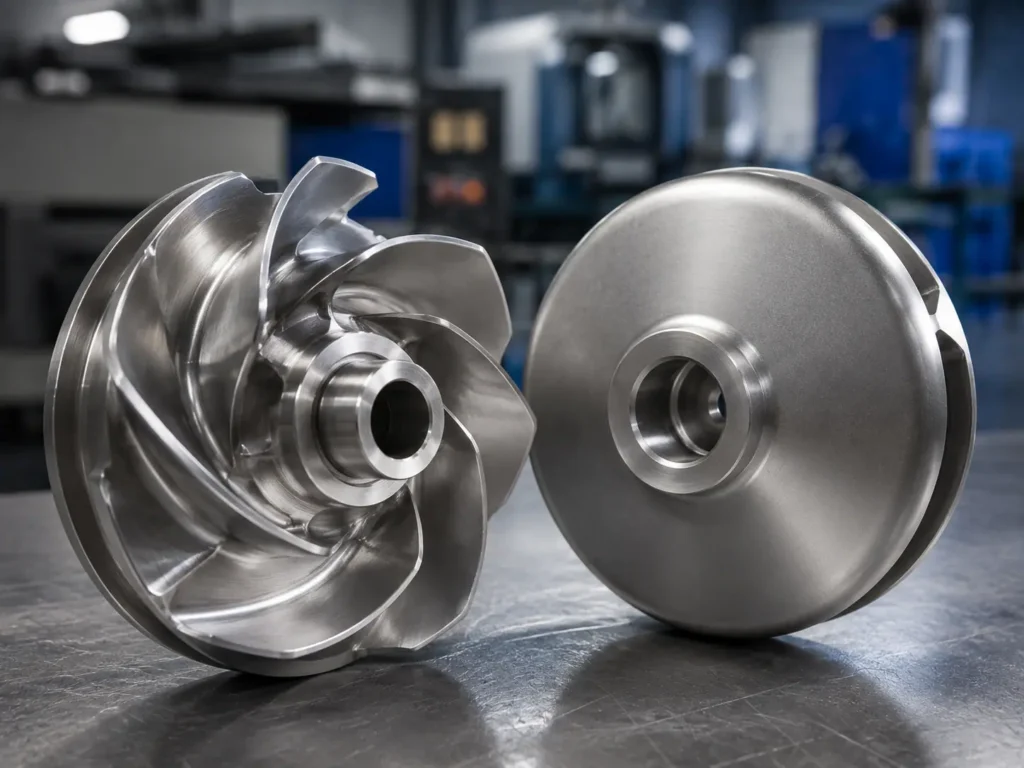
Custom impeller first article inspection is the buyer’s formal check that the first manufactured part matches the approved drawing, material, critical dimensions, process, balancing requirement, and documentation before repeat production begins. It is more than looking at photos or confirming that the impeller “seems correct.”
Short answer: an effective first article inspection for a custom impeller should identify the controlled drawing revision, verify material and critical dimensions, record manufacturing and surface-treatment requirements, confirm runout or dynamic balancing where specified, document deviations, and end with a clear approval, conditional approval, or rejection decision. Repeat batches should follow the approved baseline unless a change is reviewed.
Matson manufactures custom industrial impellers from drawings, 3D files, physical samples, and buyer specifications. This guide explains what OEM buyers should request before approving the first article for pumps, fans, blowers, mixers, compressors, and other industrial equipment.
[Image placeholder: Add a real inspection-table image showing a first custom impeller beside its approved drawing, dimensional inspection report, material certificate, calipers, and balancing report. Alt text: “Custom impeller first article inspection with drawing material certificate and dimensional report”]
What a First Article Inspection Should Prove
The purpose is not to inspect every future part in advance. It is to prove that the manufacturing interpretation is aligned with the buyer’s approved design before the supplier repeats it.
| First-article question | Evidence buyers should review | Risk controlled |
|---|---|---|
| Was the correct design used? | Drawing number, revision, 3D model reference, approved deviation list. | Manufacturing an obsolete or conflicting version. |
| Is the material correct? | Material certificate, heat or batch reference when required, approved equivalent record. | Wrong alloy, unapproved substitution, lost traceability. |
| Does the impeller fit? | Bore, keyway, hub height, mounting face, bolt pattern, shaft connection, and critical clearance dimensions. | Assembly failure, rubbing, looseness, or wrong axial position. |
| Is rotating geometry controlled? | OD, runout, blade or vane position, inlet and outlet geometry, profile checks where specified. | Interference, vibration, inconsistent flow geometry, casing mismatch. |
| Were special requirements completed? | Surface finish, coating, passivation, heat treatment, balancing, NDT, or project-specific reports. | An accepted shape that still misses the purchase specification. |
The inspection scope should come from the drawing, purchase order, quality plan, and agreed RFQ. A generic factory checklist cannot replace buyer-defined acceptance criteria.
Freeze the Reference Before Manufacturing
First article problems often begin before the part reaches inspection. The buyer sends a PDF, a STEP file, an old sample, and a marked photo, but the sources do not agree. The supplier chooses one interpretation and production starts.
Before manufacturing, record:
- Drawing number and revision
- 3D model filename and revision or issue date
- Approved sample identification, if a physical sample is a reference
- Which source controls when dimensions conflict
- Approved material grade and permitted equivalents
- Critical characteristics and required measurement method
- Surface finish, coating, heat treatment, or passivation requirements
- Dynamic balancing, runout, or vibration-related acceptance criteria
- Required certificates, reports, photographs, and marking
- Who has authority to approve deviations and the final first article
For sample-based work, identify worn, bent, corroded, repaired, ground, or previously balance-corrected areas. Matson’s article on a custom impeller from drawing or sample explains why a damaged sample should not silently become the master geometry.
Inspect Functional Dimensions First
Not every dimension has the same purchasing risk. A cosmetic dimension can be slightly different without affecting assembly, while a small bore or hub-height error can stop installation completely.
Buyers should mark the characteristics that control fit and rotation. Common examples include:
- Bore diameter and shaft fit
- Keyway width, depth, and position
- Hub diameter and hub height
- Mounting face, pilot, bolt circle, or coupling dimensions
- Outside diameter and axial width
- Impeller eye, inlet, outlet, or tip dimensions where relevant
- Wear-ring or casing interface surfaces for pump impellers
- Blade angle, blade count, blade spacing, or rotation direction
- Disc flatness, concentricity, and face or radial runout
- Tank wall and bottom clearances for large mixer impellers
The drawing should define datums and tolerances. If it does not, the buyer and manufacturer should agree on them before treating a measurement as pass or fail.
Match the Inspection Method to the Feature
A long report is not automatically a good report. The method must be capable of checking the specified feature.
| Feature | Possible inspection approach | Buyer review point |
|---|---|---|
| Bore, hub, width, accessible diameters | Caliper, micrometer, bore gauge, height gauge, or suitable fixture. | Instrument range, resolution, datum, and recorded result. |
| Runout or concentricity | Indicating fixture or specified coordinate inspection. | Where the part is located, which surface is indicated, and acceptance limit. |
| Blade or vane profile | Templates, section checks, scanning, CMM, or model comparison when specified. | Which sections are checked and how results relate to the approved model. |
| Material | Certificate review, traceability, PMI or laboratory testing when required. | Exact grade, heat or batch linkage, and agreed test scope. |
| Surface finish or coating | Visual standard, roughness measurement, thickness measurement, or treatment record. | Specified area, acceptance value, masking, and report requirement. |
| Dynamic balance | Balancing machine and report under the specified setup. | Standard, grade, part condition, correction method, and residual result. |
Matson’s impeller manufacturing and inspection work can include dimensional checks, material documentation, surface-treatment records, dynamic balancing, and export packing when the project requirements are agreed.
Material Certificates Need a Part Link
A certificate in the shipment folder does not prove much if the buyer cannot link it to the first article. The required level of traceability depends on the project, but the purchase requirement should state the material grade, certificate type, heat or batch reference where needed, and how the finished impeller is identified.
If the supplier proposes an equivalent grade, approve or reject it before manufacturing. Do not let an unapproved substitution become a first-article surprise. For corrosion, wear, temperature, or regulated applications, the buyer may also require additional testing or records. Define them early.
Balancing and Runout Are Separate Checks
An impeller can meet a balance requirement and still have dimensional runout. It can also have good geometric runout but uneven mass distribution. Treat the two checks separately.
When dynamic balancing is specified, the first article record should identify the balance standard or buyer requirement, quality grade where relevant, impeller mass and speed basis, whether the part was balanced alone or with mounting hardware, correction locations, correction method, and final residual result.
Do not copy a generic balance grade from another project. The equipment OEM or engineering owner should define the requirement. Matson’s custom impeller dynamic balancing guide gives buyers a deeper checklist.
Approval Must Be Clear and Traceable
The end of first article inspection should produce one of three decisions:
- Approved: the part and documents meet the agreed requirements and can become the repeat-production baseline.
- Conditionally approved: listed deviations are accepted for this part or batch, with written limits and any required correction before repeat production.
- Rejected: the part does not meet acceptance criteria and cannot become the production master.
Avoid vague replies such as “looks okay” or “please improve next time.” State each deviation, disposition, responsible person, due date, and whether the drawing or process needs revision.
If the buyer accepts a deviation permanently, update the controlled drawing or approved deviation record. Otherwise the supplier may continue producing to one document while the buyer expects another.
From First Article to Repeat Production
An approved first article is a baseline, not permission to change the process freely. Repeat orders should preserve the approved drawing revision, material, major process route, critical dimensions, inspection points, balancing requirement, marking, and packing standard.
Changes to the foundry, material source, fixture, machining datum, welding method, coating, balance correction method, or inspection plan may require buyer notification and reapproval. The purchase agreement should define which changes trigger a new first article.
Matson’s guide to OEM impeller supply from China explains how approved samples and revision control support later batches.
Common Questions Buyers Ask
What is custom impeller first article inspection?
It is the documented verification that the first manufactured impeller meets the approved drawing, material, critical dimensions, process, balancing, finish, and document requirements before repeat production.
Is a dimensional report enough to approve the first article?
Not always. Approval may also require material certificates, surface-treatment records, balancing results, visual checks, profile inspection, photographs, and confirmation of the correct drawing revision.
Which impeller dimensions should be treated as critical?
Typical critical dimensions include bore, keyway, hub height, mounting face, OD, runout, shaft connection, casing or wear-ring interfaces, blade geometry, and equipment-specific clearances. The buyer should mark them on the controlled drawing.
Should every repeat batch receive a new first article inspection?
Not necessarily. A new first article may be required after drawing, material, supplier, fixture, process, tooling, or other significant changes. The buyer’s quality plan should define the trigger.
Can Matson provide first-article inspection documents?
For selected custom impeller projects, Matson can prepare agreed dimensional, material, balancing, surface-treatment, and inspection records. The exact document package and acceptance criteria should be confirmed before quotation.
Need a first custom impeller reviewed before repeat production? Send Matson the controlled drawing, model, sample details, material, critical characteristics, inspection methods, balancing requirement, document list, and order quantity through the custom impeller quote page.