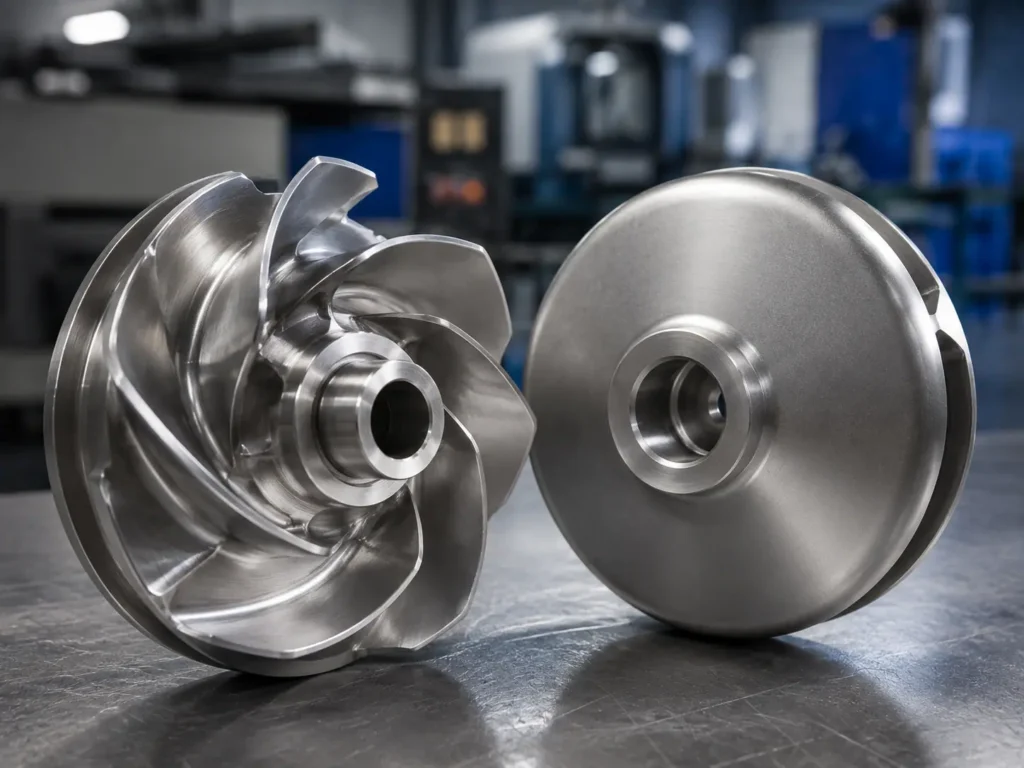
A forward curved impeller is a centrifugal fan or blower wheel with blade tips that curve in the direction of rotation. In industrial fan and blower projects, this blade family is often discussed for compact airflow equipment, HVAC units, ventilation systems, and selected packaged fan designs. For custom manufacturing, the important question is not only whether the blade is forward curved. Buyers should confirm the wheel diameter, blade count, blade angle, inlet relationship, hub and bore fit, material, operating speed, and balancing requirement before production.
Short answer: a forward curved impeller should be manufactured from a clear drawing, 3D file, or reliable sample because blade direction, rotation view, blade spacing, hub fit, weld distortion, and dynamic balance can all affect whether the fan wheel installs and runs correctly. Matson can review custom fan and blower impellers from a manufacturing, machining, inspection, and balancing perspective, while final airflow design and fan performance approval should remain with the fan OEM or engineering owner.
Matson manufactures custom fan and blower impellers from drawings, samples, and project specifications. This article focuses on forward curved fan wheel hardware, not pump impellers, consumer blower parts, or retail replacement wheels.
[Image placeholder: Add a real product or workshop image showing a forward curved centrifugal fan wheel with multi-vane blades, inlet ring, backplate, hub, bore, and balancing marks visible. Alt text: “Forward curved impeller fan wheel blade geometry hub bore and balancing inspection”]
What Is a Forward Curved Impeller?
A forward curved impeller is a centrifugal fan wheel where the blade tips lean forward in the direction of rotation. Air enters near the center of the wheel and moves outward through many curved blade passages into the fan casing or scroll.
You may see the same concept described as a forward curve impeller, forward curved fan impeller, forward curved centrifugal fan impeller, forward curved blower impeller, or forward curved multi-vane impeller. In quotation work, the exact name matters less than the drawing and geometry.
Forward curved wheels often have many relatively narrow blades. That compact, multi-vane form makes the wheel sensitive to blade spacing, rotation direction, inlet relationship, weld distortion, and balance. A quick photo can identify the general blade family, but it is not enough for controlled production.
Forward Curved vs Backward Curved Impeller
Many buyers search for forward vs backward curved impeller because both are centrifugal fan wheel styles. They should not be exchanged casually. The choice affects fan performance, motor load, casing relationship, noise, speed range, and operating behavior. Those performance decisions belong to the fan OEM or engineering owner.
From Matson’s manufacturing side, the job is narrower: produce the specified wheel accurately, with the correct blade direction, hub fit, material, inspection points, and balancing requirement.
| Review point | Forward curved impeller | Backward curved impeller | Manufacturing note |
|---|---|---|---|
| Blade direction | Blade tips curve with the rotation direction. | Blade tips curve opposite the rotation direction. | Confirm rotation view before quoting; front and back photos can be misunderstood. |
| Common hardware form | Often many narrow blades in a compact fan wheel. | Often fewer, wider blades depending on design. | Blade count, spacing, and repeatability should match the drawing. |
| Typical discussion | Compact ventilation, HVAC, packaged fans, and selected blower assemblies. | Industrial fans, blowers, process air, and efficiency/stability-focused systems. | Do not switch blade family without engineering approval. |
| Manufacturing risk | Thin blades, many welds, blade spacing, and distortion can be sensitive. | Blade angle, inlet cone relationship, wheel width, and balance are common concerns. | Both styles need clear geometry and balancing instructions. |
| RFQ risk | A damaged or dirty sample may hide blade spacing or inlet fit. | A bent sample may hide the original blade angle or width. | Send drawings, speed, material, and photos from both sides. |
For the other blade family, Matson’s backward curved impeller article explains backward curved fan wheel geometry and RFQ checks in more detail.
Blade Geometry Buyers Should Confirm
A forward curved impeller should not be quoted from the phrase “forward curve” alone. Buyers should confirm the blade count, blade width, blade thickness, blade curvature, inlet diameter, wheel outside diameter, wheel width, backplate, side plate or shroud relationship, and rotation direction.
The rotation view is especially important. A forward curved blade viewed from the wrong side can be misread. Mark the motor side, inlet side, rotation arrow, and airflow direction if known. If the wheel is copied from a sample, send photos from the front, back, side, blade passage, hub, bore, and damaged areas.
Forward curved multi-vane wheels can also be sensitive to repeated geometry. One blade may look acceptable, but the wheel still runs poorly if the blade spacing, weld sequence, or roundness varies around the circumference.
Inlet Ring, Scroll and Fit Relationship
The inlet relationship matters for fan wheels. A forward curved impeller may work with an inlet ring, scroll housing, cutoff, backplate, or other casing feature. Matson does not need to own the fan design, but the manufacturing review should understand which surfaces are functional.
Useful RFQ details include:
- inlet diameter and inlet ring relationship
- wheel outside diameter and width
- side plate or shroud dimensions
- backplate flatness and runout requirement
- hub height, bore, keyway, set screw, taper, or mounting face
- shaft size and fit requirement
- casing or scroll clearance if it affects the wheel
- whether the old wheel has rubbing, corrosion, impact damage, or repair welds
If the buyer has only a worn wheel, do not copy every mark as an original feature. A rubbed inlet edge, bent blade, enlarged bore, or repaired weld can turn a service problem into a new manufacturing specification.
Material and Surface Treatment
Forward curved impellers may be made from carbon steel, stainless steel, aluminum, alloy steel, or heat-resistant steel depending on the drawing and application environment. The material should match air or gas condition, humidity, dust, temperature, corrosion, weight target, and balancing requirement.
For HVAC and general ventilation, painted carbon steel or aluminum may be reviewed if the drawing allows it. For chemical exhaust, wastewater ventilation, humid air, or process gas, stainless steel or another specified material may be more suitable. For hot air or drying systems, heat-resistant material and weld quality may matter more.
Surface treatment should be stated before quoting. Painting, coating, passivation, polishing, or heat-resistant finish can affect sequence, masking, final weight, and balance. A coating applied unevenly after balancing can change the wheel’s mass distribution.
Fabrication, Welding and Balancing Checks
Forward curved fan wheels are often fabricated from thin or formed parts, though the actual route depends on size, material, quantity, and drawing requirements. The manufacturing plan should control blade forming, blade spacing, weld sequence, hub position, bore machining, and final balance.
Matson’s impeller manufacturing capabilities can support fabrication review, casting when suitable, CNC machining of fit surfaces, surface treatment, dimensional inspection, dynamic balancing, and export packing when project requirements are defined.
Key checks include:
- blade count, blade direction, and blade spacing
- wheel OD, width, inlet diameter, and side plate dimensions
- hub, bore, keyway, shaft fit, and mounting face
- weld size, weld location, and distortion control
- backplate flatness, wheel roundness, and runout
- material grade and surface finish
- operating RPM and balance grade
- whether a balancing report or inspection report is required
Dynamic balancing should be discussed early. A forward curved wheel with many blades and welds can look symmetrical but still carry uneven mass. Matson’s blower wheel balancing article gives a deeper review of vibration, balance weights, RPM, and report requirements.
RFQ Checklist for Forward Curved Impellers
For a useful quote, send enough information to define both the fan wheel geometry and the rotating assembly.
| RFQ item | Why it matters | What to send |
|---|---|---|
| Drawing or 3D file | Defines blade geometry, wheel width, hub, bore, and inlet relationship. | PDF, DWG, DXF, STEP, STP, IGS, or a dimensioned sketch. |
| Sample photos | Shows blade direction, welds, hub style, wear, corrosion, and damage. | Front, back, side, blade close-up, inlet close-up, hub close-up, and damaged areas. |
| Blade geometry | Forward curved wheels often rely on many repeated blades. | Blade count, blade width, blade thickness, curvature, spacing, and rotation direction. |
| Fit surfaces | A correct-looking wheel can fail if bore or hub dimensions are wrong. | Bore, keyway, shaft size, hub height, mounting face, bolt pattern, and tolerance. |
| Inlet and casing relationship | Fan wheel fit may depend on inlet ring, scroll, cutoff, or housing clearance. | Inlet diameter, casing drawing, scroll clearance, and rubbed-area photos if available. |
| Material and air condition | Temperature, dust, humidity, chemical exposure, and corrosion change material choice. | Material grade, air/gas condition, temperature, dust, moisture, corrosion, and coating need. |
| Speed and balancing | Fan wheels are sensitive to vibration and uneven mass distribution. | RPM, balancing grade, runout requirement, whether balanced alone or as an assembly, and report need. |
If the project is for recurring OEM supply, also send annual demand, sample approval process, packing requirement, and documentation needs. For broader fan and blower sourcing context, see Matson’s blower impeller page.
Common Questions We Actually Get
What is a forward curved impeller?
A forward curved impeller is a centrifugal fan or blower wheel with blades that curve in the direction of rotation. It is commonly discussed in compact fan, HVAC, ventilation, and selected blower assemblies.
Is a forward curved impeller the same as a backward curved impeller?
No. Forward curved and backward curved impellers have opposite blade directions and different fan behavior. The fan OEM or engineer should choose the wheel type; the manufacturer should follow the approved drawing.
Can Matson manufacture a forward curved fan impeller from a sample?
Yes, if the sample can be measured and the buyer can confirm critical dimensions. Bent blades, worn bores, repaired welds, corrosion, and rubbing marks should be identified before copying the part.
Does a forward curved impeller need dynamic balancing?
Often yes, especially for larger, faster, or welded fan wheels. The requirement should come from operating RPM, wheel diameter, mass, application, and buyer specification.
What should I send for a forward curved impeller quote?
Send the drawing or sample photos, blade count, wheel diameter, inlet dimensions, rotation direction, hub and bore details, material grade, operating RPM, balancing requirement, quantity, and inspection needs.
Manufacturing Summary
A forward curved impeller should be treated as a controlled fan wheel, not a generic curved-blade part. Blade direction, repeated blade spacing, inlet relationship, hub fit, material, welding distortion, runout, and dynamic balancing all affect whether the wheel can be installed and operated reliably.
Matson manufactures custom forward curved impellers, fan wheels, and blower impellers from drawings, 3D files, samples, and specifications. Send your drawing, sample photos, material grade, operating speed, balancing requirement, quantity, and application details through the custom impeller RFQ page.