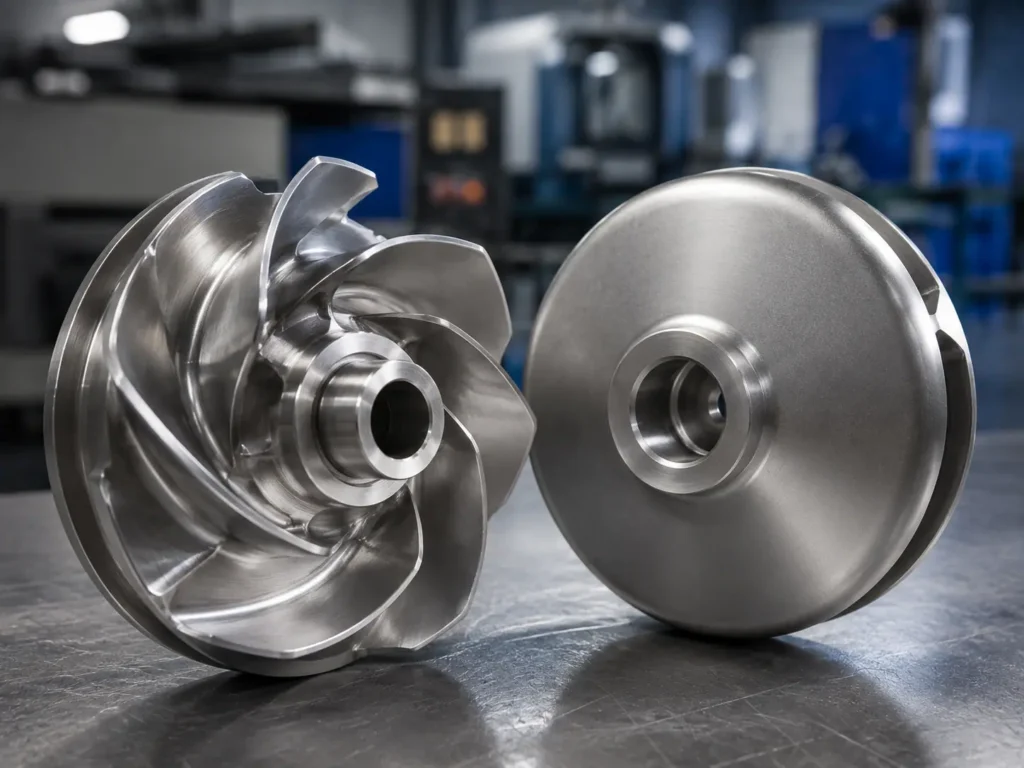
A backward curved impeller is a centrifugal fan or blower wheel with blades that curve away from the direction of rotation. In industrial fan and blower projects, buyers usually look at this blade type when efficiency, stable airflow, lower overload risk, and vibration control matter. For custom manufacturing, the key is not only the blade name. The drawing, blade angle, wheel diameter, inlet geometry, hub and bore fit, material, operating speed, and balancing requirement all need to be confirmed before production.
Matson manufactures custom fan and blower impellers from drawings, 3D files, samples, and specifications. For a backward curved impeller, Matson can review the metal hardware, fabrication or casting route, CNC machining, material, surface treatment, dimensional inspection, and dynamic balancing. Final aerodynamic performance, fan curve, motor selection, and airflow guarantee should remain with the fan OEM or engineering owner.
What Is a Backward Curved Impeller?
A backward curved impeller is a centrifugal fan wheel where the blade tips lean backward relative to the rotation direction. Air enters near the center of the wheel and moves outward through the blade passages into the fan casing. The backward blade shape is commonly discussed in centrifugal fans, industrial blowers, HVAC systems, process air equipment, dust collection, drying systems, and ventilation applications.
You may see the same part called a backward curved impeller, backward curved fan impeller, backward curved centrifugal fan impeller, backward curved blower impeller, or backward inclined impeller — they all describe the same blade family. If you are sourcing the actual wheel, start from Matson’s fan and blower impellers and blower impeller pages.
Backward Curved vs Forward Curved Impeller
Many buyers search for forward vs backward curved impeller because the two wheels can look similar in a quick photo but behave differently in a fan system. The choice is normally an aerodynamic and equipment-design decision. From Matson’s side, the manufacturing concern is to preserve the specified blade geometry and make the wheel stable enough for the required speed.
| Review point | Backward curved impeller | Forward curved impeller | Manufacturing note |
|---|---|---|---|
| Blade direction | Blade tips curve opposite the rotation direction. | Blade tips curve with the rotation direction. | Confirm rotation view before manufacturing; photos alone can mislead. |
| Common use context | Industrial fans, blowers, HVAC, process air, and systems where efficiency and stable operation matter. | Compact ventilation and selected packaged equipment designs. | The fan OEM should confirm airflow design; Matson should follow the drawing. |
| Geometry sensitivity | Blade angle, inlet cone relationship, wheel width, and backplate alignment matter. | Blade count, scroll relationship, and compact wheel geometry matter. | Do not replace one type with the other without engineering approval. |
| Balance concern | Often important because wheels may run continuously at industrial speeds. | Also important, especially with thin blades and many blade joints. | Specify RPM, balancing grade, and report requirement. |
| RFQ risk | A worn sample may hide the original blade angle or inlet clearance. | A damaged wheel may hide blade spacing and casing fit. | Send drawing, speed, material, and clear photos of hub and blade geometry. |
Blade Geometry Buyers Should Confirm
Backward curved impeller blades are not just curved plates. A quote should define the wheel diameter, blade count, blade width, blade angle, blade thickness, inlet diameter, outlet width, backplate, shroud or inlet cone relationship, hub height, bore, keyway, and rotation direction.
The phrase “backward curved impeller design” often mixes two different jobs. If the buyer is asking which wheel geometry gives a certain airflow, pressure, efficiency, noise level, or motor load, that belongs to the fan OEM or aerodynamic engineer. If the buyer already has a drawing or sample and needs custom manufacturing, Matson can review whether the specified geometry can be produced, machined, inspected, and balanced.
For worn samples, blade geometry is risky. A bent blade may look like the original curve. A cracked weld may change blade position. A rubbed inlet cone may hide the original clearance. A damaged hub may make the bore look larger than it should be. Good photos help, but production should rely on confirmed dimensions wherever possible.
Material and Application Environment
Backward curved impellers can be manufactured from carbon steel, stainless steel, aluminum, alloy steel, or heat-resistant steel, depending on the drawing and service condition. The material should match the air or gas environment, temperature, corrosion risk, dust load, abrasion, weight target, and balancing requirement.
For clean HVAC or general ventilation, carbon steel or aluminum may be considered if the drawing allows it. For chemical exhaust, wastewater ventilation, humid air, food-adjacent process air, or corrosive gas, stainless steel or another specified alloy may be more suitable. For hot air, drying, combustion air, or process equipment, the material and welding route should be reviewed carefully.
Do not choose the material from the word “fan” alone. A fan handling clean indoor air and a fan handling hot dusty process exhaust are completely different manufacturing discussions.
Manufacturing and Inspection Checks
A backward curved fan impeller may be fabricated, cast, machined, or produced through a mixed manufacturing route. The route depends on wheel size, blade form, material, quantity, tolerance, surface treatment, and balance requirement.
Matson’s impeller manufacturing capabilities can support casting, fabrication, CNC machining, surface treatment, dynamic balancing, dimensional inspection, and export packing when the project requirements are defined.
Key checks include:
- blade angle and blade count
- rotation direction and viewing side
- wheel outside diameter and width
- inlet cone or shroud relationship
- hub height, bore, keyway, set screw, or mounting face
- backplate flatness and weld quality
- shaft fit and critical tolerances
- surface treatment, coating, painting, passivation, or heat-resistant finish
- runout and dynamic balancing requirement
If the wheel is welded, welding sequence matters. Heat can pull blades out of position or distort the backplate. If the wheel is cast, machining allowance and critical fit surfaces must be controlled. If the wheel is copied from a sample, the old part should be checked for impact damage, corrosion, repair welds, and worn bore surfaces.
Dynamic Balancing Is Not Optional to Discuss
Backward curved impellers often run at speeds where unbalance becomes a real operating problem. Even if the wheel looks visually correct, uneven mass distribution can create vibration, bearing load, noise, cracked welds, and early equipment failure.
ISO 21940-11 is a useful reference when the buyer or drawing specifies rigid-rotor balancing terminology and grades. The actual grade should come from the fan speed, wheel diameter, mass, application, and equipment requirement. A universal balancing grade should not be assumed.
For a reliable RFQ, buyers should state:
- operating RPM
- wheel diameter and estimated mass
- whether the impeller is balanced alone or as an assembly
- balancing grade if specified
- whether a balancing report is required
- any vibration issue from the existing fan
For deeper background on broader blower wheel balancing and material review, see Matson’s centrifugal blower impeller article.
RFQ Checklist for Backward Curved Impellers
The fastest way to avoid quote confusion is to send the part as an industrial fan wheel, not as a generic “impeller.”
| RFQ item | Why it matters | What to send |
|---|---|---|
| Drawing or 3D file | Defines blade angle, wheel width, hub, bore, and casing-related dimensions. | PDF, DWG, DXF, STEP, STP, IGS, or a dimensioned sketch. |
| Photos of existing wheel | Helps identify blade curve, welds, hub style, wear, and damage. | Front, back, side, blade close-up, hub close-up, and damaged areas. |
| Blade geometry | Backward curved blades depend on angle, count, spacing, and width. | Blade count, blade thickness, blade angle, inlet width, outlet width, and rotation direction. |
| Fit surfaces | Wrong bore or hub dimensions can make a correct-looking wheel unusable. | Bore, keyway, hub height, shaft size, mounting face, bolt pattern, and tolerances. |
| Material and air condition | Temperature, dust, humidity, and chemical exposure affect material and coating. | Material grade, air/gas condition, temperature, dust, corrosion, and finish requirement. |
| Speed and balancing | Fan wheels are sensitive to unbalance and runout. | RPM, balancing grade, runout requirement, and report need. |
| Quantity and project type | Prototype, replacement, and OEM batch production need different planning. | Quantity, annual demand, sample approval need, and export packing requirement. |
Common Questions We Actually Get
What is a backward curved impeller?
A backward curved impeller is a centrifugal fan or blower wheel with blades that curve away from the direction of rotation. It is commonly used in industrial fans, blowers, HVAC, and process air equipment.
Is a backward curved impeller better than a forward curved impeller?
Not universally. The fan OEM or engineer should choose the wheel type based on airflow, pressure, speed, motor load, noise, casing, and application. Matson’s role is to manufacture the specified wheel accurately.
Can Matson manufacture a backward curved fan impeller from a sample?
Yes, if the sample can be measured and the buyer confirms critical dimensions. Worn, bent, repaired, or corroded samples should be reviewed carefully before copying the geometry.
Does a backward curved impeller need dynamic balancing?
Often yes, especially for larger, heavier, or faster fan wheels. The exact balancing requirement should come from the drawing, operating RPM, wheel size, and equipment specification.
What should I send for a custom backward curved impeller quote?
Send the drawing or sample photos, wheel diameter, blade count, blade angle, hub and bore dimensions, material grade, operating speed, air or gas condition, balancing requirement, quantity, and inspection needs.
Manufacturing Summary
A backward curved impeller should be treated as a controlled fan wheel, not a generic rotating part. Blade curve, rotation direction, inlet relationship, hub fit, material, weld quality, runout, and balancing all affect whether the wheel can be installed and operated reliably.
Matson manufactures custom backward curved impellers, fan wheels, and industrial blower impellers from drawings, samples, and specifications. Send your drawing, 3D file, sample photos, material grade, operating speed, balancing requirement, quantity, and application details through the custom impeller RFQ page.