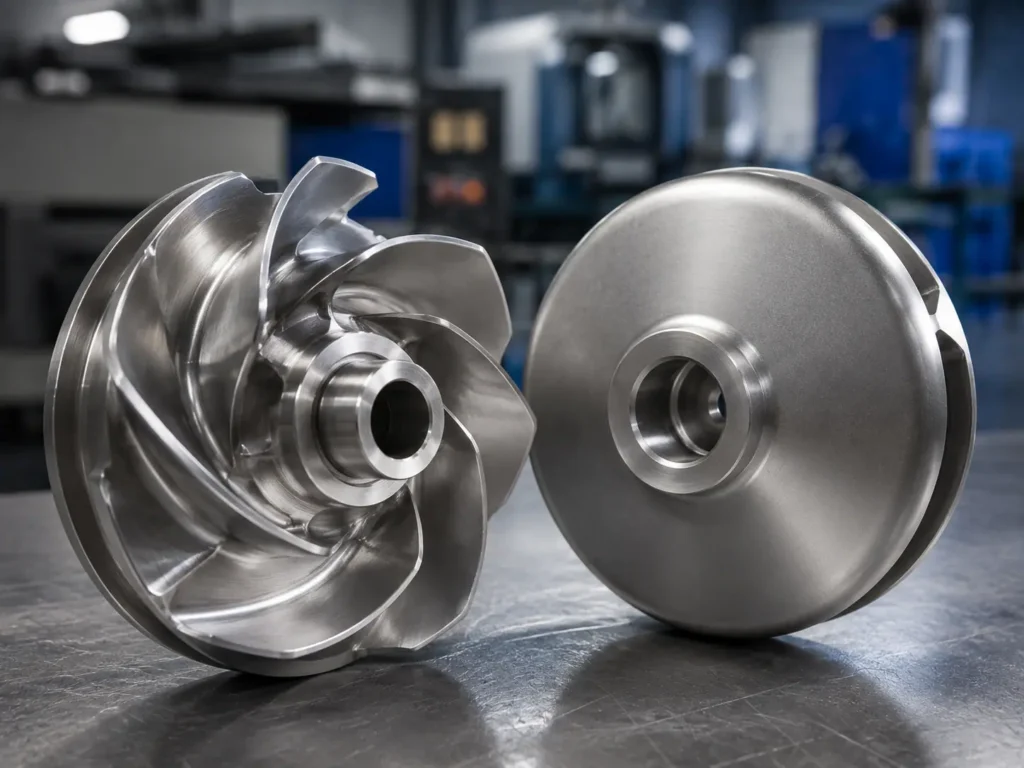
An airfoil fan impeller is a centrifugal fan wheel with blades shaped to reduce turbulence and improve airflow efficiency in selected industrial fan systems. It is usually discussed when the fan OEM wants better efficiency, lower noise, and stable performance than a simple flat or radial blade wheel can provide. For custom manufacturing, the hard part is not saying “airfoil.” The hard part is keeping the blade profile, inlet relationship, hub fit, material, weld quality, runout, and balance close to the approved drawing.
Short answer: an airfoil fan impeller can be a good fit for industrial fans, HVAC equipment, process air systems, drying units, clean exhaust, and selected high-efficiency blower assemblies when the wheel geometry is already specified by the fan OEM. Matson manufactures custom fan and blower impellers from drawings, 3D files, samples, and project specifications. Final aerodynamic selection, fan curve, efficiency target, and noise guarantee should remain with the fan OEM or engineering owner.
This article supports Matson’s fan and blower impellers, blower impeller, and industrial fan impeller pages. It is about industrial metal fan wheels, not household fan blades, appliance repair parts, or brand-specific replacement kits.
[Image placeholder: Add a real workshop or product image showing an industrial airfoil fan impeller with blade profile, inlet cone, hub, bore, and balancing marks visible. Alt text: “Airfoil fan impeller blade profile hub bore and dynamic balancing inspection”]
What Is an Airfoil Fan Impeller?
An airfoil fan impeller is a centrifugal fan wheel where each blade has an aerodynamic cross-section rather than a simple flat plate. Air enters near the wheel inlet and moves through the blade passages toward the outside diameter. The airfoil blade shape is intended to guide air more smoothly and reduce losses when the fan system is designed around that geometry.
You may see the same hardware described as an airfoil impeller, airfoil fan wheel, airfoil blower wheel, airfoil centrifugal fan impeller, or airfoil blade centrifugal fan. In sourcing conversations, the safest wording is “airfoil fan impeller” because it keeps the topic inside fan and blower equipment rather than mixing it with mixer hydrofoils or pump impellers.
For Matson, the manufacturing question is practical: can the specified wheel be made to the drawing, material, speed, balance, and inspection requirements without changing the working blade profile?
Airfoil vs Backward Curved vs Radial Blade Wheels
Airfoil fan impellers are often compared with backward curved and radial blade wheels. The selection is mainly an aerodynamic and equipment-design decision. Matson should not replace one blade family with another unless the fan OEM or engineering owner approves the change.
| Fan wheel type | Typical use context | Manufacturing concern | RFQ note |
|---|---|---|---|
| Airfoil fan impeller | Selected high-efficiency industrial fans, HVAC systems, process air, and clean or moderately clean gas streams. | Blade profile repeatability, inlet relationship, profile distortion, surface finish, and balance. | Send drawing or 3D model. A photo rarely defines the airfoil profile well enough. |
| Backward curved impeller | Industrial fans and blowers where stable airflow and efficiency matter. | Blade angle, wheel width, inlet cone fit, hub, bore, weld quality, and dynamic balancing. | Use the backward curved impeller guide when the blade is not airfoil-shaped. |
| Radial blade impeller | Dust collection, material handling, dirty air, and selected process air applications. | Blade thickness, wear risk, weld strength, abrasion, corrosion, and balance. | Often more rugged, but not a universal substitute for an airfoil wheel. |
| Forward curved wheel | Compact ventilation and packaged equipment where the OEM design requires many forward-curved blades. | Blade count, thin blade forming, wheel width, casing fit, and balance correction. | Do not confuse compact forward-curved wheels with airfoil wheels. |
Blade Profile Is the Main Risk
An airfoil blade is sensitive to shape. If the blade profile changes during fabrication, welding, casting, forming, machining, or repair, the wheel may still fit the shaft but no longer behave like the original fan wheel.
This is where sample-based projects become tricky. A worn airfoil fan impeller may have dented leading edges, rubbed inlet areas, cracked welds, corroded blade skins, or previous repair patches. Those damaged areas should not be copied blindly. A clean drawing, 3D model, or reliable reference part is much better than a single worn sample.
For a useful quote, buyers should confirm:
- blade count and blade profile
- wheel outside diameter and width
- inlet diameter and inlet cone relationship
- blade leading edge and trailing edge details
- backplate, shroud, or sideplate geometry
- hub height, bore, keyway, taper, or mounting face
- rotation direction and viewing side
- runout and dynamic balancing requirement
The phrase “airfoil impeller design” can mean two different things. If the buyer is asking which airfoil shape will meet a fan curve, pressure, efficiency, or noise target, that belongs to the fan OEM or aerodynamic engineer. If the buyer already has approved geometry and needs the wheel manufactured, Matson can review manufacturability, material, machining, inspection, and balancing.
Materials and Service Conditions
Airfoil fan impellers may be made from carbon steel, stainless steel, aluminum, alloy steel, heat-resistant steel, or another buyer-specified material. The right material depends on air or gas condition, temperature, corrosion, dust load, moisture, wheel size, operating speed, and weight target.
For clean HVAC or general industrial ventilation, carbon steel or aluminum may be suitable when the drawing allows it. For chemical exhaust, wastewater ventilation, humid air, or corrosion-sensitive process air, stainless steel or another corrosion-resistant alloy may be required. For drying systems, combustion air, hot air, or process equipment, heat resistance and distortion risk should be reviewed before production.
Do not choose material from the word “airfoil” alone. Airfoil describes blade shape. It does not define corrosion resistance, temperature capability, weld method, coating, or balance grade.
Manufacturing and Inspection Checks
An airfoil fan impeller may involve fabrication, welding, forming, casting, CNC machining, surface treatment, and dynamic balancing. The route depends on size, blade construction, material, quantity, tolerance, and documentation requirement.
Matson’s impeller manufacturing capabilities can support casting, CNC machining, surface treatment, dimensional inspection, dynamic balancing, and export packing when the project data is defined.
Key manufacturing checks include:
- blade profile consistency from blade to blade
- inlet cone or shroud relationship
- backplate flatness and wheel width
- bore, hub, keyway, mounting face, and shaft fit
- weld sequence and heat distortion
- surface finish, coating, painting, passivation, or heat-resistant finish
- runout before and after balancing
- balance correction method and report requirement
For fabricated airfoil wheels, weld distortion deserves attention. A small change in blade angle or sideplate position can affect both fit and balance. For cast or mixed-route wheels, machining allowance and inspection datums should be agreed before production.
Dynamic Balancing and Vibration
Airfoil fan impellers are often used in equipment where efficiency and smooth operation matter. That makes balancing a serious manufacturing item, not a final afterthought.
Unbalance can create vibration, bearing load, noise, seal or shaft stress, cracked welds, and early equipment failure. ISO 21940-11 is a useful reference when the drawing or buyer specification uses rigid-rotor balancing terminology and grades. The actual balance grade should come from the fan speed, wheel diameter, mass, application, and equipment requirement.
For deeper discussion of vibration and balance-related RFQ details, see Matson’s blower wheel balancing article.
What Buyers Should Send for an Airfoil Fan Impeller Quote
The fastest RFQ is specific. A message that says “airfoil impeller needed” is not enough for manufacturing review.
| RFQ item | Why it matters | What to send |
|---|---|---|
| Drawing or 3D model | The blade profile cannot be reliably copied from one photo. | PDF, DWG, DXF, STEP, STP, IGS, or approved drawing package. |
| Wheel dimensions | Fit and performance depend on OD, inlet, width, hub, and casing relationship. | Outside diameter, inlet diameter, outlet width, wheel width, hub height, and bore. |
| Blade details | Airfoil geometry is the main controlled feature. | Blade count, blade profile, blade thickness, leading edge, trailing edge, and rotation direction. |
| Fit surfaces | A correct-looking wheel is useless if it does not assemble. | Bore tolerance, keyway, taper, thread, shaft size, mounting face, and critical datums. |
| Material and environment | Heat, humidity, chemical exposure, and dust change the material and finish discussion. | Material grade, air or gas condition, temperature, dust, corrosion, moisture, and coating need. |
| Speed and balance | Fan wheels are sensitive to unbalance and runout. | Operating RPM, balance grade, whether a report is required, and any vibration history. |
| Project context | Prototype, replacement, and OEM batch production need different planning. | Quantity, annual demand, sample approval need, inspection report, and export packing requirement. |
Common Questions We Actually Get
What is an airfoil fan impeller?
An airfoil fan impeller is a centrifugal fan wheel with aerodynamic blade profiles. It is used in selected industrial fan and blower systems where efficiency, stable airflow, and noise control are important.
Is an airfoil impeller the same as a backward curved impeller?
Not always. Many airfoil wheels are backward-inclined or backward-curved in general behavior, but the word airfoil refers specifically to the blade cross-section. The drawing should define the exact geometry.
Can Matson manufacture an airfoil fan impeller from a sample?
Yes, Matson can review sample-based projects, but airfoil blade profiles are hard to copy from worn or damaged parts. Drawings, 3D files, and reliable measurements are strongly preferred.
What materials are used for airfoil fan impellers?
Common options include carbon steel, stainless steel, aluminum, alloy steel, and heat-resistant steel. The correct material depends on the drawing, speed, temperature, corrosion risk, dust load, and service environment.
Does an airfoil fan impeller need dynamic balancing?
Usually yes for industrial service, especially when the wheel is large, high-speed, continuous-duty, or precision-sensitive. The balance grade should come from the drawing, RPM, wheel size, and equipment requirement.
Manufacturing Summary
An airfoil fan impeller is worth treating as a controlled aerodynamic wheel, not a generic rotating part. Blade profile, inlet relationship, hub fit, material, weld quality, surface finish, runout, and balance all affect whether the finished wheel can run reliably.
Matson manufactures custom fan wheels, blower impellers, and industrial impellers from drawings, samples, and specifications. Send your airfoil fan impeller drawing, 3D file, sample photos, material grade, operating speed, balancing requirement, quantity, and application details through the contact page. We can review manufacturing, machining, inspection, and balancing requirements before quoting.