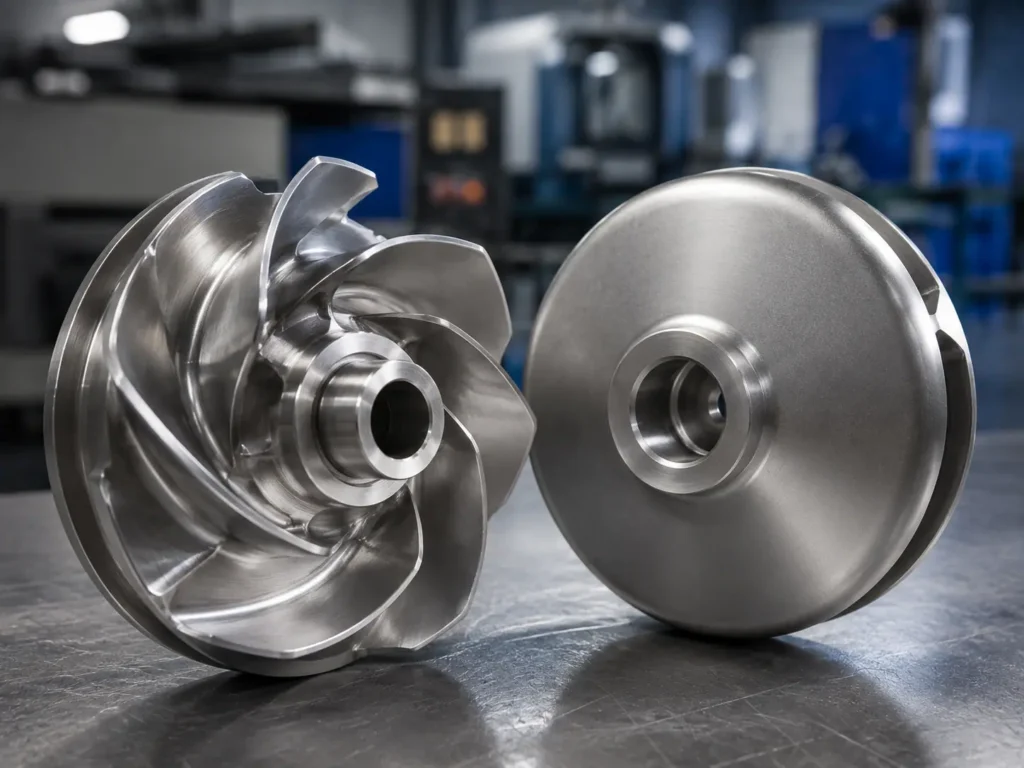
Impeller erosion is surface material loss caused by fast-moving liquid, abrasive particles, slurry, sand, grit, silt, or combined erosion-corrosion. On a pump impeller, it often appears as thinned vane edges, washed flow passages, rough outlet areas, worn shroud surfaces, or uneven metal loss along the direction of flow. For industrial buyers, the useful question is not only “what material is harder?” It is what is wearing the impeller, where the wear starts, and whether the replacement part should change material, surface treatment, manufacturing route, or inspection focus.
Short answer: pump impeller erosion should be reviewed as a damage pattern, not just a material problem. Buyers should confirm the liquid, solids content, particle size, particle hardness, flow velocity, pump speed, operating point, corrosion condition, original material, casting quality, CNC machined surfaces, clearances, and balancing requirement before ordering a replacement impeller.
Matson manufactures custom pump impellers from drawings, 3D files, physical samples, and project specifications. If an existing impeller shows erosion, Matson can review the part from a manufacturing and RFQ perspective: material, casting route, machining allowance, critical dimensions, surface treatment, inspection, and balancing.
[Image placeholder: Add a real close-up image of a metal pump impeller showing eroded vane edges, worn flow passages, or abrasive surface loss. Alt text: “Pump impeller erosion with worn vane edges and abrasive surface damage”]
What Impeller Erosion Looks Like
Erosion is not always random. In many pump impellers, it follows the flow path. The first signs may appear at vane leading edges, vane outlet tips, the impeller eye, shroud surfaces, outside diameter, or clearance areas where velocity and particle impact are high.
Abrasive erosion often looks directional. The metal may look washed, grooved, thinned, or polished by particles. Severe service can remove section thickness until vane edges become sharp or uneven. In slurry, sludge, wastewater, mining, dredging, seawater, or chemical service, erosion can also appear together with corrosion or cavitation damage.
That mixed damage is where quotes go wrong. A buyer sees “wear” and orders the same part again. If the actual cause is sand, chloride, poor material, high velocity, wrong clearance, or repeated cavitation, the new impeller may fail in the same way.
Erosion vs Cavitation vs Corrosion
Buyers often use the same word for several different damage patterns. Before choosing a material or approving a replacement, separate these causes as much as possible.
| Damage type | Typical appearance | Common cause | What to check before quoting |
|---|---|---|---|
| Abrasive erosion | Directional wear, thinned vane edges, washed passages, worn outlet or shroud surfaces. | Sand, grit, slurry, silt, mineral particles, high particle velocity. | Solids content, particle size, hardness, pump speed, material, wear pattern photos. |
| Cavitation erosion | Pitting, rough torn metal, honeycomb-like surface, often near impeller eye or vane inlet. | Vapor bubble collapse caused by suction condition, NPSH margin, operating point, or temperature. | Suction condition, liquid temperature, pump duty, inlet condition, noise and vibration history. |
| Corrosion | Surface attack, discoloration, pitting, dezincification, chemical loss, uneven attack. | Wrong alloy for pH, chloride, seawater, chemical liquid, galvanic pairing, temperature. | Fluid chemistry, pH, chloride, temperature, alloy grade, material certificate. |
| Erosion-corrosion | Fast material loss where chemistry weakens the surface and flow removes it. | Corrosive liquid plus velocity, solids, turbulence, or damaged protective film. | Liquid chemistry, flow area, velocity, solids, surface finish, material and coating suitability. |
If the damage is mainly cavitation, see Matson’s article on pump impeller cavitation. If several failure modes are present, the broader pump impeller failure topic is a better starting point.
Why Erosion Happens in Pump Impellers
Most erosion problems come from a combination of service condition and geometry. Hard particles do not simply pass through the pump in a neat line. They strike vane surfaces, slide along passages, rebound from shrouds, and concentrate in high-velocity zones.
Common causes include:
- Sand, grit, silt, tailings, catalyst particles, scale, or mineral solids in the liquid
- High pump speed or high local velocity through the impeller passage
- Abrasive slurry, sludge, wastewater, dredging, or mining service
- Vane leading edges or outlet areas exposed to repeated particle impact
- Excessive clearance, rubbing, recirculation, or operation away from the intended duty point
- Corrosive liquid that weakens the metal surface before particles remove it
- Coating damage, poor surface preparation, or coating thickness that changes critical clearances
- Material that is suitable for clean water but weak for abrasive or corrosive service
This is why erosion should not be handled with one stock answer. A high-chrome material may make sense in abrasive slurry, but it is not automatically right for a chemically aggressive liquid. Stainless steel may help corrosion resistance, but it may still lose material quickly when hard particles dominate the wear.
Where to Look on an Eroded Impeller
The damage location gives useful clues.
Vane leading-edge erosion suggests particle impact or unstable inlet flow. Vane outlet erosion may point toward high exit velocity, solids sliding, or abrasive flow leaving the passage. Wear near the impeller eye may overlap with cavitation or suction-side issues. Shroud or OD wear may involve clearance, casing relationship, or recirculation. Bore and hub damage are less about flow erosion and more about fit, assembly, rubbing, or vibration.
When sending photos, do not send only one front view. Send the front, back, side, bore, hub, vane inlet, vane outlet, OD, shroud surfaces, and close-ups of the worst damage. Mark whether the damage is deep, sharp-edged, polished, pitted, cracked, or corroded.
For abrasive slurry and mining service, Matson’s slurry pump impeller material guide gives more context on wear-resistant material discussions.
Material and Surface Treatment Review
Material selection for impeller erosion depends on the actual service. The old material is a clue, not a final answer.
For clean or mildly corrosive water, stainless steel or bronze may be suitable in selected conditions. For seawater, chloride, or chemical liquid, duplex stainless, super duplex, bronze, or other corrosion-resistant alloys may enter the discussion. For abrasive slurry, high-chrome, hard alloy, or wear-resistant material may be considered. For general industrial service, carbon steel or alloy steel may still be used when the liquid, corrosion, and wear demand allow it.
Surface treatment can help in selected cases, but it is not magic. A coating can fail at edges, wear through in high-impact zones, change clearance, or create balancing and masking questions. If the service has severe grit impact, the coating itself may become a weak layer unless the application, thickness, adhesion, and inspection plan are well matched.
For surface-treatment context, review the coating specification, coating thickness, edge survival, adhesion requirement, masking plan, and whether coating changes critical clearances.
Manufacturing Checks Before Replacing an Eroded Impeller
An eroded sample is useful, but it may not be a safe master part. The surfaces that wear first are often the same surfaces needed for accurate reproduction.
| Manufacturing check | Why it matters with erosion | Buyer should send |
|---|---|---|
| Original drawing or 3D file | The worn sample may not show original vane thickness, OD, inlet shape, or outlet width. | PDF, DWG, DXF, STEP, STP, or approved drawing revision if available. |
| Material grade | Erosion resistance and corrosion resistance must be reviewed together. | Current grade, required standard, certificate need, failed-part material test if available. |
| Wear pattern photos | The location of metal loss helps separate abrasion, cavitation, corrosion, and rubbing. | Close-ups of vane edges, eye, outlet, shroud, OD, bore, hub, and casing-contact areas. |
| Critical dimensions | Erosion may remove original dimensions used for fit and hydraulic passage control. | OD, bore, hub height, keyway, mounting face, vane width, eye diameter, clearance surfaces. |
| Casting and machining route | Wear-resistant alloys, stainless grades, and coatings may change process planning. | Quantity, casting method preference, machining allowance, surface finish, inspection requirement. |
| Balancing requirement | Uneven erosion and replacement geometry can affect vibration and bearing load. | Pump speed, impeller mass, balance grade, report requirement, assembly condition. |
Matson’s impeller manufacturing work can include casting, CNC machining, surface treatment, dimensional inspection, dynamic balancing, documentation, and export packing when project requirements are defined.
What to Send for an Impeller Erosion RFQ
Send:
- 2D drawing, 3D file, or physical sample
- Existing material grade and any material certificate
- Application: clean water, wastewater, sludge, slurry, mining, chemical, seawater, or process fluid
- Solids content, particle size, particle hardness, sand, grit, silt, fibers, or scale information
- Liquid chemistry, pH, chloride, temperature, and corrosion history
- Pump speed, operating condition, and whether the pump runs near its intended duty point
- Photos of eroded surfaces from multiple angles
- Original OD, bore, hub height, keyway, eye diameter, vane width, shroud surfaces, and critical clearances
- Required casting route, machining tolerance, surface finish, coating, passivation, or inspection documents
- Balancing requirement and whether a balancing report is needed
- Quantity, batch plan, and expected service-life concern
If the part failed earlier than expected, say that plainly. A replacement quote should not treat early erosion the same as normal end-of-life wear.
When the Same Design Is Still Acceptable
Sometimes the correct action is simple: manufacture the same impeller again from the approved drawing. That can be reasonable when the service life was acceptable, the erosion is expected for the application, the pump duty has not changed, and the buyer only needs a repeat batch.
A deeper review is needed when erosion happens much earlier than expected, the material is unknown, the sample is heavily worn, the liquid condition changed, grit or chemical exposure increased, or several damage patterns appear together. In that case, the pump OEM or engineering owner should review the operating condition, while the impeller manufacturer reviews material, process, dimensions, and quality control.
That separation matters. It keeps the article honest: Matson can support manufacturing review, material discussion, casting, CNC machining, coating, inspection, and balancing. Final pump hydraulic decisions should remain with the pump OEM, system designer, or engineering owner.
Common Questions We Actually Get
What causes impeller erosion?
Impeller erosion is commonly caused by abrasive particles, sand, grit, slurry, silt, high local velocity, corrosive liquid, erosion-corrosion, cavitation-related surface damage, or operation outside the intended pump condition.
Is pump impeller erosion the same as cavitation?
No. Abrasive erosion usually follows particle impact and flow direction. Cavitation often causes pitting or rough torn metal near low-pressure zones such as the impeller eye or vane inlet. They can also happen together.
Can a coating stop impeller erosion?
A coating can help in selected services, but it must match the liquid, particles, impact, thickness, adhesion, clearance, and balancing requirements. It is not a universal fix for severe slurry or grit erosion.
What material is best for an eroded pump impeller?
There is no universal best material. The choice depends on particle hardness, corrosion, temperature, pump speed, impeller geometry, casting route, machining needs, cost, and expected service life.
Can Matson manufacture a replacement from an eroded sample?
Yes, Matson can review an eroded sample, but worn vane edges, OD, eye, shroud, and clearance surfaces may not show the original geometry. Drawings, mating dimensions, and failure photos make the quote safer.
CTA
Need a replacement impeller after erosion damage? Send Matson your drawing, eroded sample photos, material grade, liquid condition, solids details, pump speed, critical dimensions, quantity, and balancing requirement through the contact page. We can review the impeller from a manufacturing, material, casting, machining, coating, inspection, and RFQ perspective before quoting.