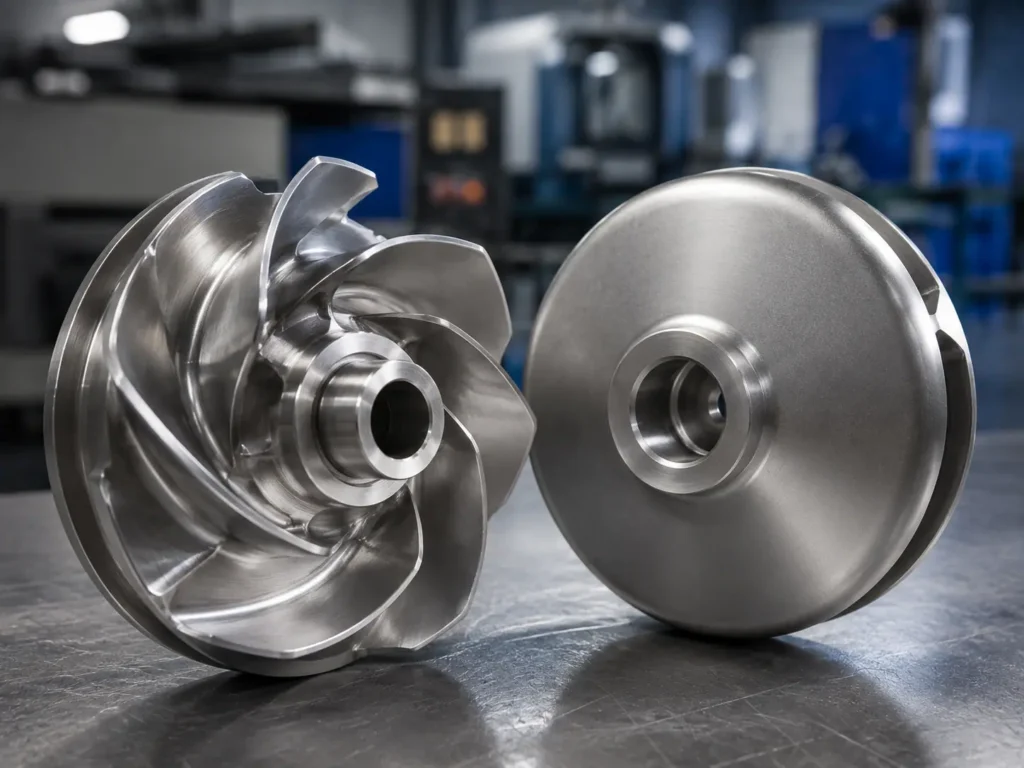
Pump impeller coatings are used to protect selected industrial impellers against corrosion, abrasion, chemical attack, buildup, or service wear. They can help in the right environment, but coating is not a shortcut for poor material selection, wrong clearance, rough surface preparation, or an impeller that is already unsuitable for the pump duty.
Short answer: pump impeller coatings should be reviewed together with the base material, liquid condition, solids, temperature, pump speed, surface preparation, coating thickness, critical dimensions, and balancing requirement. A coating may protect exposed surfaces, but it can also change fit, hide defects, chip at edges, or fail early if the application is wrong.
Matson manufactures custom pump impellers from drawings, 3D files, samples, and specifications. For coated impeller projects, Matson can review the casting, CNC machining, surface treatment, inspection, and balance requirements before quoting. Final coating chemistry and service compatibility should be confirmed by the buyer, pump OEM, or coating specification owner.
When Coating Makes Sense
A coating is usually discussed when the impeller body is acceptable mechanically but needs extra surface protection. Common reasons include corrosion resistance, abrasion resistance, anti-stick behavior, smoother exposed surfaces, or temporary protection in a controlled service.
The important word is controlled. A coating has to stay attached while the impeller rotates, handles fluid, sees turbulence, and sometimes passes sand, crystals, fibers, or chemical solids. If the coating system cannot handle that environment, it becomes another failure point.
For many industrial RFQs, the better first question is not “Can you coat this impeller?” It is: “What damage are we trying to prevent, and are the material, geometry, clearance, and surface preparation suitable for coating?”
Coating Is Not a Universal Fix
Coating can reduce some surface problems, but it cannot solve every impeller problem.
If cavitation is eating the inlet edge, coating may fail quickly because the operating condition is still unstable. If slurry is cutting through the vane passage, a thin coating may disappear long before the base metal reaches its expected life. If the pump casing clearance is already tight, coating thickness can create rubbing. If the bore, keyway, wear-ring surface, or mounting face is coated by mistake, assembly problems can appear.
That is why coating review belongs in the same conversation as pump impeller material selection, machining, inspection, and balance.
Common Coating Directions for Pump Impellers
Different coating words can mean very different things. The table below is a practical first screen, not a universal coating selection chart.
| Coating direction | Why buyers ask about it | Main risk | What to confirm first |
|---|---|---|---|
| Protective paint or industrial coating | General corrosion protection or surface protection in selected water, air, or process environments. | Weak adhesion, edge damage, underfilm corrosion, or wrong coating for the liquid. | Fluid, temperature, coating specification, surface preparation, dry film thickness, and exposed areas. |
| Epoxy-type coating | Often discussed for corrosion resistance, smoothness, or selected liquid handling. | Chipping, thickness change at clearances, poor performance in high-abrasion or unsuitable chemical service. | Chemical exposure, solids, velocity, cure requirement, thickness, and inspection method. |
| Ceramic coating | Considered where abrasion, erosion, or wear protection is a concern. | Brittleness, impact damage, poor edge survival, and mismatch with severe slurry service. | Particle size, hardness, solids content, impeller speed, coating thickness, and edge geometry. |
| PTFE or fluoropolymer-type coating | May be discussed for anti-stick behavior, chemical resistance, or easier cleaning. | Mechanical damage, thickness control, temperature limit, and service mismatch. | Chemical, temperature, cleaning cycle, adhesion requirement, and whether the impeller geometry can be coated evenly. |
| Passivation or electropolishing | Used for stainless steel surface condition rather than a thick protective coating. | Not a replacement for wrong stainless grade or severe corrosion environment. | Stainless grade, surface finish, weld condition, cleaning requirement, and acceptance standard. |
Surface Preparation Matters More Than the Coating Name
A coating depends on the surface underneath it. Poor surface preparation can make even an expensive coating fail.
For cast impellers, the surface may include casting skin, machining marks, small recesses, vane passages, fillets, and local roughness. For fabricated or welded impellers, weld cleanup, heat tint, sharp edges, and grinding marks matter. For CNC machined areas, the question is often whether the surface should be coated at all.
Before coating, buyers should confirm which areas are functional fit surfaces and which areas are exposed flow surfaces. Bore, keyway, mounting face, thread, taper, seal surface, wear-ring surface, and close-clearance OD may need to remain uncoated or be masked and inspected separately.
For broader process planning, see Matson’s impeller manufacturing capability page.
Coating Thickness Can Change Fit and Balance
This is where coating stops being a simple finishing step.
Coating adds thickness. On a large exposed vane surface, that may be acceptable. On a close-clearance diameter, wear-ring area, bore, hub face, or keyway, the same thickness can create an assembly or rubbing problem. Even a small thickness change matters when the drawing has controlled tolerances.
Coating can also affect dynamic balance. If coating thickness is uneven around the impeller, mass distribution changes. If the impeller is balanced before coating and the coating is heavy or uneven, the final balance may no longer match the requirement. In many projects, the safe approach is to decide the coating sequence, masking plan, machining status, and balancing requirement before production begins.
For rotating parts, pump impeller balancing should not be treated as an afterthought.
Coating for Corrosion Service
For corrosion, coating can be useful only when the coating is compatible with the liquid and the mechanical service. The base metal still matters.
If the impeller is used in seawater, chemical processing, wastewater, or mildly corrosive industrial water, the buyer should confirm the actual liquid condition instead of writing only “corrosion-resistant coating.” Chloride, pH, temperature, cleaning chemical, stagnant areas, solids, and flow velocity can all change the result.
There is also a repair trap here. If an old impeller failed from corrosion, coating a new impeller in the same base material may not solve the cause. The old failure pattern should be reviewed first: pitting, underfilm corrosion, edge loss, galvanic attack, crevice corrosion, or combined corrosion and abrasion.
If chemical compatibility is central to the project, a chemical pump impeller material review is more useful than a generic coating claim.
Coating for Abrasion or Slurry
For abrasive service, coating selection becomes more difficult. Sand, grit, mining slurry, crystals, and hard particles can cut through weak coatings quickly.
Ceramic coating for pump impeller projects is sometimes discussed for erosion or abrasion resistance. It may be useful in selected services, but it should not be presented as a universal answer for slurry pumps. Particle size, hardness, solids concentration, impact angle, speed, and impeller geometry all affect whether a coating survives.
In heavy abrasive slurry, the base material, section thickness, vane geometry, speed, and wear pattern often matter more than a thin surface layer. Coating can be part of the discussion, but it should sit behind a clear wear review.
For mining and abrasive media, see Matson’s slurry pump impeller material article.
Manufacturing Checks Before Coating
Use this checklist before asking for coated pump impellers. It helps prevent late changes after casting, machining, or balancing.
| Check item | Why it matters | Buyer should provide |
|---|---|---|
| Coating purpose | Corrosion, abrasion, anti-stick, and cosmetic protection require different decisions. | Damage problem, service goal, previous failure photos, and coating specification if available. |
| Base material | Coating performance depends on the metal underneath and the service environment. | Material grade, certificate requirement, previous material, and operating condition. |
| Surface preparation | Adhesion depends on cleaning, roughness, blasting, weld cleanup, and surface condition. | Surface standard, roughness target, masking instruction, and inspection expectation. |
| Coating thickness | Thickness can change fit, clearance, and balance. | Dry film thickness or coating build, tolerance areas, and critical dimensions. |
| Masked areas | Bore, keyway, mounting faces, wear-ring surfaces, and threads may need protection from coating. | Drawing marks showing coated and uncoated areas. |
| Final balancing | Coating can change mass distribution. | Operating speed, balance grade, report requirement, and whether balancing happens after coating. |
| Inspection and documentation | Coated parts may need visual, thickness, adhesion, dimensional, or balance reports. | Acceptance criteria, certificate needs, photo requirements, and packing instructions. |
What Buyers Should Send for a Coated Impeller RFQ
A useful RFQ should include:
- 2D drawing, 3D file, or physical sample
- Pump application and fluid condition
- Corrosion, abrasion, buildup, cleaning, or anti-stick reason for coating
- Base material grade and required certificate, if any
- Coating type, brand/specification, thickness, color, cure, or acceptance standard if already specified
- Areas that must be coated and areas that must stay uncoated
- Bore, keyway, hub, mounting face, wear-ring, OD, and other critical dimensions
- Pump speed, balancing grade, and whether final balancing should happen after coating
- Temperature, pH, chloride, solids, particle size, chemical exposure, or slurry condition
- Surface finish, blasting, polishing, passivation, or inspection requirement
- Photos of old coating failure, corrosion, abrasion, chipping, rubbing, or buildup
- Quantity, batch plan, export packing, and documentation requirement
If the old impeller has a failed coating, do not copy the failure blindly. Mark the peeled, chipped, worn, corroded, and rubbed areas. Those marks help separate coating failure from material selection, surface preparation, clearance, or operating-condition problems.
Common Questions We Actually Get
Are pump impeller coatings always worth using?
No. Coatings are useful only when the service condition, base material, surface preparation, thickness, and inspection plan fit the application. In some cases, a better base material or different impeller design is more important.
Can coating improve pump impeller efficiency?
Sometimes a smoother surface is discussed for flow or fouling reasons, but efficiency claims should be handled carefully. Pump performance depends on hydraulic design, clearance, speed, casing fit, wear, and operating condition, not coating alone.
What is ceramic coating for pump impeller service?
Ceramic coating is often discussed for abrasion or erosion resistance. It can help in selected services, but particle hardness, impact, slurry concentration, speed, coating thickness, and edge geometry must be reviewed before choosing it.
Should the impeller be balanced before or after coating?
That depends on the coating thickness, mass, and project requirement. If coating can change mass distribution, final balancing after coating may be required. The balance sequence should be confirmed before production.
Can Matson manufacture coated pump impellers from drawings or samples?
Yes. Matson can review drawings, 3D files, samples, material grade, coating requirement, machining surfaces, inspection points, and balancing needs for custom coated pump impeller manufacturing.
Send Us Your Drawing
Need a coated pump impeller manufactured from a drawing, 3D file, or sample? Send Matson your impeller drawing, base material, coating purpose, coating specification, critical dimensions, masked areas, speed, balance requirement, quantity, and service condition through the contact page. We can review casting, CNC machining, surface treatment, inspection, balancing, and documentation needs before quoting.