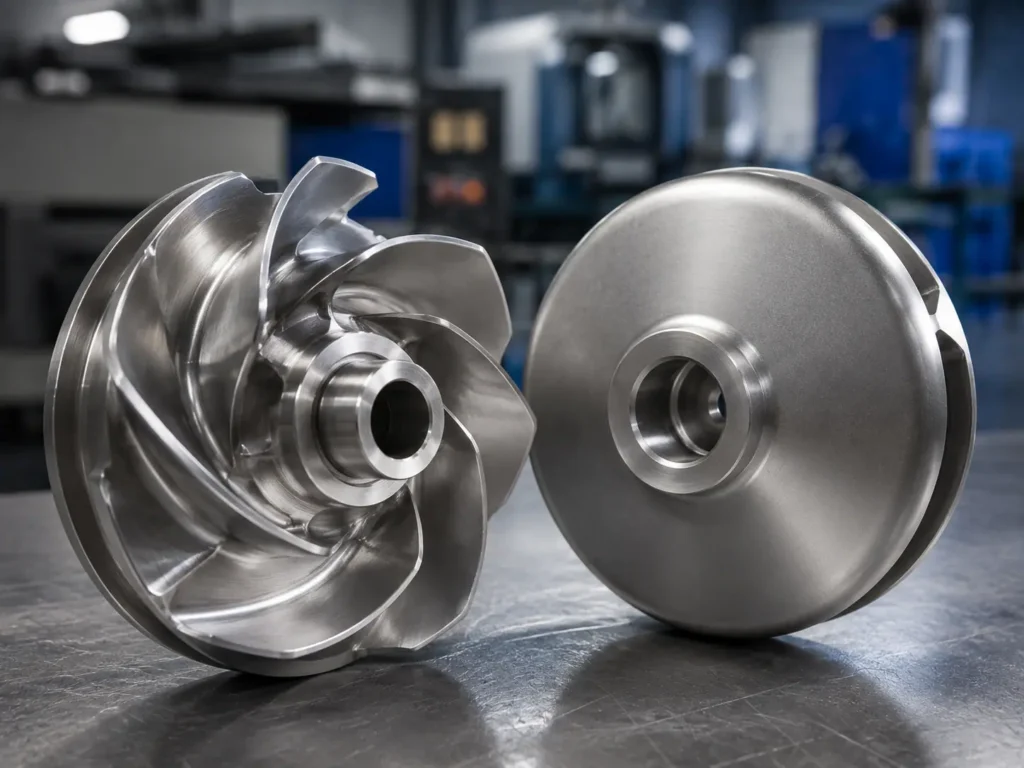
The impeller eye is the inlet opening where liquid enters a pump impeller before the vanes move it outward. In a centrifugal pump, the eye area affects suction flow, inlet velocity, cavitation risk, casting geometry, CNC machining access, and how accurately a replacement impeller can be made from a drawing or worn sample.
Short answer: buyers should confirm the impeller eye diameter, inlet shape, vane entry condition, hub relationship, wear pattern, material, pump speed, and suction-side operating condition before ordering a custom pump impeller. Matson can manufacture pump impellers from drawings, 3D files, samples, and project specifications, but final hydraulic sizing and pump selection should stay with the pump OEM or engineering owner.
Matson manufactures centrifugal pump impellers and other custom pump impellers for industrial pump projects. This article explains what buyers should check around the impeller eye before sending an RFQ.
What Is the Impeller Eye?
The impeller eye is the opening at the suction side of an impeller. Liquid enters through this area and then moves into the vane passages. On many centrifugal pump impellers, the eye is easy to see from the front side. On double suction impellers, there are inlet areas on both sides.
The eye is not just a hole in the part. Its diameter, edge condition, inlet radius, vane entry, shroud shape, and relationship to the pump casing can affect fit and service performance. For manufacturing, it is also one of the areas where a worn sample can be misleading.
If the old impeller has cavitation damage near the eye, or if the inlet edge is worn thin, copying the sample without checking the original drawing may reproduce a damaged geometry.
Why the Eye Area Matters Before Manufacturing
For a custom impeller project, the eye area often connects several problems: suction flow, cavitation, material wear, casting quality, machining access, and dimensional inspection.
| Eye-area item | Why it matters | What buyers should confirm |
|---|---|---|
| Eye diameter | Controls the inlet opening and affects how the part matches the original pump design. | Approved drawing dimension, tolerance, and whether the sample is worn. |
| Vane entry | The vane inlet shape guides liquid from the eye into the passage. | Vane count, vane direction, inlet edge condition, and photos from the suction side. |
| Hub and bore relationship | The hub, bore, and keyway decide how the impeller sits on the shaft. | Bore, hub height, mounting face, shaft fit, keyway, taper, or thread details. |
| Inlet edge wear | Cavitation, corrosion, or abrasion can remove material near the eye. | Damage photos, service history, liquid condition, and reliable original dimensions. |
| Casting and machining access | Complex inlet geometry may need careful casting allowance and finishing. | Casting route, CNC machining plan, inspection points, and surface finish requirement. |
| Suction-side condition | Poor suction condition can damage the new impeller again. | Pump speed, liquid temperature, NPSH review by engineering owner, suction pipe condition, and operating point. |
Outside diameter gets most of the attention in many RFQs. That is understandable, but it is not enough. A replacement impeller can have the right OD and still be wrong if the eye, hub, bore, vane inlet, or casing relationship does not match the pump.
Impeller Eye Diameter and RFQ Risk
The phrase “impeller eye diameter” sounds simple, but buyers should be careful about how the dimension is measured. The opening may include a radius, chamfer, worn edge, shroud curve, or vane entry that makes field measurement difficult.
If you measure a used impeller, mark which surface was measured and whether the edge is damaged. A caliper reading from a worn inlet may not represent the original design. If the impeller has corrosion, cavitation pitting, or broken vane tips near the eye, the safest reference is the approved drawing or a less damaged sample.
For Matson’s manufacturing review, useful eye-area information includes:
- Eye diameter and tolerance from the drawing
- Front-side photos showing the full inlet opening
- Close-up photos of vane entry and damaged areas
- Bore, hub height, keyway, mounting face, and shaft fit
- Outside diameter, outlet width, shroud details, and rotation direction
- Material grade, liquid condition, solids, temperature, and service history
- Pump speed, balancing requirement, and inspection report needs
This is also why Matson’s pump impeller design guide treats eye diameter as one part of the wider geometry review, not a standalone dimension.
Eye Damage, Cavitation and Wear
Cavitation damage often appears near the impeller eye because pressure can drop in the suction-side inlet area. The surface may look rough, pitted, torn, or honeycomb-like. Abrasion can also remove material near the inlet if the liquid carries sand, grit, slurry, or other solids. Corrosion can make the inlet edge thinner or uneven.
The practical point: do not assume every damaged eye area has the same cause.
| Observed condition near the eye | Possible cause | RFQ note |
|---|---|---|
| Pitting or torn-metal texture | Cavitation or unstable suction condition. | Send suction-side photos, pump speed, liquid temperature, and operating history. |
| Smooth directional wear | Abrasion from solids, sand, slurry, or dirty liquid. | Confirm solids, particle size, material, and wear history. |
| Uneven corrosion or edge thinning | Chemical attack, chloride exposure, or material mismatch. | Confirm liquid chemistry, pH, chloride, temperature, and current material. |
| Cracks near vane inlet | Stress, vibration, casting defect, severe wear, or repeated overload. | Send multiple photos, operating speed, balance history, and failure interval. |
| Old repair marks | Welding, grinding, or modification on the sample. | Identify repaired areas so they are not copied blindly. |
For deeper failure discussion, Matson’s pump impeller cavitation article explains why material choice alone cannot fix a suction or operating-point problem.
Single Suction vs Double Suction Eye Areas
In a single suction centrifugal impeller, liquid enters from one side. In a double suction impeller, liquid enters from both sides. That difference changes the manufacturing review.
For a single suction impeller, buyers should confirm the inlet eye, bore side, hub side, vane direction, and casing relationship. For a double suction impeller, both inlet eyes need attention. Side-to-side symmetry, dual wear-ring surfaces, axial position, and balancing can become more sensitive.
If only one side of a double suction impeller is worn, the damaged side should not automatically be used as the reference. Photos and dimensions from both sides are important. For a deeper structural discussion, see double suction impeller centrifugal pump.
Casting, CNC Machining and Inspection Notes
The eye area may be formed by casting, finished by machining, polished, or left with a controlled as-cast surface depending on the drawing and pump design. The correct route depends on material, geometry, tolerance, surface finish, and quantity.
Manufacturing points to review include:
- Casting allowance around the inlet and vane entry
- Machining datum for bore, hub, eye, and OD
- Surface finish requirement near the inlet
- Radius, chamfer, or edge-break detail
- Inspection access for internal vane passages
- Balance after final machining
- Material certificate and dimensional report requirements
For cast-and-machined impellers, the part should be reviewed as a complete rotating component. The eye area, bore, hub, OD, outlet width, vane entry, and balance condition all connect. Matson’s impeller manufacturing page explains the broader casting, CNC machining, inspection, and dynamic balancing scope.
What Buyers Should Send
For an impeller eye or eye diameter review, send more than one front photo. A useful RFQ package includes:
- Approved 2D drawing, 3D file, or reliable sample
- Front, back, side, bore, hub, vane inlet, and damaged-area photos
- Eye diameter, outlet width, OD, bore, hub height, keyway, and mounting face
- Rotation direction and viewing side
- Current material grade and required material if different
- Liquid, temperature, solids, corrosion, abrasion, and cavitation history
- Pump speed, balancing grade, and report requirements
- Quantity, batch schedule, and export documentation needs
If the eye is damaged, mark it clearly. Also mark any surfaces that were repaired, welded, ground, trimmed, or heavily worn. That small note can prevent a wrong dimension from becoming the basis for a new batch.
Common Questions We Actually Get
What is the eye of an impeller?
The eye of an impeller is the suction-side inlet opening where liquid enters before moving into the vane passages. In centrifugal pump impellers, it is an important geometry and inspection area.
Is impeller eye diameter enough for a quote?
No. Eye diameter helps, but buyers should also send OD, bore, hub height, keyway, vane count, outlet width, rotation direction, material, pump speed, and damage history.
Why does cavitation often appear near the impeller eye?
Cavitation often starts where local pressure drops, and the suction-side inlet area can be vulnerable. The exact cause should be checked against suction condition, operating point, liquid temperature, and impeller geometry.
Can Matson copy the eye area from a worn sample?
Matson can review sample-based manufacturing, but a worn or cavitation-damaged eye area should not be copied blindly. Drawings, reliable dimensions, and damage photos are important.
Is a double suction impeller eye different?
Yes. A double suction impeller has inlet areas on both sides, so buyers should confirm both eye dimensions, side-to-side symmetry, wear-ring surfaces, shaft fit, and balancing requirements.
Send Us Your Drawing
Need a custom pump impeller reviewed from a drawing, sample, or damaged part? Send Matson the eye diameter, bore, hub, vane inlet photos, material grade, liquid condition, pump speed, balancing requirement, quantity, and inspection needs through the contact page. We can review the part from a manufacturing, casting, CNC machining, inspection, and RFQ perspective before quoting.