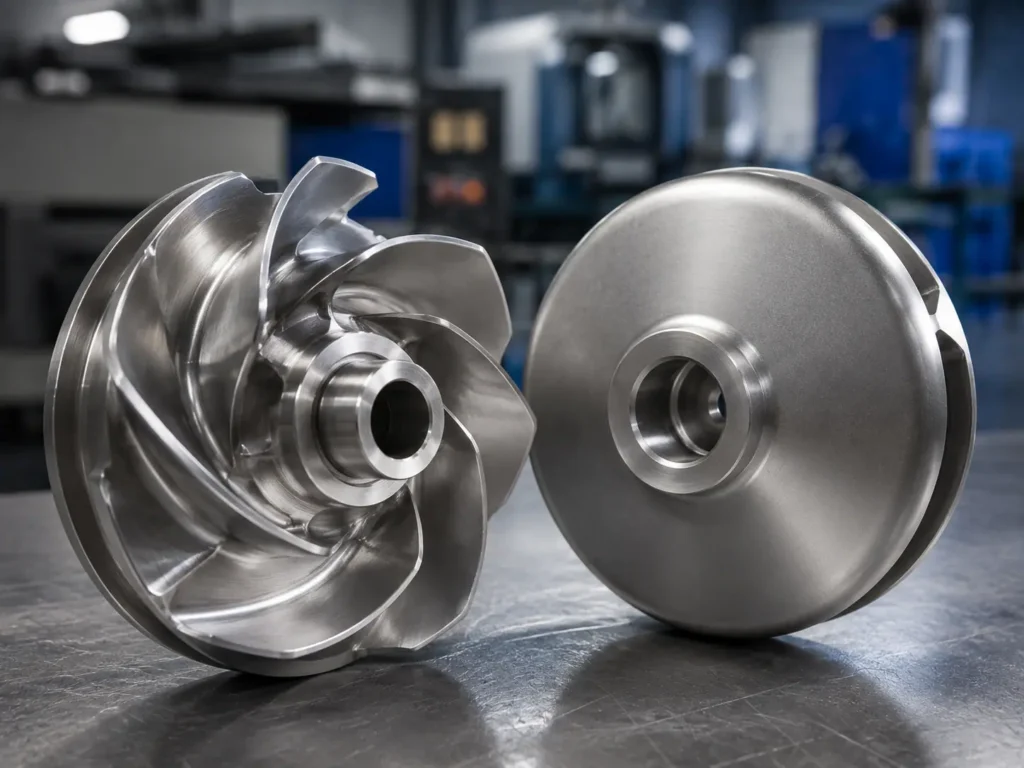
Impeller velocity and BEP flow rates in slurry pumps for mining should be treated as engineering review context, not as a shortcut for selecting or redesigning a pump. For buyers, the practical question is simple: does the impeller drawing, material, casting route, machining plan, and balancing requirement match the slurry duty near the intended operating range?
Short answer: BEP means best efficiency point, the flow rate where a pump operates most efficiently under a given test condition. Impeller velocity can refer to tip speed, passage velocity, or local flow velocity through the impeller. In mining slurry service, these numbers matter because abrasive solids, density, particle size, and operating away from BEP can change wear, vibration, and wet-end part life. Matson uses this information to review custom impeller manufacturing details, while final hydraulic selection should remain with the pump OEM or engineering owner.
Matson manufactures slurry pump impellers for mining applications from drawings, samples, and technical specifications. If a buyer sends flow rate, duty point, pump speed, material grade, solids data, and worn-part photos, the manufacturing review becomes much more useful than quoting from an outside diameter alone.
What BEP Flow Means in a Slurry Pump Discussion
BEP is the best efficiency point of a pump curve. It is normally discussed as a flow rate, with corresponding head, power, speed, and efficiency. A pump running close to BEP is generally in a more stable hydraulic region than one running far to the left or right of the curve.
That does not mean BEP is a magic number for slurry service. Clean-water pump curves do not fully describe mining slurry behavior. Solids concentration, particle size, particle hardness, slurry density, pipe losses, and settling risk can change the actual operating picture.
Hydraulic Institute ANSI/HI 12.1-12.6 is a more relevant reference mindset for slurry pumps because slurry service differs from clear-water service and can alter pump performance while causing wet-end wear. For buyer communication, that is the key point: BEP and flow rate belong inside a slurry-specific conversation.
What Impeller Velocity Means
The phrase impeller velocity can mean different things in different conversations. A buyer should confirm what is being discussed before making a manufacturing decision.
In a basic RFQ, velocity often points to impeller tip speed. Tip speed is calculated from outside diameter and rpm. Matson covered that calculation in the article on impeller tip speed in slurry pumps.
In a pump engineering conversation, velocity can also refer to the flow velocity through impeller passages, inlet areas, outlet areas, or local wear zones. Those numbers depend on pump geometry and duty condition. A manufacturing supplier should not guess them from a photo.
BEP, Velocity and Manufacturing Review
The useful manufacturing question is not “what is the highest velocity this impeller can handle?” That question is too loose. A better question is: “What operating data should be checked before manufacturing this impeller for a mining slurry pump?”
| Buyer information | Why it matters near BEP or flow review | Manufacturing point to confirm |
|---|---|---|
| Flow rate and duty point | Shows whether the impeller is expected to run near the intended operating range. | Do not quote from diameter only when flow and head are critical. |
| Pump speed and impeller diameter | Controls tip speed and affects stress, wear, and balancing discussion. | Confirm finished OD, trim diameter, rpm, VFD range, and balance requirement. |
| Slurry density and solids concentration | Changes load, wear severity, and power demand. | Confirm material, section thickness, casting route, and inspection points. |
| Particle size and hardness | Hard or coarse particles can accelerate vane and shroud wear. | Review passage width, leading edges, wear zones, and material grade. |
| Operating away from BEP | May increase recirculation, vibration, and uneven wear. | Ask for worn-part photos and balancing history before repeating the part. |
| Existing failure pattern | Wear, cracking, pitting, or vibration marks can reveal a process mismatch. | Check material, heat treatment, machining datum, bore, hub, and balance. |
Why Mining Slurry Makes the Topic Harder
Mining pumps rarely handle gentle service. Tailings, mineral processing slurry, coal preparation slurry, dredging slurry, and other abrasive duties can combine high solids, sharp particles, variable density, and long operating hours.
When flow rate moves too far from the intended operating region, the impeller may see uneven loading and unstable internal flow. With clean water, the result might be lower efficiency or vibration. With abrasive slurry, the same behavior can become faster wear on the vane inlet, vane outlet, shroud, throatbush, liner, or clearance areas.
This is why the article should stay conservative. A manufacturer can use BEP, flow rate, and velocity information to review whether the impeller is practical to cast, machine, inspect, and balance. It should not promise that a copied impeller will fix a system curve, pipe velocity, sump issue, or upstream solids problem.
For geometry-level discussion, see Matson’s article on slurry pump impeller design.
Material Notes for Velocity and Flow Conditions
Material selection should not be separated from velocity and flow condition.
A slurry pump impeller running near a reasonable duty point may still wear quickly if the material does not match particle hardness or corrosion. A high-chrome white iron impeller can be useful for abrasive wear in some duties, and ASTM A532 is often referenced for high-chromium abrasion-resistant cast irons. But high-chrome is not a universal answer. Impact, corrosion, section thickness, machining surfaces, and heat treatment still matter.
Stainless steel, duplex stainless, bronze, carbon steel, alloy steel, or hard iron choices should be reviewed against the actual slurry. If corrosion and abrasion occur together, the material question becomes more complicated than a single hardness number.
For a deeper material article, see slurry pump impeller material selection.
Manufacturing Notes Buyers Should Not Skip
If the impeller is already selected by the OEM or engineering team, manufacturing still has three review points worth getting right before production:
- Confirm the drawing matches the duty condition. A worn sample can be misleading because the OD, vane edges, and clearances may no longer represent the original part. Photos help, but they do not replace dimensions.
- Confirm the casting and machining plan. The bore, hub, mounting face, keyway, wear ring area, inlet eye, outlet width, and OD may need controlled machining after casting. For mining slurry parts, the rough casting surface, machining allowance, and inspection datum should be discussed before production. Matson’s impeller manufacturing capabilities page explains the broader casting, CNC machining, inspection, and balancing scope.
- Confirm balancing. A heavy impeller running at higher speed, or a part with uneven wear history, should not be treated casually. ISO 21940-11 is a common reference for rigid-rotor balancing terminology and grades when a project specification requires it. The correct grade still needs to come from the drawing, pump speed, mass, and buyer requirement.
What Buyers Should Send Before Quoting
For a mining slurry pump impeller RFQ, send:
- Pump model or drawing number if available
- 2D drawing, 3D model, or sample photos
- Finished impeller diameter and trim diameter
- Pump speed, VFD range, and normal operating rpm
- Flow rate, head, duty point, and pump curve if available
- BEP flow information if the OEM or engineering team provides it
- Slurry density, solids concentration, particle size, and particle hardness
- Material grade, previous material, and any ASTM or project specification
- Bore, hub height, keyway, mounting face, inlet eye, outlet width, and rotation direction
- Wear pattern photos, failure interval, and vibration history
- Required casting route, CNC machining surfaces, inspection report, and balancing requirement
If some data is missing, send what you have. A drawing plus operating context is still better than a drawing alone.
Common Questions We Actually Get
What is BEP flow in a slurry pump?
BEP flow is the flow rate at the pump’s best efficiency point under a defined condition. In slurry service, it should be reviewed together with solids, density, wear, and the actual operating duty.
Does Matson select the BEP for a mining slurry pump?
No. Matson manufactures impellers from drawings, samples, and specifications. BEP selection, pump curve confirmation, and hydraulic responsibility should stay with the pump OEM or engineering owner.
Why does impeller velocity matter in mining slurry pumps?
Impeller velocity matters because speed, diameter, passage geometry, solids, and particle hardness can affect abrasive wear, vibration, material choice, and balancing requirements.
What information should I send for a slurry pump impeller quote?
Send the drawing or sample, diameter, rpm, flow and head data, slurry condition, material grade, worn-part photos, quantity, machining requirements, and balancing requirement.
Can the same impeller drawing work at different flow rates?
It might, but the operating range should be checked by the pump OEM or engineering team. From the manufacturing side, different speed, flow, and wear conditions can change material, machining, inspection, and balancing review.
Send Us Your Drawing
Need a custom mining slurry pump impeller manufactured from a drawing or sample? Send Matson the drawing, pump speed, flow data, slurry condition, material grade, worn-part photos, quantity, and balancing requirement through the contact page. We can review the manufacturing route before quoting.