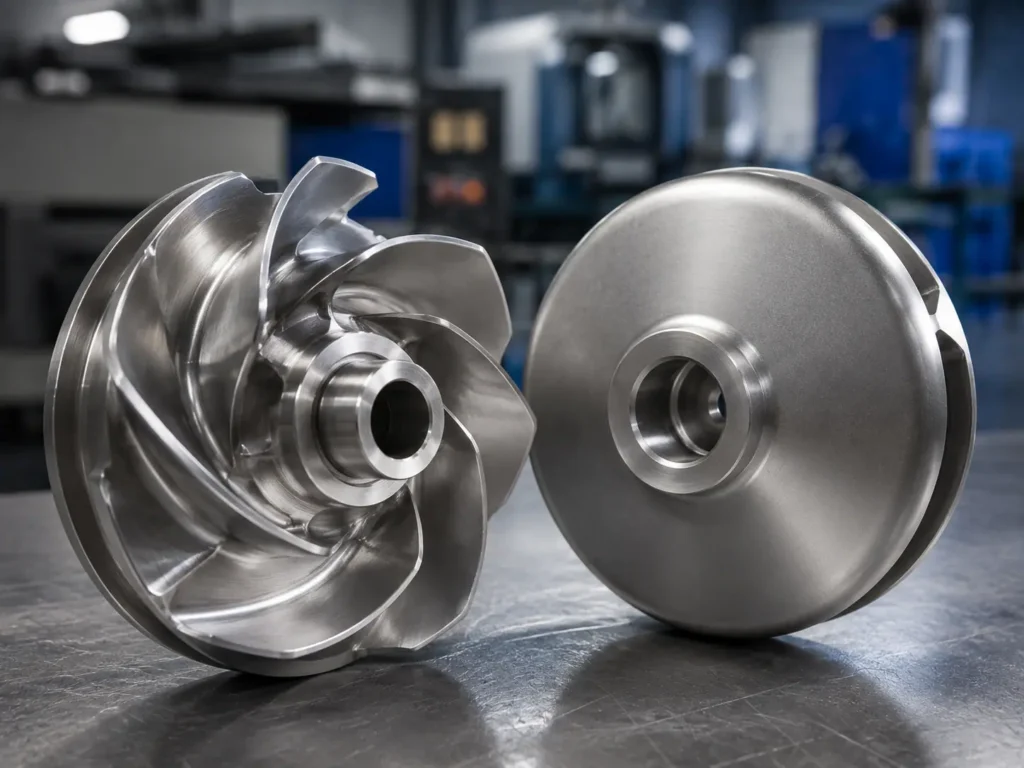
A sludge pump impeller is used where the pumped liquid carries thick sludge, suspended solids, grit, fibers, organic matter, or settled material that can clog narrow passages and wear metal surfaces. For custom manufacturing, the important question is not only the impeller name. Buyers should confirm sludge consistency, solids content, particle size, viscosity, abrasiveness, corrosion, pump speed, impeller type, material, clearance, and balancing requirement before requesting a quote.
Short answer: a sludge pump impeller should be reviewed for solids passage, clogging risk, abrasive wear, corrosion, fit with the casing, and manufacturing repeatability. Vortex, open, semi-open, recessed, and other pump-specific impeller forms may be used, but the final choice should come from the pump OEM, drawing, and working condition. Matson manufactures custom sludge pump impellers from drawings, samples, and specifications for industrial and municipal projects.
Matson’s water and wastewater impeller work covers custom metal impellers for sewage, sludge, wastewater, and solids-handling pumps. The focus here is industrial and municipal sludge service — not household pump repairs or off-the-shelf replacement parts.
Sludge Is Not Just Dirty Water
Sludge is usually more difficult than normal wastewater because it may be thicker, heavier, more abrasive, and less predictable. It can contain organic solids, grit, sand, fibers, settled particles, chemical residue, or mineral content. Some sludge flows easily. Some behaves like a sticky semi-solid. Those two conditions should not lead to the same impeller discussion.
That is why the first review should start with the material being pumped. Is it primary sludge, activated sludge, digested sludge, industrial sludge, mining sludge, chemical-process sludge, or wastewater with heavy settled solids? Does it contain sand or grit? Does it settle quickly? Does it contain stringy fibers? Does it corrode stainless steel, carbon steel, or bronze?
The word “sludge” gives a direction. It does not provide enough data for manufacturing.
What Makes a Sludge Pump Impeller Different
Sludge pump impellers are usually judged by passage, wear, and reliability before clean-water efficiency. A design that works well in clear water may clog, wear, or lose performance quickly when the liquid carries heavy solids.
| Sludge condition | Impeller concern | What buyers should confirm |
|---|---|---|
| High solids content | Narrow passages can clog or lose flow. | Solids percentage, particle size, maximum solids, and whether solids settle quickly. |
| Sticky or fibrous sludge | Fibers can wrap around vane edges, hub areas, or casing features. | Fiber type, clogging history, cleaning frequency, and current impeller geometry. |
| Grit or sand | Abrasion can thin vane edges, shrouds, and clearance surfaces. | Particle hardness, grit load, wear pattern, material grade, and expected service life. |
| Chemical or industrial sludge | Corrosion and abrasion may happen together. | pH, chloride, temperature, chemical exposure, material specification, and certificates. |
| Variable sludge consistency | The pump may see thin liquid one hour and heavy sludge later. | Duty cycle, startup condition, settling behavior, and whether the pump runs continuously or intermittently. |
| Worn sample only | The sample may no longer show original vane thickness or outside diameter. | Mark worn, repaired, corroded, and rubbed areas before using the sample for reproduction. |
Vortex, Open, Semi-Open and Recessed Directions
There is no universal “best kind of impeller for pumping sludge.” The right direction depends on the pump design and the sludge condition.
A vortex or recessed impeller direction is often discussed when keeping solids away from tight vane passages matters more than maximum efficiency. In many designs, the impeller creates circulation in the casing while allowing more difficult solids to pass with less direct contact through narrow channels. This can help with clogging, but it does not make the pump immune to every fiber, rag, or settled solid.
Open impellers can be easier to inspect and clean. They may suit sludge with moderate solids when the pump design allows exposed vanes and controlled clearance. The tradeoff is that vane edges and front clearance can wear, and efficiency may be lower than more enclosed clean-liquid designs.
Semi-open impellers sit between open and closed structures. They may offer more hydraulic control than a fully open impeller while still giving some solids tolerance. But open-side clearance and wear-plate or casing relationship must be controlled carefully.
For broader custom pump manufacturing context, see Matson’s custom pump impellers page.
Wear and Material Review
Sludge pump impeller material should be selected around both wear and corrosion. It is easy to over-simplify this step.
If the sludge contains sand, grit, mineral particles, or hard solids, abrasion becomes the main threat. Vane leading edges, exposed passages, shroud surfaces, OD, and casing-clearance areas may lose material. If the sludge is chemically aggressive, corrosion can weaken the surface before solids remove it faster.
Stainless steel, duplex stainless, carbon steel, alloy steel, bronze, high-chrome or hard alloy materials, and other specified grades may be reviewed according to the drawing and service. No material is automatically best. Stainless steel may help with corrosion but still wear quickly under abrasive grit. A harder material may resist wear but may not be suitable for the chemistry, casting route, machining, or cost target.
For abrasive-media material context, Matson’s slurry pump impeller material guide is a useful related reference. Sludge is not always mining slurry, but the wear questions often overlap.
Clogging and Failure Patterns
When a sludge pump impeller fails or underperforms, the damage pattern is useful.
Fibers wrapped near the hub or vane roots point toward passage and geometry issues. Worn vane tips may point toward abrasion, rubbing, or clearance problems. A polished ring on the OD or shroud can indicate contact with the casing or wear plate. Pitting can indicate corrosion, cavitation-like damage, or combined attack. Cracked areas may involve impact, casting quality, stress, imbalance, or previous repair.
Do not ask a manufacturer to copy a damaged sludge impeller without explaining what happened. The sample may be missing original vane thickness, outside diameter, hub height, or clearance surfaces. If the sample has repair welds or heavy grinding marks, those areas should be marked clearly.
A simple photo is helpful, but it is not enough. Send close-ups of the bore, hub, vane entries, worn edges, rubbed areas, cracked areas, and any area where sludge collects or wraps.
Manufacturing Checks Before Quoting
Sludge service makes manufacturing details more important, not less important.
| Manufacturing check | Why it matters | Buyer should send |
|---|---|---|
| Impeller type and casing fit | Solids-handling behavior depends on the pump geometry, not only the impeller name. | Drawing, casing section, impeller position, rotation direction, and photos inside the casing if available. |
| Passage and vane geometry | Small changes can affect clogging, wear, and repeatability. | Vane count, passage width, OD, inlet area, outlet width, and worn-area photos. |
| Bore, hub, keyway, and mounting face | Fit errors can create vibration, rubbing, or assembly failure. | Shaft size, bore tolerance, hub height, keyway, mounting face, and datum details. |
| Material and casting route | Wear-resistant or corrosion-resistant materials may need different casting and machining planning. | Material grade, standard, certificate need, heat treatment if required, and service condition. |
| Clearance and wear surfaces | Sludge and grit can punish poor clearance control. | Wear-plate, casing, OD, shroud, and mating-part dimensions. |
| Balancing and inspection | Uneven geometry or service wear can create vibration. | Pump speed, balance grade, dimensional report, material certificate, and inspection requirement. |
Matson’s impeller manufacturing process can include casting, CNC machining, surface treatment, dimensional inspection, dynamic balancing, material documentation, and export packing when the project requirements are defined.
What Buyers Should Send for a Sludge Pump Impeller RFQ
Send:
- 2D drawing, 3D file, or physical sample
- Pump application: wastewater sludge, treatment plant sludge, industrial sludge, mining sludge, or process sludge
- Sludge consistency, solids percentage, particle size, grit, sand, fiber, and settling behavior
- Current problem: clogging, fast wear, corrosion, rubbing, vibration, low flow, or repeated failure
- Current impeller type and pump casing information
- Photos of the existing impeller from front, back, side, bore, hub, vane, and worn areas
- Material grade, existing material, required standard, certificate, and testing requirements
- Outside diameter, bore, hub height, keyway, mounting face, and critical clearances
- Pump speed, duty condition, impeller mass, balancing grade, and report requirement
- Surface finish, coating, passivation, or inspection requirement if specified
- Quantity, batch schedule, export packing, and documentation needs
If the old sample is heavily worn, measure it carefully and mark unreliable surfaces. A sludge pump impeller can lose material in exactly the areas that matter most for manufacturing.
Common Questions We Actually Get
What type of impeller is best for pumping sludge?
There is no single best type. Vortex, recessed, open, and semi-open impellers may be used depending on solids, viscosity, fibers, grit, casing design, pump speed, and service goal.
Is a recessed impeller sludge pump good for clogging?
A recessed or vortex-style impeller can help reduce clogging in selected pump designs because solids may pass with less direct contact through narrow vane passages. It still needs casing, solids, speed, and material review.
What causes fast wear on a sludge pump impeller?
Fast wear often comes from grit, sand, mineral particles, high solids content, poor material fit, wrong clearance, corrosion-abrasion, or operation outside the intended duty condition.
Can Matson manufacture a sludge pump impeller from a worn sample?
Yes, Matson can review sample-based manufacturing, but worn vane edges, OD, bore, hub, and clearance surfaces should not be copied blindly. Drawings or mating dimensions make the review safer.
What information is most important for a sludge pump impeller quote?
Send the drawing or sample, sludge condition, solids and grit details, material grade, pump speed, casing relationship, failure photos, critical dimensions, quantity, and balancing requirement.
Send Us Your Drawing
Need a sludge pump impeller manufactured from a drawing, 3D file, or sample? Send Matson your sludge condition, solids details, material grade, worn-part photos, critical dimensions, pump speed, quantity, and balancing requirement through the contact page. We can review material, casting, machining, inspection, balancing, and manufacturing feasibility before quoting.