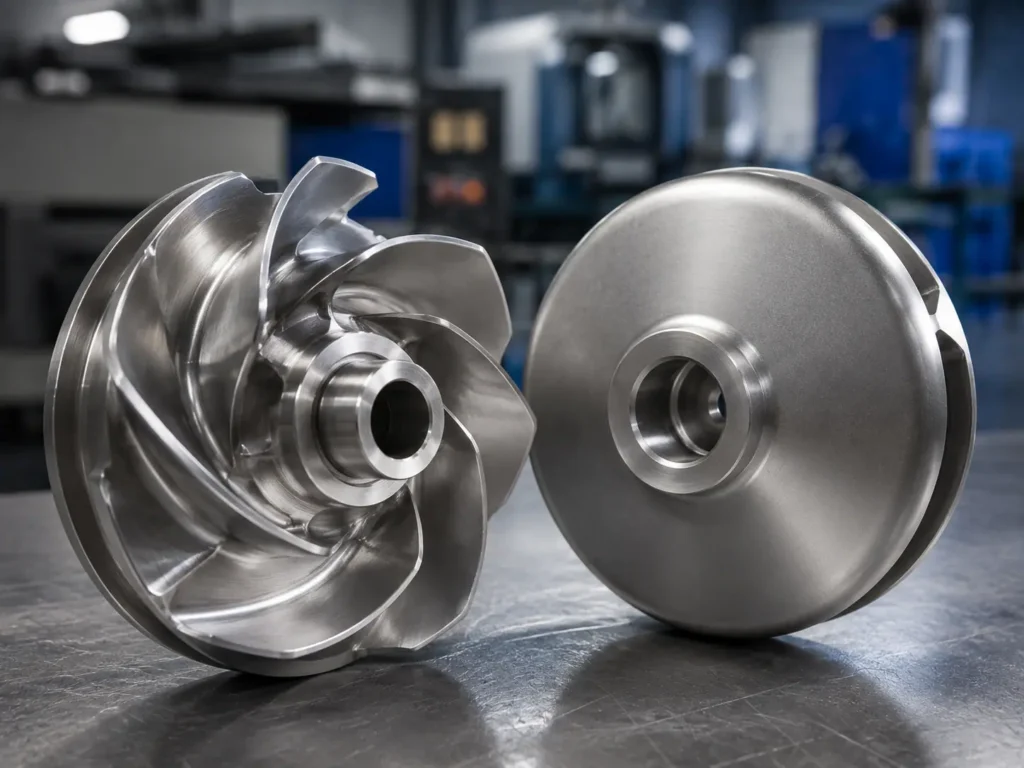
A reverse vane impeller is a pump impeller configuration in which the main working vanes and the critical running-clearance relationship are arranged toward the rear cover or backplate side rather than being treated like a conventional front-open impeller. In industrial process pumps, the term is commonly used for a manufacturer-specific semi-open impeller arrangement designed to work with a defined rear-side clearance and axial adjustment method.
The important caution is that “reverse vane impeller” is not one universal geometry. Pump manufacturers use different casing, cover, wear, adjustment, and vane arrangements. A replacement or custom RFQ must be based on the correct pump drawing, section view, sample condition, rotation direction, and mating-part dimensions—not the name alone.
Matson can review custom industrial pump impellers from drawings, 3D files, samples, and specifications. Hydraulic selection, clearance setting, and approval should remain with the pump OEM or responsible engineering owner.
[Image placeholder: Add a real side-by-side inspection image of a reverse vane impeller and a conventional open impeller with the rear cover side, front casing side, bore, hub, vane direction, and running-clearance surfaces clearly marked. Alt text: “Reverse vane impeller vs open impeller clearance and manufacturing features”]
Reverse Vane Impeller vs Open Impeller
The useful comparison is not simply which design is “better.” Buyers need to identify which side controls the running clearance, how wear is compensated, which mating surface belongs to the pump, and whether the sample still represents the original dimensions.
| Review point | Reverse vane arrangement | Conventional open or front-clearance arrangement |
|---|---|---|
| Primary clearance relationship | Often referenced to the rear cover or backplate side under the pump OEM’s design. | Often referenced between open vane edges and the casing or front wear surface. |
| Adjustment direction | Axial setting follows the reverse-vane pump’s approved rear-clearance procedure. | Axial setting follows the pump’s approved front-clearance procedure. |
| Sample measurement risk | Rear vane or cover wear can hide the original controlling dimension. | Front vane-tip or casing wear can hide the original controlling dimension. |
| Drawing requirement | Rear-side section, cover relationship, axial stack, and datum are essential. | Front-side vane, casing or wear-plate relationship, and datum are essential. |
| Interchangeability | Do not assume interchangeability with an open impeller of similar OD. | Do not convert to reverse vane without pump-owner engineering approval. |
Both structures can be called semi-open in some documentation. Terminology varies. The section drawing and mating components are more reliable than a catalog label.
Why the Clearance Side Matters
Running clearance affects leakage, recirculation, rubbing risk, axial position, and the relationship between the impeller and stationary pump parts. When the wrong side is treated as the controlling surface, a newly manufactured impeller can have the right outside diameter and bore but still sit incorrectly in the pump.
A buyer should confirm:
- Which stationary component controls clearance
- Whether the reference is the rear cover, casing, wear plate, or another surface
- Required cold clearance and the operating condition behind it
- Shaft, sleeve, bearing, gasket, and cover stack-up
- Direction of axial adjustment
- Permitted adjustment range after wear
- Which impeller face or vane edge is the inspection datum
- Whether the mating part is new, worn, resurfaced, or replaced
Do not copy a generic clearance value from another pump. The pump OEM’s drawing and service instructions should control the setting.
Matson’s pump impeller clearance guide explains why wear-ring, casing, tip, front, and back clearances must be reviewed as relationships between parts.
A Worn Sample Can Point to the Wrong Geometry
Sample-based manufacturing becomes risky when the controlling vane edge or cover-facing surface has worn away. Abrasion, corrosion, rubbing, cavitation-like damage, grinding, weld repair, and previous clearance adjustments can all change the sample.
Before measurement, mark:
- Rear vane edges and cover-facing wear pattern
- Front shroud, disc, or casing-side contact marks
- Bore scoring, sleeve wear, and keyway damage
- Hub face and shaft-side rubbing
- Vane thickness loss and directional erosion
- Previous grinding or metal buildup
- Balance correction marks, drilled areas, and attached weights
- Cracks near vane roots, hub transition, or stressed sections
If the sample and mating cover are both worn, measuring only the gap between them does not reveal the original design. Use an approved drawing, a reliable spare, pump assembly dimensions, or a documented engineering decision to restore critical geometry.
Dimensions Buyers Should Put in the RFQ
A reverse vane impeller RFQ needs more than OD, material, and quantity. Send a controlled section drawing and 3D model when available.
| Feature | Information to confirm | Manufacturing concern |
|---|---|---|
| Bore and shaft connection | Bore size and fit, taper or straight form, keyway, thread, sleeve, nut, and datum. | Controls assembly, concentricity, torque transfer, and machining setup. |
| Hub and mounting face | Hub diameter, height, face position, fillet, and axial stack. | Controls impeller location and rear-side clearance relationship. |
| Reverse vanes | Count, profile, height, thickness, inlet and outlet location, and rotation direction. | Worn vane edges should not become the automatic production master. |
| Rear cover relationship | Cover profile, mating diameter, datum, required gap, and adjustment method. | Requires coordinated impeller and stationary-part dimensions. |
| OD and axial width | Finished diameter, overall width, trim status, and casing envelope. | Affects fit, mass, balance, and approved pump geometry. |
| Runout and balance | Face and radial runout, operating speed, balance requirement, setup, and report. | Machining and mass correction must follow approved acceptance criteria. |
Also include material grade, casting or machining specification, surface treatment, inspection plan, quantity, operating liquid, solids, temperature, corrosion or abrasion condition, and required quality documents.
Rotation Direction Must Include the Viewing Side
“Clockwise” is incomplete without stating where the observer stands. A drawing should specify rotation as viewed from the drive end, suction end, impeller face, or another unambiguous reference.
For a reverse vane impeller, a mistaken view can reverse the assumed vane direction, inlet and outlet orientation, or cover relationship. Photos should show both sides and include a written viewing convention. If the pump casing or cover is available, include assembly photos and a section view.
Do not mirror a 3D model to create the opposite hand unless the pump owner has approved all affected geometry. Bore threads, keyway orientation, cover profile, vane curvature, balance correction zones, and casting details may also change.
Manufacturing Route Depends on Geometry and Material
Reverse vane impellers may use casting followed by CNC machining, direct machining for selected geometries, or another approved route. The correct choice depends on size, vane access, material, quantity, tolerance, surface requirement, and whether the geometry is already validated.
For a cast route, review draft, wall thickness, vane roots, feeding, machining allowance, surface cleanup, and accessible inspection points. Critical interfaces such as bore, keyway, hub face, and selected clearance surfaces may require finish machining.
For sample reproduction, the manufacturer should distinguish measured geometry from restored geometry. A scan can record the damaged sample accurately; it does not automatically reconstruct the unworn part.
Matson’s impeller manufacturing capabilities include casting, CNC machining, surface treatment, dimensional inspection, dynamic balancing, and export packing for suitable drawing-based projects.
Material Cannot Correct a Clearance or Pump Problem
Material selection should consider corrosion, abrasion, solids, temperature, strength, castability, machinability, and compatibility with the casing, cover, shaft, and process liquid. Stainless steel, duplex stainless, bronze, carbon steel, or another alloy should come from the approved specification.
A harder or more corrosion-resistant material may improve service life in the right duty, but it does not correct wrong axial setting, rubbing, poor suction conditions, off-design operation, shaft movement, or a damaged mating cover. When an old impeller failed, record the wear pattern and operating history before changing material.
Inspection Should Follow Functional Datums
The inspection report should show more than general dimensions. Confirm the datum scheme that links the bore, hub, mounting face, vane geometry, rear-side clearance surface, OD, and axial width.
Useful checks may include:
- Bore diameter, taper, roundness, and surface finish
- Keyway position and dimensions
- Hub height and mounting-face location
- Rear vane height at defined positions
- Profile or section comparison against the approved model
- OD and overall axial width
- Face and radial runout under the specified setup
- Material certificate and traceability
- Surface condition and required treatment
- Dynamic balancing result under the buyer’s acceptance requirement
An impeller can pass balancing and still have incorrect runout or axial geometry. Treat dimensional inspection and mass balance as separate controls.
Common Questions Buyers Ask
What is a reverse vane impeller?
It is a pump impeller arrangement commonly associated with rear-facing working vanes and a defined rear-cover clearance relationship. Exact geometry and terminology vary by pump manufacturer, so the controlled drawing should define the part.
Is a reverse vane impeller the same as an open impeller?
Not necessarily. Both may be described as semi-open, but the vane orientation, controlling-clearance side, cover or casing relationship, and adjustment method can differ. They should not be assumed interchangeable.
Which is better, a reverse vane or open impeller?
Neither is universally better. The correct choice belongs to the approved pump design and duty. Buyers should compare solids, wear, casing or cover arrangement, adjustment method, material, maintenance plan, and OEM requirements.
Can a reverse vane impeller be copied from a worn sample?
It can be reviewed, but worn rear vanes, rubbing, corrosion, grinding, bore damage, and previous repairs can hide the original dimensions. Critical geometry should be restored from reliable drawings, mating parts, or engineering approval.
Can Matson manufacture a custom reverse vane impeller?
Matson can evaluate selected reverse vane impeller projects from drawings, 3D files, samples, material specifications, dimensions, and inspection requirements. Manufacturing feasibility and scope are reviewed project by project.
Need a reverse vane impeller reviewed for custom manufacturing? Send Matson the controlled drawing, model, sample photos from both sides, pump section view, cover or casing dimensions, material, rotation direction, critical clearance, operating condition, quantity, balancing requirement, and inspection needs through the custom pump impeller quote page.