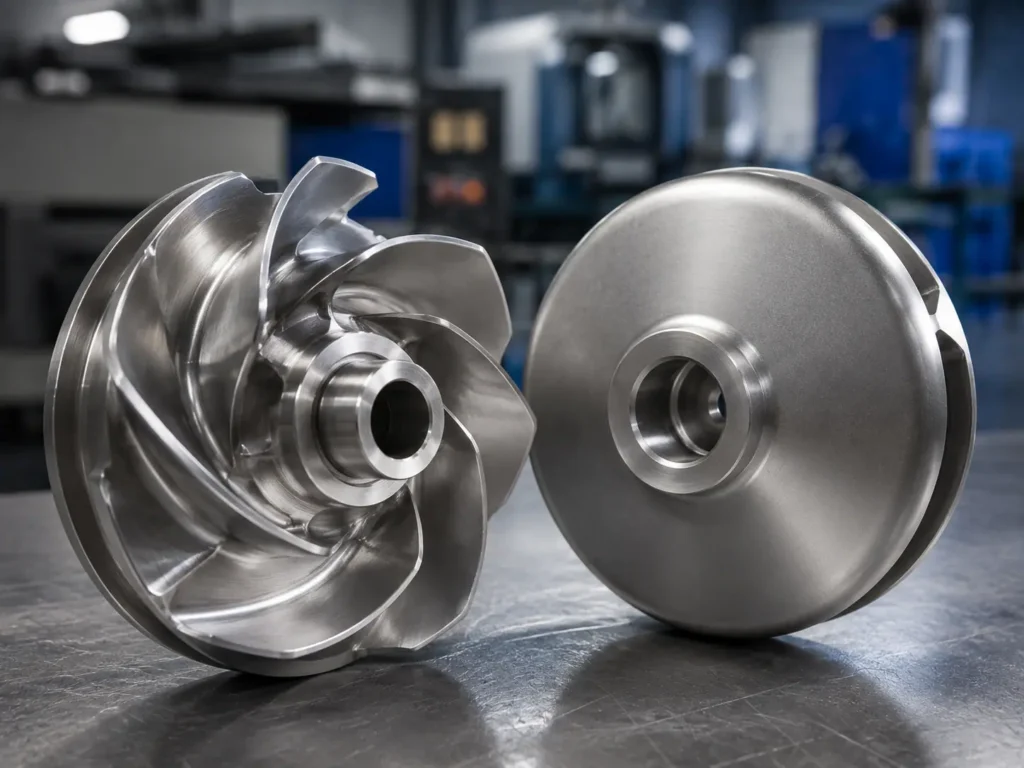
A mixed flow impeller moves liquid with both radial and axial flow components. In pump work, that means the liquid does not leave the impeller purely outward like a radial centrifugal impeller, and it does not move purely along the shaft like an axial-flow propeller. The geometry sits between those two directions, so buyers should treat it as a drawing-specific part, not a generic round casting.
Short answer: before custom manufacturing a mixed flow impeller, buyers should confirm the approved drawing, blade shape, hub profile, inlet and outlet dimensions, bore, keyway, casing relationship, material, pump speed, rotation direction, inspection points, and balancing requirement. Matson can manufacture mixed-flow pump impellers from drawings, 3D files, samples, and project specifications, while final hydraulic design and pump selection should remain with the pump OEM or engineering owner.
Matson manufactures custom pump impellers for industrial pump OEMs, equipment builders, and sourcing teams. This article focuses on mixed flow impeller manufacturing review and RFQ preparation.
What Is a Mixed Flow Impeller?
A mixed flow impeller combines radial and axial flow behavior. The liquid enters the impeller and leaves at an angle that has both outward and axial direction. This structure is often used where a pump needs higher flow than many radial centrifugal designs, while still producing more head than a pure axial-flow arrangement.
That is the simplified explanation. For manufacturing, the real part is more specific. Blade shape, blade angle, hub contour, shroud or open-side geometry, inlet eye, outlet width, outside diameter, and casing relationship all matter.
A mixed flow impeller should not be quoted from a photo and outside diameter alone. The blade and hub geometry carry too much of the part’s function.
Mixed Flow vs Radial vs Axial Flow
Use this comparison as a manufacturing and RFQ guide, not as a pump-selection shortcut.
| Impeller type | Flow direction | Typical discussion | Manufacturing note |
|---|---|---|---|
| Radial centrifugal impeller | Liquid mainly moves outward from the center. | Common in many centrifugal pump applications. | OD, eye, outlet width, shroud, wear-ring, hub, and balance are often critical. |
| Mixed flow impeller | Liquid leaves with both radial and axial direction. | Often discussed for higher-flow pump applications with moderate head. | Blade angle, hub profile, casing relationship, and outlet geometry need careful drawing review. |
| Axial flow impeller | Liquid mainly moves along the shaft direction. | Often associated with high-flow, low-head movement. | Blade pitch, hub, shaft fit, material, and balance are key manufacturing concerns. |
The important point is that “mixed flow” describes a behavior and geometry family. It does not define one universal blade shape. The drawing, sample, pump casing, and operating condition still decide the manufacturing route.
Why Mixed Flow Impeller Design Should Be Handled Carefully
Searchers often use the phrase “mixed flow impeller design.” For Matson’s manufacturing scope, this should be handled carefully.
Matson can manufacture to a provided drawing, 3D file, sample, or defined specification. The final hydraulic design, performance curve, and pump duty selection should stay with the pump OEM or engineering owner. That boundary matters because a small change in blade angle, hub contour, outlet width, or diameter can affect pump performance.
For a sourcing team, the safer question is not “Can you design a mixed flow impeller from scratch?” The better question is: “Can you manufacture this approved mixed flow impeller geometry accurately, with the required material, machining, inspection, and balancing?”
Geometry Details Buyers Should Confirm
Mixed flow impellers can look simple from one angle and become complicated once the blade and hub surfaces are checked. A useful RFQ should define the geometry that controls fit and manufacturing.
| Geometry item | Why it matters | What buyers should send |
|---|---|---|
| Blade shape and angle | Mixed-flow behavior depends heavily on blade geometry. | Drawing, 3D model, blade count, rotation direction, and photos from multiple sides. |
| Hub profile | The hub guides flow and controls shaft-side geometry. | Hub contour, bore, keyway, mounting face, taper, thread, or sleeve details. |
| Inlet and outlet dimensions | The part must match the pump casing and flow passage. | Inlet eye, outlet width, OD, trim diameter, and casing relationship. |
| Shroud or open-side structure | Some designs have shrouded areas; others are more open. | Front/back photos, shroud thickness, open-side clearance, and wear areas. |
| Material and section thickness | Material affects casting behavior, corrosion resistance, wear, and strength. | Specified grade, liquid condition, solids, temperature, corrosion, and certificate needs. |
| Balance and runout | Blade and hub variation can create vibration risk. | Pump speed, balancing grade, runout requirement, and report format. |
For a broader type overview, Matson’s pump impeller types guide explains how mixed-flow impellers fit among closed, open, semi-open, vortex, and slurry designs.
Manufacturing Route: Casting, CNC Machining and Inspection
Many mixed flow pump impellers are cast and then CNC machined at the functional interfaces. The correct process depends on size, material, blade complexity, tolerance, quantity, surface finish, and inspection requirement.
Common manufacturing review points include:
- Casting route and machining allowance
- Blade surface condition and cleanup access
- Hub and bore machining datum
- Keyway, taper, thread, or retaining detail
- Inlet eye, outlet edge, and OD control
- Shroud or open-side clearance surfaces if present
- Surface finish requirement
- Dimensional inspection points
- Dynamic balancing after final machining
If the buyer only has a sample, the sample condition matters. A worn blade edge, damaged hub, corroded surface, or repaired area can mislead the manufacturer. Mark worn or repaired areas clearly before quoting.
Matson’s impeller manufacturing capabilities include casting, CNC machining, dimensional inspection, dynamic balancing, surface treatment, and export packing when project requirements are defined.
Material and Service Condition
Mixed flow impellers can appear in water, wastewater, marine, chemical, cooling, and other industrial pump applications. Material should follow the drawing and operating condition, not the impeller name alone.
Clean water may point toward stainless steel, bronze, carbon steel, or another specified material depending on the pump. Seawater may require bronze, duplex stainless, or another corrosion-resistant alloy. Wastewater or dirty liquid may bring corrosion and solids together. Abrasive service needs a wear discussion, not only a corrosion discussion.
If the old impeller failed, send photos of the worn blade, hub, eye, outlet, and casing-contact areas. The damage pattern can affect material review, machining allowance, and whether a sample is safe to copy.
For material direction, use Matson’s pump impeller material selection article as a support reference.
What About Mixed Flow Impeller Fans?
The keyword data includes “mixed flow impeller fan.” That term can be relevant in fan and ventilation equipment, but this article stays mainly with pump impellers. The same manufacturing ideas still apply in a broad sense: blade geometry, hub fit, material, balancing, and inspection must match the drawing and operating speed.
For fan and blower projects, the better target page is Matson’s custom fan and blower impellers page. Do not mix pump duty and fan duty in the same RFQ without explaining the equipment type.
What Buyers Should Send for RFQ
For a mixed flow impeller project, send:
- Approved 2D drawing and 3D file if available
- Physical sample if drawing data is incomplete
- Photos from inlet, outlet, front, back, side, bore, hub, and damaged areas
- Blade count, blade direction, rotation direction, and viewing side
- OD, inlet eye, outlet width, trim diameter, hub profile, and casing relationship
- Bore, keyway, mounting face, taper, thread, sleeve, or retaining details
- Shroud, open-side clearance, wear-ring, or casing-clearance details if present
- Material grade, liquid condition, solids, corrosion, temperature, and service history
- Pump speed, balancing grade, runout requirement, and report needs
- Quantity, batch schedule, packing, and documentation requirements
If the part is copied from a worn sample, tell the manufacturer which dimensions are reliable. Mixed-flow blade and hub surfaces should not be reverse-guessed from damaged areas.
Common Questions We Actually Get
What is a mixed flow impeller?
A mixed flow impeller moves liquid with both radial and axial flow components. It is commonly discussed between radial centrifugal and axial-flow impeller behavior.
Is a mixed flow impeller the same as a centrifugal impeller?
It is related, but not always the same as a common radial centrifugal impeller. A mixed-flow design has a different discharge direction and blade/hub geometry, so the drawing should be checked carefully.
Can Matson design a mixed flow impeller?
Matson can manufacture mixed flow impellers from drawings, 3D files, samples, and specifications. Final hydraulic design and pump performance selection should be confirmed by the pump OEM or engineering owner.
What should buyers confirm before manufacturing a mixed flow pump impeller?
Confirm the drawing, blade shape, hub profile, inlet and outlet dimensions, bore, keyway, material, rotation direction, casing relationship, pump speed, inspection points, and balancing requirement.
Can a mixed flow impeller be made from a sample?
Yes, sample-based review is possible, but worn blade edges, damaged hubs, corrosion, and repaired areas should be marked clearly. A reliable drawing or 3D file is safer when performance-critical geometry is involved.
Send Us Your Drawing
Need a mixed flow impeller manufactured from a drawing, 3D file, or sample? Send Matson the drawing, blade and hub photos, material grade, liquid condition, pump speed, balancing requirement, quantity, and inspection needs through the contact page. We can review casting, CNC machining, inspection, and balancing requirements before quoting.