Direct Drive vs Belt Drive Blower Wheel: How to Choose for an Industrial Fan
Direct drive connects the blower wheel to the motor shaft or a direct coupling; belt drive transfers motor power through belts and sheaves to a separate fan shaft. Direct drive usually reduces drive components and routine belt service, while belt drive gives designers another way to set wheel speed and arrange the motor. Neither is automatically more efficient or reliable: choose from the required fan duty, speed-control method, environment, maintenance access, and the fan maker’s selection data.
First, separate the blower wheel from the drive system
A blower wheel (also called a fan wheel or blower impeller) is the rotating aerodynamic component. “Direct drive” and “belt drive” describe how the motor turns the fan assembly; they do not identify a wheel blade profile or prove that one wheel is suitable for a duty. A backward-curved, forward-curved, radial-blade, or airfoil wheel can be used only in configurations offered and validated by the equipment designer.
This distinction matters when you are sourcing a replacement-by-drawing or a new OEM wheel. The blower manufacturer or system engineer selects the complete fan, motor, drive, operating point, and safeguards. A custom wheel manufacturer should receive the approved wheel geometry and interface requirements—not be asked to infer a complete fan selection from the phrase “direct drive” or “belt drive.”
Direct drive vs. belt drive: practical comparison
| Decision factor | Direct-drive blower wheel | Belt-drive blower wheel | What to confirm before choosing |
|---|---|---|---|
| Power path | Wheel is mounted on the motor shaft, or connected through a direct coupling in a fan arrangement | Motor sheave drives a fan-shaft sheave through one or more belts | Does the fan arrangement use a motor-shaft wheel, a separate fan shaft, or a coupling? “Direct” is not always the same mechanical layout. |
| Speed setting | Wheel speed follows motor speed unless the motor/control system varies it | Speed can be selected through sheave ratio and may also use a variable-speed control | Ask the fan supplier for the actual operating RPM and approved speed range. |
| Commissioning changes | A different operating speed may require control changes, another motor speed, or a different fan selection | Sheave changes can provide a mechanical speed adjustment, within the manufacturer’s limits | Do not change pulley ratio or control settings without checking the fan curve, motor load, and maximum wheel speed. |
| Components and service | Fewer belt-drive parts; motor bearings and the wheel/motor interface still need correct selection and inspection | Adds belts, sheaves, fan shaft and often separate bearings; condition, tension and alignment require attention | Compare the full service plan, access, spares, and isolation procedure—not just the number of parts. |
| Layout | Often compact, but motor position and wheel-on-motor-shaft geometry can constrain the arrangement | Motor and fan shaft can be located separately; the assembly needs room for the drive and guarding | Check footprint, access, guard clearance, inlet/discharge arrangement, and any hazardous-area or temperature constraints. |
| Wheel interface | Motor-shaft diameter, extension, fit, retention, runout and bearing limits can directly govern the wheel design | Fan-shaft diameter, key/locking method, hub position and sheave overhang/load must be coordinated | Put shaft/bore, keyway, hub, locking, axial position and datum details on the controlled drawing. |
| Typical fit | Compact equipment or applications where a suitable motor speed and wheel selection are available | Applications needing a separate shaft arrangement or a mechanically selected speed, when permitted by the fan design | Final suitability comes from the certified/approved fan selection and duty—not a general rule of thumb. |
Twin City Fan’s engineering note on direct-drive fan selection describes the trade-off: direct-drive selections can be compact and have fewer maintenance items, but available motor speeds can limit selection unless speed control is used. Its V-belt drive selection guidance treats belt selection as an engineering task involving the complete drive and fan. Those are selection tendencies, not guarantees for every blower.
When direct drive is a reasonable candidate
Direct drive is worth evaluating when the selected motor speed can meet the required operating point, the wheel-to-motor connection is practical, and a compact assembly or fewer belt-service tasks is valuable. It can also simplify the power path by removing belts and sheaves. That does not remove all maintenance: the motor, bearings, wheel, mounting, controls, and guarding still need inspection according to the equipment maker’s instructions.
For variable airflow, verify how speed will actually be controlled. A variable-frequency drive (VFD) can change motor speed only when the motor, drive, fan, and operating range are compatible. Confirm the required minimum and maximum RPM, motor cooling at reduced speed, control limits, vibration behavior, and whether the fan curve still covers the required flow and pressure. “Direct drive” by itself does not mean variable speed.
Direct mounting also makes the motor shaft and wheel hub a critical interface. A wheel that fits the nominal bore can still be wrong if the shaft extension, keyway, shoulder, retention method, axial location, runout, or balance condition differs from the approved assembly. If you are buying a custom wheel, provide the motor/shaft drawing and assembly references rather than specifying only a bore diameter.
When belt drive may be worth evaluating
Belt drive can be useful where the equipment design benefits from a separate fan shaft or where the drive ratio is part of the approved speed selection. Motor placement may be more flexible than with a motor-shaft-mounted wheel, although the base, guarding, shaft, bearings, sheaves, belts, and access space all need to fit the installation.
The trade-off is added drive hardware and maintenance checks. Belt condition, tension, sheave alignment, bearing loads, guarding, and replacement access can affect service planning. Incorrect tension or alignment is not a harmless detail: it can contribute to drive wear, additional loads, noise, or vibration. Follow the fan and drive manufacturers’ specified procedure and values; do not apply a generic tension value to every installation.
Changing sheave diameters is not a substitute for a fan-system review. A speed increase can change fan power demand and may exceed wheel, shaft, bearing, or motor limits. Ask the equipment supplier to check the duty and allowable speed before changing a ratio. Where the required flow is known, the selection should also account for system resistance, air density and installation effects, rather than comparing drive types in isolation.
A decision sequence for OEM engineers and buyers
- Define the duty first. Record required airflow, static or total pressure basis, air density or temperature where relevant, operating hours, and the system configuration used for the fan selection. Keep normal, minimum, and maximum operating cases separate.
- Ask the fan supplier to select the complete assembly. Request the proposed wheel, fan arrangement, motor, drive method, operating speed, control method, and performance data for the stated duty. Do not select a drive from maintenance preference alone.
- Check speed and control limits. For direct drive, ask which motor speed or VFD range meets the duty. For belt drive, request the approved ratio and allowable adjustment range. Confirm maximum allowable RPM and motor load with the equipment designer.
- Review service and installation constraints. Compare space, access, guard removal, motor location, belt replacement needs, environmental exposure, and site maintenance capability. Where air temperature, corrosive atmosphere, combustible dust, or hazardous-area requirements apply, refer those conditions to the fan and motor suppliers.
- Freeze the wheel interface. Approve wheel diameter and width, blade geometry and direction, inlet side, hub, bore, keyway or locking method, shaft extension, axial position, retention, material, and applicable runout/balance requirements on the drawing.
- Plan inspection and release. State which dimensions are critical to assembly, what inspection evidence is needed, whether the balance requirement applies to the wheel alone or a defined assembly, and how any deviation must be approved.
Quick selection matrix
| If your priority or constraint is… | Start by evaluating… | Still verify… |
|---|---|---|
| Compact arrangement and fewer belt-service items | Direct drive | Suitable motor speed, motor-shaft/wheel fit, cooling/control range, and approved fan performance |
| Separate motor and fan shaft arrangement | Belt drive or another approved arrangement | Shaft/bearing design, sheave ratio, bearing load, alignment, guarding, and maintenance access |
| Frequent airflow adjustment | The fan maker’s direct-drive/VFD and belt-drive/control options | Stable duty range, motor/control compatibility, wheel limits, and the system curve |
| High temperature, corrosive or contaminated airstream | A fan arrangement designed for that exact environment | Motor/bearing location, materials, seals, temperature limits, and applicable safety requirements |
| Custom wheel procurement only | The wheel drawing and approved assembly data | Do not ask the wheel supplier to choose the motor, drive ratio, or complete fan duty without design authority and required data |
Manufacturing and balance checks are different from drive selection
The drive affects how the wheel is mounted and operated, but it does not replace wheel-level manufacturing control. For a custom industrial fan or blower wheel, define the drawing revision, material, manufacturing route, hub and bore features, blade position, weld or casting requirements where applicable, critical dimensions, and inspection records. Do not assume the same wheel can be transferred between motor shafts or fan shafts just because the nominal diameter matches.
Dynamic balancing also needs a defined condition. State the balance criterion or governing specification, the applicable speed and assembly condition, whether the wheel is balanced alone or with specified attached components, and what report is required. The fan designer should determine how the complete rotating assembly is verified. A wheel-only balance report does not by itself certify installed vibration performance; installation, alignment, foundation, system effects, and the rest of the rotating assembly also matter.
For the manufacturing scope and documented inspection options, see Matson’s impeller manufacturing capabilities. For custom industrial blower and fan wheels made from a drawing or sample, start with the fan and blower impellers page. If the key issue is wheel-to-motor fit, the related motorized impeller interface guide covers that narrower manufacturing topic.
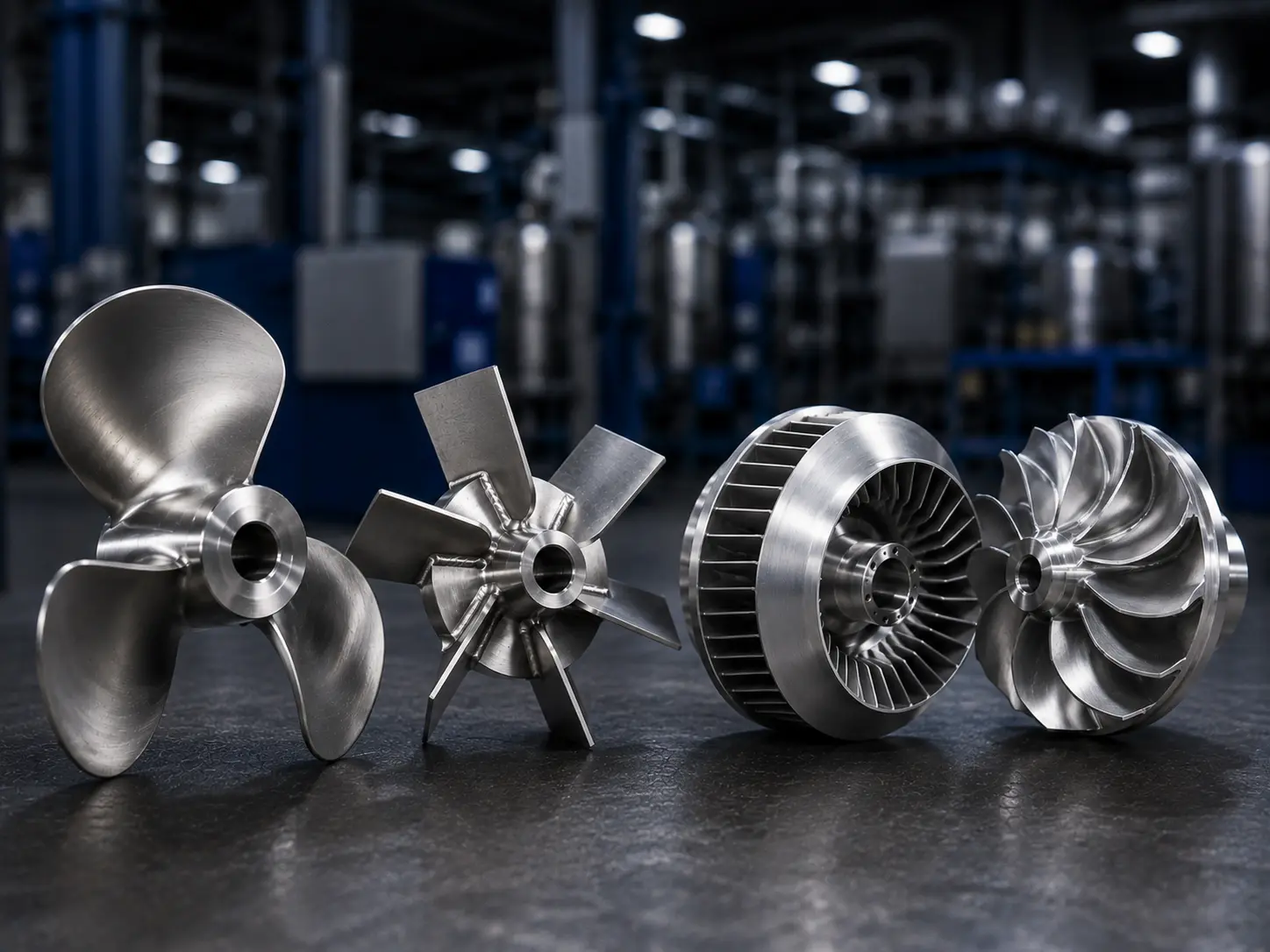
Industrial fan and blower wheel forms in a workshop. The photo shows the wheels only; it does not show or compare direct-drive and belt-drive assemblies.
What to include in a blower wheel RFQ
If you are sourcing the wheel rather than the complete fan, send the information that lets the supplier preserve the approved design and assembly fit:
- 2D drawing and 3D model, including revision and the controlling document;
- wheel type, rotation direction with viewing reference, inlet side, outside diameter, width, blade and shroud details;
- shaft or motor interface drawing: bore, keyway, hub, fit, axial position, retention, and any runout requirement;
- material grade, operating temperature, air composition, corrosion or dust exposure, and any surface-treatment requirement;
- required operating RPM and the fan maker’s confirmed maximum speed, if relevant to wheel manufacture and balance;
- critical inspection dimensions, material documentation, balance criterion and report format;
- prototype or production quantity, repeat-order expectations, packaging, and export requirements.
If the drive architecture is still undecided, say so. The fan OEM should confirm motor and drive selection before the wheel interface is released for production. A useful supplier review can identify missing dimensions or ambiguous requirements; it cannot replace the fan-system selection or approval authority.
Common questions
Is a direct-drive blower wheel always more efficient than a belt-drive wheel?
No. Drive losses, motor efficiency, fan selection, operating point, control method, and installation all affect total performance. Direct drive removes the belt transmission, but that does not prove the complete fan uses less energy in every application. Compare manufacturer selection data at the required airflow and pressure, then evaluate power input at the actual duty rather than relying on the drive label alone.
Can a belt-drive blower wheel be converted to direct drive?
Not by changing only the motor. The wheel hub and bore, shaft arrangement, bearing support, speed, motor load, fan curve, structure, guard, and mounting may all differ. A conversion needs review and approval from the fan equipment designer. For custom wheel manufacture, the supplier needs the revised controlled drawing and interface requirements; a nominally matching diameter is not enough to establish interchangeability.
Does direct drive mean the blower is variable speed?
No. Direct drive describes the mechanical power path, not the control package. A fixed-speed motor can directly drive a wheel at a fixed operating speed. Variable speed requires a compatible motor and control method, plus an approved operating range. Confirm minimum and maximum speed, cooling, motor load, wheel limits, and the required system operating points with the fan supplier.
Why choose belt drive if it has more components to maintain?
A belt-drive arrangement may be selected when a separate fan shaft, motor location, or approved sheave ratio suits the equipment design. Those benefits must be weighed against belt and sheave inspection, tension and alignment requirements, added space, guarding, and service access. The decision is application-specific; the equipment manufacturer should confirm that the proposed arrangement meets the duty and operating limits.
What should I send when requesting a custom blower wheel quote?
Send the controlled 2D drawing and 3D model where available, revision, material, quantity, operating RPM, wheel rotation/view, shaft or motor interface, critical dimensions, balance requirement, inspection documents, and application conditions. If a sample is the starting point, identify wear, repairs, or distortion and provide the intended assembly information. Ask the fan OEM to approve the final wheel interface and operating limits.
Final Thoughts
Direct drive and belt drive are complete-fan decisions, not competing blower-wheel geometries. Choose the arrangement against the duty, speed range, controls, installation, and service plan, then lock the wheel interface and balance condition into the approved documents. If you need a custom industrial fan or blower wheel, Matson can review a drawing or sample with the material, fit, inspection, and RFQ details needed for quotation.
For a drawing-based fan or blower impeller inquiry, send Matson your drawing, quantity, material, operating RPM, and interface requirements.