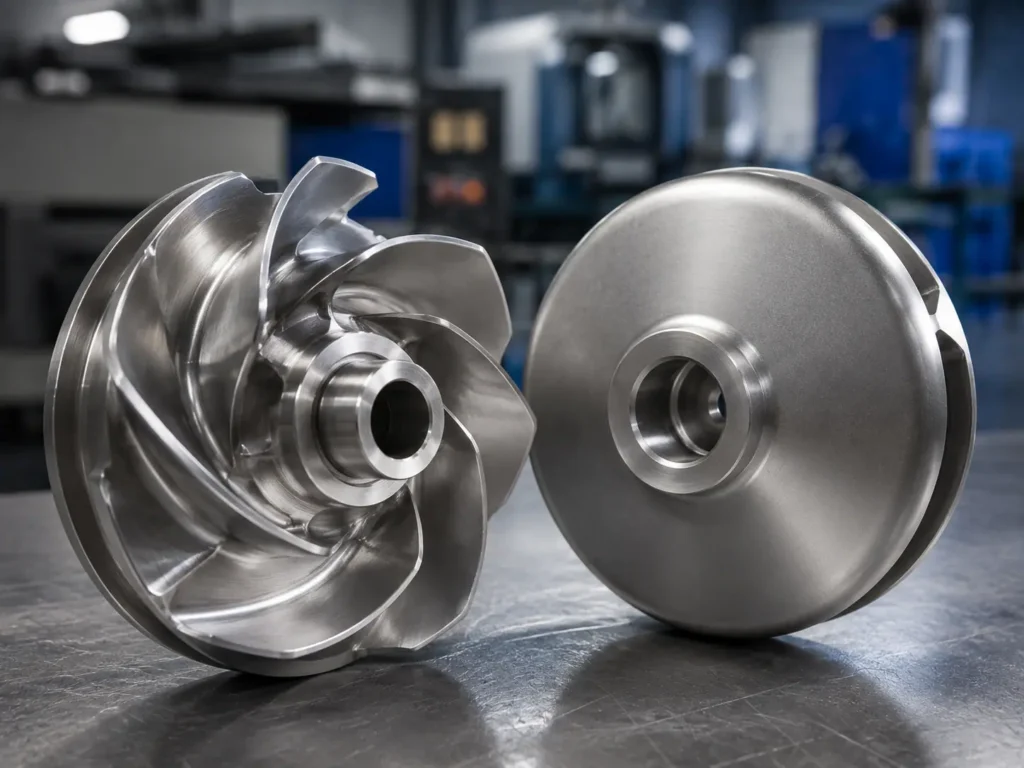
A custom impeller balancing report should identify the exact part tested, its mounting condition, the agreed acceptance limits, and the final residual unbalance in each required tolerance plane. A grade label or a green pass symbol alone does not provide enough evidence for shipment approval. Before you release an order, check that the report describes the finished impeller you will receive and compares its measured results with the correct limits.
What does a balancing report actually prove?
A report records the balance condition of a particular rotor in a particular test setup. Its usefulness rests on three connections: the result must belong to your part, the test condition must match the agreed supply condition, and the acceptance rule must match the purchase specification.
For custom pump impellers, fan wheels and mixer components, these connections are easy to lose when reports are assembled separately from production records. A drawing number identifies a design; it does not identify which physical impeller was tested. Likewise, a report dated before final machining needs an explanation before it can support final release.
Use the broader custom impeller dynamic balancing guide to define the requirement before production. The review below begins when the supplier submits the completed report.
Start with identity and the supplied configuration
Match the report number to the purchase order, part number, drawing revision and serial number or agreed batch identification. Where individual balancing is required, each result needs an unambiguous link to the individual component. A batch summary is acceptable only when its supporting records and identification meet the approved inspection plan.
Next, ask what rotated during the test. Was it the bare impeller on a mandrel, the impeller with permanent mounting hardware, or a shaft assembly? Record included and excluded components. For keyed parts, confirm the agreed key convention and how it was implemented. An unexplained difference between the balancing setup and the delivered assembly leaves the result difficult to interpret.
For custom pump impellers, identify the mounting bore and locating face used during balancing. A photograph helps explain the fixture, but cannot replace a setup description or dimensional acceptance record.
Read the units before comparing the numbers
Residual unbalance is the unbalance remaining after correction. Reports commonly express it as mass multiplied by radius, such as g·mm. A correction mass in grams is a different quantity: without its radius, it cannot be compared directly with a residual-unbalance limit in g·mm.
Specific residual unbalance normalizes unbalance by rotor mass. A value in g·mm/kg therefore cannot be compared numerically with one in g·mm without the appropriate mass conversion. Keep the original units visible in any purchasing spreadsheet; stripping the unit column can turn a clear report into a misleading comparison.
Also distinguish balance quality grade from measured vibration. A G-grade label does not by itself demonstrate that the assembled pump or fan meets a bearing-housing vibration limit. Equipment vibration involves the installed machine and its operating conditions, beyond the component balance record.
Schenck’s balancing instrument documentation illustrates why report headings matter: correction weights, residual unbalance and vibration data are distinct entries. Identify the reported quantity before accepting a numerical comparison.
Check the acceptance basis and each required plane
The report should state the specified grade or other approved acceptance criterion, the applicable standard and edition, and the inputs used to establish the limits. Where the limit calculation uses rotor mass and service speed, verify those inputs against the approved configuration and operating requirement. Record balancing-machine speed separately so it is not mistaken for the speed used to define acceptance.
ISO 21940-11 addresses rotors with rigid behaviour, including permissible residual unbalance, correction planes, allocation to tolerance planes and balancing errors. It does not cover flexible rotor behaviour. The equipment engineering owner should confirm applicability and the project requirement; a purchasing team should not select a universal grade from an example certificate.
For a report with two tolerance planes, review each plane against its allocated limit. Do not assume the total permissible unbalance is automatically the limit for each plane, or that every rotor uses an equal split. The report or supporting calculation should explain the allocation and identify the plane locations.
A useful review comment is precise: “Please identify planes A and B on the setup sketch and provide the acceptance limit beside each final reading.” Asking only for a better certificate often produces a cleaner page with the same missing evidence.
Balancing report review decision table
Use this table to route missing evidence. A request for clarification is not automatically a failed component; it means the submitted record does not yet support release.
| Report finding | Why it matters | Buyer action before release |
|---|---|---|
| Drawing number present; tested-part identity missing | The result cannot be linked reliably to the shipment. | Request serial or agreed batch mapping and the supporting test record. |
| Grade shown; numerical limits absent | The pass statement cannot be independently checked. | Request the acceptance basis, calculation inputs and plane limits. |
| Correction weight shown only in grams | Correction mass is not residual unbalance. | Request the final measured residual values with units. |
| Two results shown; planes unidentified | Results cannot be matched to their allocated tolerances. | Request a plane sketch and corresponding limits. |
| Test predates a later machining or coating operation | The delivered balance condition needs confirmation. | Obtain the change assessment and repeat-test evidence where required. |
| Final reading exceeds an approved limit | The submitted result does not satisfy that criterion. | Hold release for approved correction and retest or formal engineering disposition. |
| Readable final results, traceable identity and compliant limits | The balance evidence is reviewable. | Accept the balance record, subject to the remaining order-release requirements. |
Confirm the final reading represents the finished part
Separate initial readings, trial runs and final verification. A large improvement from the initial condition is useful process information, but the final result still has to satisfy the approved limit. Confirm that trial weights were removed or converted into authorized permanent corrections and that the record identifies the final check run.
Review the correction method against the drawing. Material removal must respect restricted areas and remaining geometry. Added weights need an approved retention method. The balance report should reference any required correction record; it does not independently authorize grinding a functional vane surface or welding onto a finished component.
Consider the production sequence. Subsequent trimming, keyway machining, coating, welding or hardware changes can alter the balance condition. Ask which operations followed the recorded test and whether their effect was reviewed. Do not invent a retrospective final-test date to make paperwork match shipment.
Measurement confidence matters when results are close to a limit or appear inconsistent. Request the agreed verification evidence, equipment identification and relevant calibration or performance-check references. If fixture seating or mandrel influence is suspected, ask the balancing specialist for an appropriate investigation. A machine specification alone does not establish the uncertainty of this particular setup.
Apply the review to the right equipment context
For a water or chemical pump impeller supplied separately, confirm whether the purchase specification requires component balancing only. Shaft assembly checks and hydraulic performance remain separate acceptance activities. Passing the component balance review does not approve the complete pump.
For a fabricated industrial fan wheel, pay particular attention to the final correction record and any painting or hardware installation after balancing. For a mixer impeller shipped as detachable blades and a hub, establish whether the report covers individual pieces or the agreed assembled arrangement. Do not assume an assembly result remains representative after unrestricted reassembly.
Selected compressor or other vibration-sensitive rotor projects need engineering review of the rotor behaviour and test specification. This checklist is a document-review framework, not qualification for a particular operating speed or rotor design.
Agree the report format before the order
Send your required report template with the RFQ. Include the part identification scheme, approved balance requirement, service-speed basis, supplied configuration, key convention where relevant, numerical result units, plane identification and required sign-off. Define whether individual reports or a traceable batch summary are acceptable.
Matson can review custom impeller drawings, materials, quantities, inspection needs and balancing documentation as part of its impeller manufacturing review. Agree project-specific test and reporting requirements before production. Existing equipment data and an approved drawing provide a firmer starting point than a certificate copied from an unrelated order.
Specific questions about balancing report acceptance
Is a report stating only “G2.5 passed” sufficient?
It is insufficient for a detailed acceptance review unless the supporting records provide the missing evidence. Ask for the tested-part identity, applicable requirement, calculation inputs, tolerance-plane limits and final residual readings with units. G2.5 is an example of a grade designation, not a universal recommendation for custom impellers. Your approved equipment specification should establish whether that grade applies.
Can I compare reports from suppliers using different units?
Yes, once you identify the quantities and convert them consistently. Residual unbalance in g·mm, specific unbalance in g·mm/kg and correction mass in grams describe different things. You need rotor mass for the relevant normalization and radius to interpret correction mass. Preserve the original readings and conversions in your review record, and ask for clarification when a heading is ambiguous.
Must the balancing-machine speed equal the service speed?
Do not reject or accept a report on speed equality alone. The appropriate balancing method depends on rotor behaviour and the agreed specification. For applicable rigid rotors, the machine test speed and service-speed basis for tolerance need not be identical. Ask the responsible specialist to confirm the method, and keep both speeds clearly identified rather than treating one RPM field as sufficient.
Does one passing sample cover every impeller in a batch?
Only the agreed inspection plan can establish what evidence is required for batch release. One sample report does not prove the individual balance condition of every part. When individual balancing is specified, request a result-to-part mapping for each impeller. If a batch summary is allowed, confirm that its underlying records remain available and traceable to the delivered components.
Does a passing report guarantee low vibration after installation?
No. It supports the balance acceptance of the tested component or assembly under the recorded conditions. Installed vibration also reflects mounting, alignment, shaft condition, bearings and operating effects. Use the report alongside the equipment acceptance requirements. If vibration appears during commissioning, preserve the original balance record and investigate the installed system before assuming a different balance grade will resolve it.
Final Thoughts
Approve a custom impeller balancing report when you can connect the finished part, test setup, numerical limits and final readings without guessing. Resolve missing identities, ambiguous units and unexplained later operations before shipment. Matson can review these documentation needs alongside your custom impeller drawing and manufacturing requirements, helping you define what evidence the order must deliver and what remains the equipment owner’s responsibility.
Send Matson your impeller RFQ with the drawing revision, material grade, quantity, operating-speed requirement and preferred balancing report template.