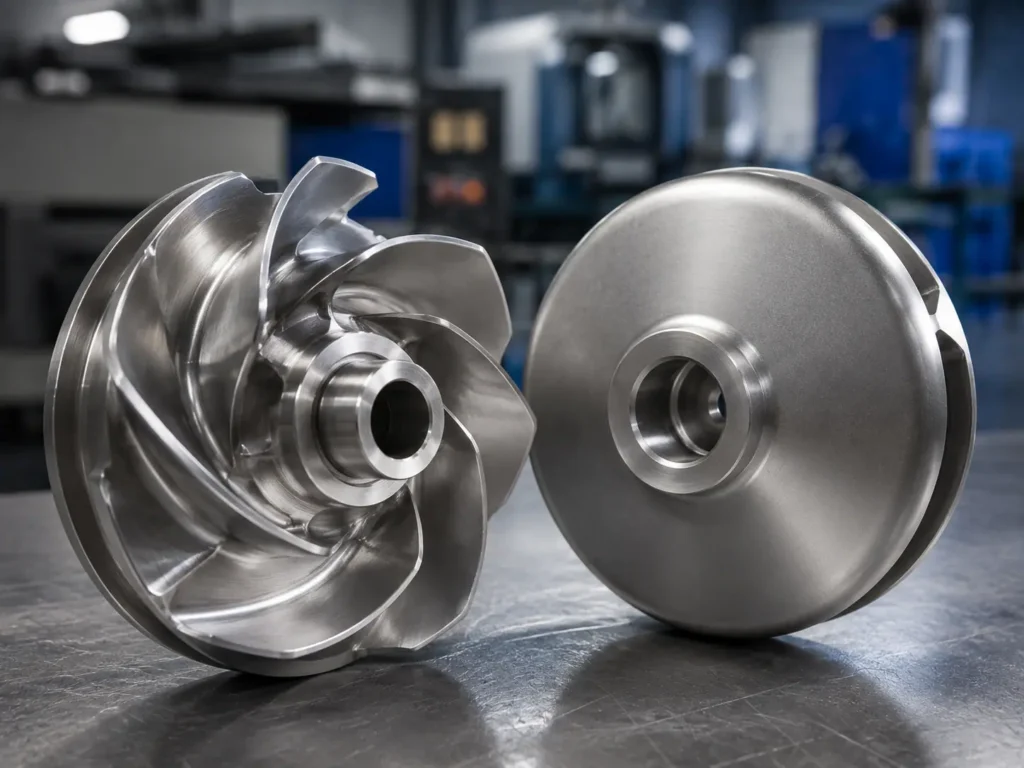
A centrifugal blower impeller is the rotating fan wheel inside a centrifugal blower that moves air or gas outward from the center toward the casing. For industrial fans, HVAC systems, process air equipment, dust collection, chemical exhaust, and wastewater ventilation, the impeller must match the drawing, blade geometry, material, operating speed, and balancing requirement.
Short answer: a centrifugal blower impeller should be reviewed around wheel diameter, blade type, bore and hub dimensions, material, operating speed, temperature, corrosion or dust exposure, manufacturing route, inspection points, and dynamic balancing. Matson manufactures custom blower impellers from drawings, samples, and specifications, but final airflow performance should be confirmed by the fan or blower OEM.
This article supports Matson’s blower impeller page and the broader fan and blower impellers product page. It is about industrial metal blower wheels, not snow blower, leaf blower, blower vac, appliance, or brand-specific consumer replacement parts.
What Makes a Centrifugal Blower Impeller Different
A centrifugal blower impeller moves air by rotating inside a housing. Air enters near the center and is thrown outward by the blades. The casing then guides the air toward the outlet.
That basic function sounds simple, but the manufactured part is sensitive to geometry and balance. Blade shape, outside diameter, inlet width, hub design, bore fit, material thickness, weld or casting quality, and balance all affect whether the impeller can run reliably.
For buyers, the practical question is not only “Can you make this blower impeller?” It is “Can you manufacture this wheel to the drawing, material, speed, fit, and balancing requirement without changing the working geometry?”
Centrifugal Blower Impeller Review Checklist
Use this table before requesting a custom quote. It helps separate performance design questions from manufacturing and sourcing questions.
| Review item | Why it matters | What buyers should confirm |
|---|---|---|
| Blade type | Backward-curved, forward-curved, radial, and airfoil wheels behave differently. | Existing blade type, blade count, blade profile, rotation direction, and application. |
| Wheel dimensions | Small dimensional errors can affect fit, casing clearance, and blower performance. | Outside diameter, inlet diameter, outlet width, wheel width, hub height, bore, and mounting dimensions. |
| Operating speed | Speed affects stress, balance, vibration, and material selection. | RPM, motor data, impeller diameter, mass, and whether overspeed or proof testing is specified. |
| Material | Air temperature, dust, corrosion, and weight affect material choice. | Carbon steel, stainless steel, aluminum, alloy steel, heat-resistant material, or buyer-specified grade. |
| Manufacturing route | Fabricated, cast, or machined routes have different tolerances and inspection needs. | Drawing requirement, weld details, casting allowance, CNC machining surfaces, and surface treatment. |
| Balancing | Unbalance can cause vibration, bearing load, noise, and early equipment failure. | Balancing grade, operating speed, report requirement, and whether the wheel is balanced alone or as an assembly. |
| Application environment | Dust, heat, humidity, chemicals, or abrasive particles can change the design review. | HVAC, process air, drying, dust collection, chemical exhaust, or wastewater ventilation condition. |
Blade Types and Application Fit
Centrifugal blower impellers are not all the same. A backward-curved wheel is often discussed where efficiency and stable operation matter. A forward-curved wheel can be compact and useful in selected ventilation or packaged equipment designs. A radial blade impeller can be practical where dust, particles, or tougher process air conditions are present. Airfoil wheels may be used when aerodynamic efficiency and noise control are important.
Matson manufactures to the buyer’s drawing, sample, or specification. The final aerodynamic selection should come from the fan OEM, blower designer, or engineering owner. Matson’s manufacturing review focuses on whether the specified wheel can be produced, machined, inspected, balanced, and packed according to the project requirement.
If the project is a fan wheel rather than a blower wheel, the same sourcing logic often applies: confirm geometry, material, speed, balance, and application environment before quoting.
Material Considerations
Common centrifugal blower impeller materials include carbon steel, stainless steel, aluminum, alloy steel, and selected heat-resistant steels. The right material depends on temperature, corrosion, dust load, weight, strength, drawing requirement, and service life.
Carbon steel can be practical for many general industrial air applications when corrosion and temperature are limited. Stainless steel may be considered for humid air, chemical exhaust, wastewater ventilation, food/process environments, or corrosion-sensitive service. Aluminum can reduce weight in selected applications, but strength, speed, and manufacturing method must be checked. Heat-resistant steel or alloy options may be discussed for hot air, drying systems, combustion air, or process equipment when the drawing and specification support that choice.
Material should not be chosen from the application name alone. “Process air” can mean clean warm air, dusty exhaust, chemical vapor, humid air, or high-temperature gas. The RFQ should describe the actual environment.
Manufacturing Route and Fit Surfaces
A centrifugal blower impeller may be fabricated, cast, machined, or produced through a mixed process depending on the design and specification. Whatever the route, the functional surfaces need control.
Key manufacturing points include bore size, hub height, shaft fit, keyway, mounting face, back plate, shroud, inlet cone relationship, blade profile, outside diameter, and casing clearance. If the buyer sends only a photo, the factory cannot confirm these details.
For worn or damaged samples, the risk is higher. Bent blades, worn hubs, enlarged bores, repair welds, corrosion, or impact damage may hide the original geometry. Photos help with first review, but measurements and drawings are much better for production.
Matson’s impeller manufacturing work can include casting, CNC machining, surface treatment, dynamic balancing, dimensional inspection, and export packing when project requirements are defined.
Dynamic Balancing and Vibration Control
Balancing is one of the most important manufacturing considerations for centrifugal blower impellers. Even a small mass error can become a serious vibration problem at operating speed.
ISO 21940-11 is a useful reference when a drawing or buyer specification defines rigid-rotor balancing terminology and grades. The actual balancing requirement should come from the blower speed, wheel diameter, mass, application, and equipment specification. Do not assume one balancing grade fits every fan wheel.
Buyers should also state whether they need a balancing report, whether balancing should be performed on the impeller alone or with related hardware, and whether there are any site vibration issues with the existing equipment.
What Buyers Should Send for a Quote
A useful RFQ for a centrifugal blower impeller should include:
- 2D drawing, 3D file, or physical sample
- Blade type: backward-curved, forward-curved, radial, airfoil, or custom
- Outside diameter, inlet diameter, width, bore, hub height, and mounting dimensions
- Shaft fit, keyway, mounting face, and critical tolerances
- Material grade or previous material
- Operating speed and motor/blower information if available
- Application: HVAC, process air, drying, dust collection, chemical exhaust, or wastewater ventilation
- Temperature, humidity, dust, corrosion, chemical exposure, or abrasion details
- Surface finish, coating, painting, passivation, or heat treatment requirement
- Balancing grade and balancing report requirement
- Quantity, batch schedule, and export packing requirement
- Photos of worn, cracked, corroded, or repaired areas if quoting from a sample
If the project is reverse manufacturing from a sample, mark which dimensions are still reliable and which surfaces are worn or repaired. A damaged sample should not be copied blindly.
Common Questions We Actually Get
What is a centrifugal blower impeller?
A centrifugal blower impeller is the rotating fan wheel inside a centrifugal blower. It moves air or gas outward from the center toward the casing and outlet.
What materials are used for centrifugal blower impellers?
Common materials include carbon steel, stainless steel, aluminum, alloy steel, and selected heat-resistant steels. The right choice depends on temperature, corrosion, dust load, speed, weight, and the buyer’s drawing.
Why is dynamic balancing important for blower impellers?
Dynamic balancing helps reduce vibration, bearing load, noise, and early equipment failure. It is especially important when the wheel is large, heavy, high-speed, or used in continuous industrial service.
Can Matson manufacture a centrifugal blower impeller from a sample?
Yes. Matson can review a physical sample, photos, drawings, and dimensions for custom manufacturing. Worn or damaged samples should be measured carefully because the original blade shape, bore, or hub dimensions may be lost.
What information should I send for a custom centrifugal blower impeller quote?
Send the drawing or sample, blade type, diameter, bore, hub, material, operating speed, application environment, quantity, and any balancing, inspection, or documentation requirement.
Send Us Your Drawing
Need a custom centrifugal blower impeller for an industrial fan or process air project? Send Matson your drawing, sample photos, blade type, material grade, operating speed, quantity, and balancing requirement through the contact page. We can review manufacturing, machining, material, inspection, and balancing factors before quoting.