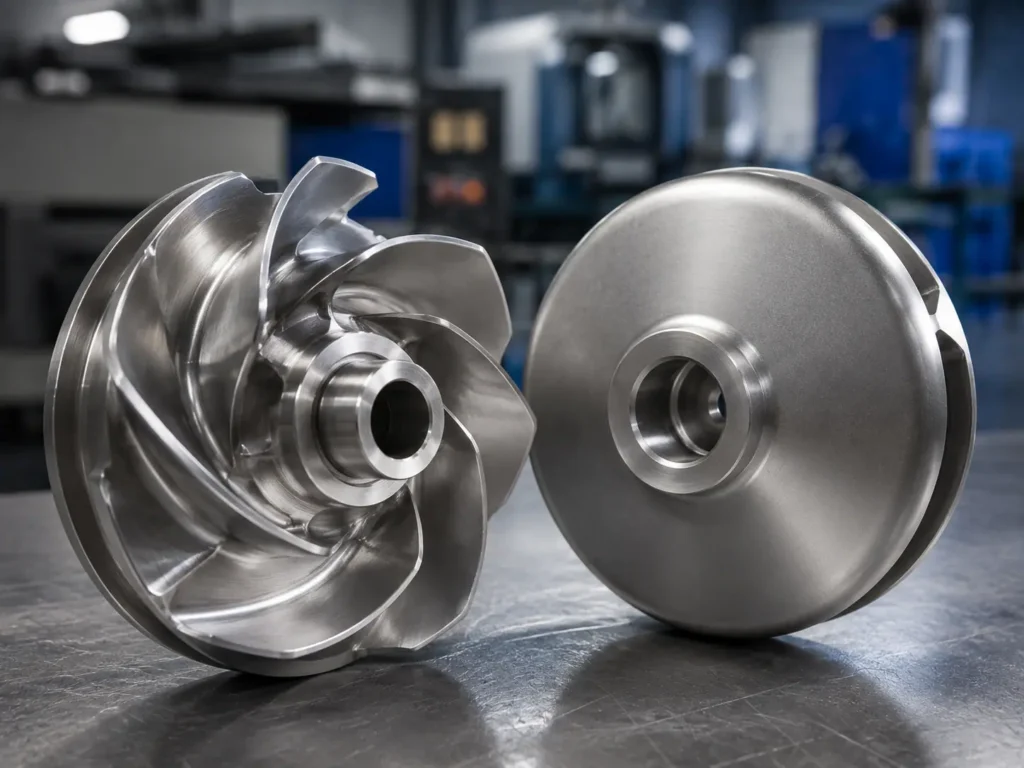
Seawater pump impeller material selection is mainly about chloride corrosion, galvanic compatibility, seawater temperature, solids or fouling, pump duty, and manufacturability. For marine and industrial seawater pumps, the impeller material must resist seawater while still allowing reliable casting, CNC machining, dimensional inspection, and balancing.
Short answer: bronze, 316L stainless steel, duplex stainless, and super duplex stainless may all be considered for a seawater pump impeller. The right choice depends on seawater exposure, chloride level, temperature, shaft and casing materials, flow condition, solids, service life target, required certificates, and whether the impeller will be cast and finish machined.
Matson manufactures custom pump impellers from drawings, samples, and specifications. For a seawater pump impeller, Matson can review material grade, casting route, CNC machining, surface treatment, dimensional inspection, and balancing requirements before quoting. This article refers to industrial metal pump impellers, not rubber outboard motor impellers or flexible impeller repair kits.
Why Seawater Material Selection Is Different
Seawater is not just water. Chloride, oxygen, temperature, biological fouling, suspended solids, stagnant zones, and mixed-metal assemblies all affect corrosion behavior.
A material that works well in clean freshwater may pit or crevice-corrode in seawater. A stainless grade that looks attractive on paper may suffer when chloride, temperature, deposits, or stagnant flow are present. A bronze alloy that works in many seawater pump applications still needs to match the shaft, casing, and operating condition.
That is why seawater pump impeller material selection should start with the operating environment, not with a material name alone.
Seawater Impeller Material Comparison
Use this table as a first review tool. It does not replace the buyer’s material specification, marine engineering requirement, or pump OEM guidance.
| Material family | Why buyers consider it | Main seawater concerns | What to confirm before quoting |
|---|---|---|---|
| Bronze / marine bronze | Common history in seawater and ship pump applications. | Alloy grade, dezincification risk, galvanic pairing, erosion-corrosion. | Exact bronze grade, shaft material, casing material, water velocity, and certificate requirement. |
| 316 / 316L stainless steel | Useful corrosion resistance and good manufacturing behavior in selected conditions. | Chloride pitting, crevice corrosion, stagnant seawater, deposits, temperature. | Chloride exposure, temperature, flow condition, passivation need, and whether 316L is actually specified. |
| Duplex stainless | Higher strength and stronger chloride resistance than common austenitic stainless grades. | Casting quality, heat treatment, machining, documentation, cost. | Exact grade, project specification, ASTM or EN reference, inspection and certificate needs. |
| Super duplex stainless | Considered for more severe chloride or seawater service. | Higher cost, stricter process control, casting and heat-treatment review. | Grade, acceptance standard, machining surfaces, testing requirement, and buyer approval. |
| Coated carbon or alloy steel | May appear in selected industrial systems where coating strategy is controlled. | Coating damage, underfilm corrosion, wear at fit surfaces, service-life risk. | Coating type, exposed surfaces, abrasion, inspection plan, and maintenance expectation. |
Bronze in Seawater Pump Impellers
Bronze is often a practical option for marine and seawater pump impellers. It has a long history in seawater systems and can work well in many ship cooling, ballast, service, and seawater transfer applications.
The word “bronze” is not enough for a production quote. Different bronze and copper-alloy grades have different corrosion behavior, mechanical properties, casting behavior, and compatibility with shafts and casings. Buyers should specify the alloy grade if known and tell the manufacturer what shaft and casing materials are used.
Galvanic compatibility matters. Seawater is an electrolyte, and mixed metals can create accelerated corrosion when the material pairing is poor. A bronze impeller in one pump assembly may behave differently from the same bronze impeller in another assembly because the shaft, casing, fasteners, and cathodic protection context are different.
For a broader marine pump overview, see Matson’s marine pump impeller article.
Stainless Steel, Duplex, and Super Duplex
316 and 316L stainless steel can be considered for some seawater-related pump applications, but buyers should be careful. Chloride pitting and crevice corrosion can become serious in warm seawater, stagnant areas, deposits, and tight gaps.
Duplex stainless and super duplex stainless are often discussed when seawater corrosion resistance and strength requirements are higher. These grades can be attractive for more demanding service, but they also raise manufacturing questions: casting control, heat treatment, machining, surface condition, inspection, and documentation all matter.
ASTM and EN material specifications may be used when the buyer has a defined grade. ASTM G48 is sometimes referenced in corrosion testing discussions for stainless and duplex materials, especially where pitting or crevice corrosion resistance is being evaluated. It should be treated as a project-specific requirement, not a default test for every seawater impeller.
For a general comparison of pump materials, see pump impeller material selection.
Seawater Corrosion Modes Buyers Should Name
The phrase “seawater corrosion” can mean several things.
Pitting corrosion creates local holes and can be severe in chloride environments. Crevice corrosion can appear around tight gaps, deposits, or shielded surfaces. Erosion-corrosion can occur when seawater carries sand, suspended solids, or high-velocity flow. Galvanic corrosion can occur when different metals are electrically connected in seawater.
The buyer does not need to solve the entire corrosion analysis before sending an RFQ, but the RFQ should say what is known: seawater or brackish water, temperature, flow condition, solids, fouling, shaft material, casing material, old impeller material, and photos of the failure pattern if there is one.
If the old impeller shows pitting, dezincification, cracked vanes, worn clearance surfaces, or heavy deposits, send photos. Those photos help separate material mismatch from flow, clearance, fouling, and operating issues.
Manufacturing Review for Seawater Impellers
Material selection and manufacturing route should be reviewed together.
Cast seawater pump impellers often need finish machining on the bore, hub, keyway, mounting face, wear-ring surface, and other fit areas. Bronze, stainless, duplex, and super duplex grades do not all cast and machine the same way. A material that is strong against seawater corrosion can still create cost or feasibility issues if the drawing has tight machining surfaces or complex passages.
Matson’s impeller manufacturing work can include casting, CNC machining, surface treatment, dynamic balancing, dimensional inspection, and export packing when the buyer’s requirements are clear.
If the impeller runs at meaningful speed, balancing should be discussed before production. ISO 21940-11 is commonly referenced for rigid-rotor balancing terminology and grades, but the actual grade should come from the drawing, pump speed, impeller mass, and buyer specification.
What Buyers Should Send for a Seawater Material Review
A useful RFQ should include:
- 2D drawing, 3D file, or physical sample
- Pump application: ship cooling, ballast, bilge, seawater transfer, industrial cooling, or process support
- Seawater, brackish water, or industrial seawater condition
- Temperature, flow condition, solids, sand, fouling, or stagnant-zone information
- Current material grade and required material standard, if known
- Shaft material, casing material, fasteners, and any galvanic compatibility concern
- Outside diameter, bore, hub height, keyway, mounting face, and wear-ring dimensions
- Impeller type, vane count, rotation direction, inlet eye, and outlet width
- Surface finish, passivation, coating, or inspection requirement
- Material certificate, dimensional report, balancing report, or corrosion-test requirement
- Photos of pitting, corrosion, worn areas, cracks, deposits, or repaired surfaces
- Quantity, batch schedule, and export packing requirement
If the sample is heavily corroded, do not assume it still shows the original dimensions. Measure the functional surfaces before copying it.
Common Questions We Actually Get
What material is best for a seawater pump impeller?
There is no single best material. Bronze, 316L stainless, duplex stainless, and super duplex stainless can all be considered depending on seawater exposure, temperature, shaft and casing materials, galvanic risk, pump duty, and buyer specification.
Is bronze good for seawater pump impellers?
Yes, bronze is commonly used in many seawater and marine pump impeller applications. The exact alloy grade, shaft material, casing material, and galvanic compatibility should still be confirmed.
Is 316L stainless steel suitable for seawater impellers?
Sometimes, but not always. 316L may work in selected conditions, but warm seawater, chloride concentration, stagnant zones, deposits, and crevices can increase pitting and crevice-corrosion risk.
When should duplex or super duplex be considered?
Duplex or super duplex stainless may be considered when chloride corrosion resistance, strength, or service severity is higher. The exact grade, casting route, heat treatment, machining, and documentation requirements should be confirmed before quoting.
What information should I send for a seawater pump impeller quote?
Send the drawing or sample, seawater condition, material grade, shaft and casing materials, dimensions, pump speed, quantity, corrosion photos, and any certificate, inspection, corrosion-test, or balancing requirement.
Send Us Your Drawing
Need help reviewing material for a custom seawater pump impeller? Send Matson your drawing, sample photos, seawater condition, material grade, shaft and casing material, quantity, and documentation requirements through the contact page. We can review material, casting, CNC machining, inspection, balancing, and manufacturing feasibility before quoting.