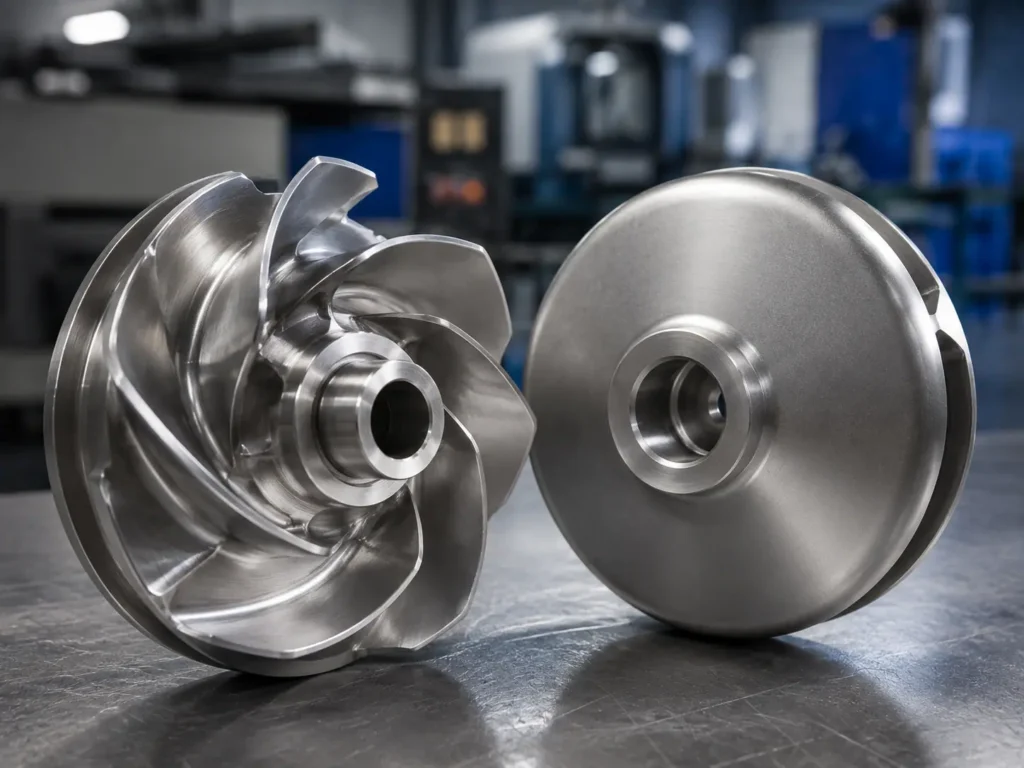
Chemical pump impeller selection is mainly about corrosion, liquid chemistry, material compatibility, manufacturing route, and fit with the pump duty. For chemical processing, the impeller must move acids, solvents, process liquids, effluent, or other corrosive media while maintaining the required dimensions, balance, surface condition, and service life.
Short answer: a chemical pump impeller should be reviewed around the chemical name, concentration, temperature, pH, chloride level, solids, impeller type, material grade, casting route, machining interfaces, and inspection requirements. Stainless 316L, duplex stainless, super duplex, and other corrosion-resistant alloys may be considered, but no material should be chosen from the word “chemical” alone.
Matson manufactures custom pump impellers from drawings, samples, and specifications. For a chemical pump impeller, Matson can review material, casting, CNC machining, surface treatment, dimensional inspection, and balancing factors before quoting. Final chemical compatibility and process design should be confirmed by the buyer’s engineering team or material specialist.
Chemical Pump Impellers Are Not Only About Stainless Steel
Many chemical pump RFQs start with “stainless steel impeller.” That is a starting point, not a complete specification.
304 stainless, 316L stainless, duplex stainless, super duplex, alloy steel, and other corrosion-resistant materials do not behave the same way in acids, solvents, chlorides, hot liquids, cleaning cycles, or mixed process fluids. The difference becomes important when the impeller has thin vane sections, tight bore dimensions, wear ring surfaces, or a balancing requirement.
For buyers, the best question is not “Can you make a stainless chemical pump impeller?” It is: “Here is the liquid, concentration, temperature, drawing, material grade, and operating condition. What material and manufacturing risks should we check before production?”
What Buyers Should Confirm First
Use this table as a practical RFQ review checklist. It helps separate chemical compatibility questions from manufacturing questions.
| Review item | Why it matters | What buyers should confirm |
|---|---|---|
| Chemical exposure | The same material can behave differently in different chemicals and concentrations. | Chemical name, concentration, pH, chloride level, additives, cleaning liquid, and exposure cycle. |
| Temperature | Higher temperature can increase corrosion rate and change material behavior. | Normal temperature, maximum temperature, thermal cycling, and cleaning temperature. |
| Solids or crystals | Corrosion plus abrasion can damage impellers faster than corrosion alone. | Solids content, crystal formation, slurry condition, particle size, and whether deposits occur. |
| Impeller type | Closed, open, semi-open, and recessed designs expose different surfaces to the liquid. | Existing pump design, casing relationship, clearance, cleaning need, and clogging risk. |
| Material grade | Material name alone is not enough for production or certification. | Exact grade, ASTM or EN reference if specified, certificate requirement, and previous material. |
| Manufacturing route | Some corrosion-resistant alloys need careful casting, machining, finishing, and inspection. | Casting method, CNC machining allowance, bore, keyway, wear ring, surface finish, and passivation need. |
| Balancing and inspection | Chemical impellers still need stable rotation and controlled dimensions. | Operating speed, balancing grade, dimensional report, material certificate, and inspection points. |
Common Material Directions for Chemical Pump Impellers
316 and 316L stainless steel are often discussed for chemical pump impellers because they provide better corrosion resistance than 304 in many process environments. 316L can also be preferred where welding, surface condition, or reduced carbon content matters. Still, chloride, temperature, acid concentration, and cleaning chemicals can change the decision.
Duplex stainless and super duplex materials may be considered when the liquid is more aggressive, especially where chloride stress corrosion, strength, or corrosion resistance is a concern. These materials should be specified carefully because casting, heat treatment, machining, and quality documentation need to match the project requirement.
For some chemical duties, other corrosion-resistant alloys or coated solutions may be considered by the pump OEM or process owner. Matson’s role is to manufacture to the confirmed drawing, grade, sample, or specification and to flag practical manufacturing questions around casting, machining, inspection, and balancing.
For broader material comparison across water, chemical, marine, and slurry service, see the guide to pump impeller material selection.
Corrosion Risks Buyers Should Name Clearly
“Corrosion-resistant” is not a precise requirement. Chemical service can involve several different damage patterns.
General corrosion removes material more evenly. Pitting corrosion can create deep local attack, especially in chloride-containing environments. Crevice corrosion can occur around tight gaps, deposits, or shielded surfaces. Stress corrosion cracking can become a concern when material, tensile stress, temperature, and environment line up badly. Erosion-corrosion can happen when corrosive liquid also carries solids or flows at damaging velocity.
The buyer does not need to write a textbook. But the RFQ should say what is known: chemical name, concentration, chloride, pH, temperature, solids, and the failure pattern of the old impeller if there is one. A photo of pitting, cracked vanes, worn clearance surfaces, or damaged bore areas can change the material and manufacturing discussion.
NACE MR0175 / ISO 15156 is sometimes referenced in oil, gas, and sour-service material selection. ASTM material specifications may be referenced for stainless or duplex castings when the buyer has a defined grade. These standards should be used only when they actually match the project; they are not generic proof that one impeller material fits all chemical pumps.
Impeller Type and Surface Condition
Chemical pump impeller type still matters.
A closed impeller may offer better efficiency in clean chemical liquid, but internal passages are harder to inspect after service. An open or semi-open impeller can be easier to clean and inspect, but clearances and vane wear need control. A recessed or vortex-style design may be considered when the liquid carries solids, crystals, or fibrous material, but it should be checked against pump efficiency and casing design.
Surface condition also matters. Rough cast surfaces, machining marks, crevices, and deposits can affect corrosion behavior in some services. If the project requires passivation, polishing, coating, or a specific surface finish, put that into the RFQ before quoting. It affects process planning and cost.
For a general comparison of impeller structures, use Matson’s guide to pump impeller types.
Casting, CNC Machining, and Fit Surfaces
A chemical pump impeller has to resist the fluid, but it also has to fit the pump.
Critical manufacturing points often include the bore, hub height, shaft fit, keyway, mounting face, wear ring surface, outside diameter, vane profile, and rotation direction. If those surfaces are off, the impeller may not assemble correctly even when the material is correct.
Corrosion-resistant alloys can also affect casting and machining. Some grades require tighter process control, heat treatment review, or careful machining around fit surfaces. If the drawing specifies a material grade plus tight dimensions, the foundry and machining plan should be reviewed together.
Matson’s impeller manufacturing work can include casting, CNC machining, surface treatment, dynamic balancing, dimensional inspection, and export packing when the project requirements are clear.
Balancing and Documentation
Chemical process equipment can run continuously, so balance and documentation should not be treated as afterthoughts.
If the impeller is large, high-speed, or used in a critical process pump, the RFQ should state the balancing requirement. ISO 21940-11 is a common reference when buyers specify rigid-rotor balancing terminology and grades, but the actual grade should come from the drawing, pump speed, impeller mass, and project specification.
Documentation may also matter. Buyers may request a material certificate, dimensional inspection report, balancing report, surface finish confirmation, or photos before shipment. Say this before quoting. It is much easier to plan inspection and documentation before production than after the part is packed.
What to Send for a Chemical Pump Impeller Quote
A useful RFQ should include:
- 2D drawing, 3D file, or physical sample
- Current material grade and required material standard, if known
- Chemical name, concentration, pH, chloride level, and additives
- Operating temperature and cleaning temperature
- Solids, crystals, fibers, or abrasive particles in the liquid
- Pump type, flow, head, speed, and duty condition if available
- Outside diameter, bore, hub height, mounting face, keyway, and wear ring dimensions
- Impeller type, vane count, rotation direction, and casing relationship
- Surface finish, passivation, coating, or polishing requirement
- Balancing grade, material certificate, and inspection report requirement
- Photos of corrosion, pitting, cracks, worn areas, or failed surfaces
- Quantity, batch schedule, and export packing requirement
If you have only a worn sample, mark the damaged surfaces clearly. A corroded or worn sample may no longer show the original vane thickness, clearance, bore condition, or sealing surface. Copying it without review can repeat the same problem.
Common Questions We Actually Get
What is a chemical pump impeller?
A chemical pump impeller is the rotating component inside a pump that moves chemical or process liquid. It is usually reviewed for corrosion resistance, material grade, dimensional fit, surface condition, and manufacturing route.
What material is best for a chemical pump impeller?
There is no single best material. 316L stainless, duplex stainless, super duplex, or other corrosion-resistant materials may be used depending on chemical concentration, temperature, pH, chloride, solids, and pump duty.
Is 316L stainless steel enough for chemical pump service?
Sometimes, but not always. 316L can work in many process environments, but aggressive chloride, high temperature, strong acid, mixed chemicals, or solids may require a different material review.
What information should I send for a custom chemical pump impeller quote?
Send the drawing or sample, chemical name, concentration, temperature, pH, chloride level, material grade, dimensions, speed, quantity, and any certificate, inspection, surface finish, or balancing requirement.
Can Matson manufacture chemical pump impellers from samples?
Yes. Matson can review drawings, 3D files, physical samples, photos, material grades, and operating conditions for custom chemical pump impeller manufacturing. Worn or corroded samples should be measured carefully before copying.
Send Us Your Drawing
Need a custom chemical pump impeller for a corrosion-resistant process application? Send Matson your drawing, sample photos, chemical condition, material grade, quantity, and documentation requirements through the contact page. We can review material, casting, machining, inspection, balancing, and manufacturing feasibility before quoting.