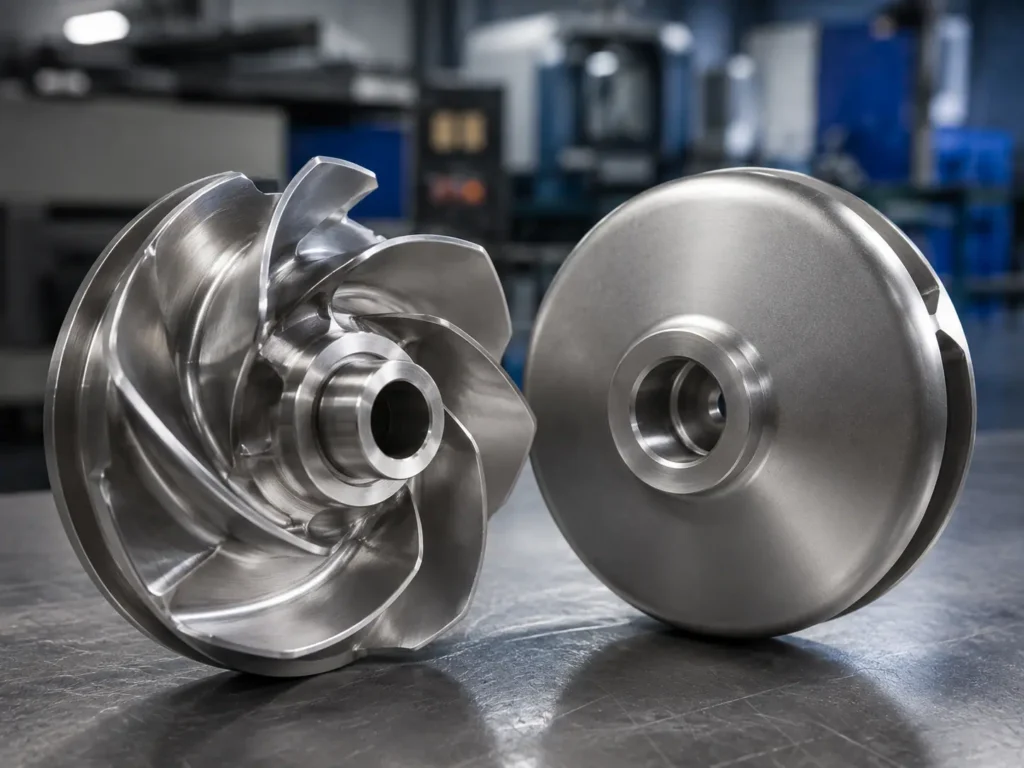
The impeller vane count effect is a balance between flow guidance and the space occupied by the blades. More vanes can reduce slip, but they also change blockage, surface friction and rotor-stator interaction. They do not automatically improve head, efficiency or reliability. Before approving a different count, compare the complete pump’s performance across its intended duties and confirm passage geometry, liquid conditions, shaft power and the engineering release for the revised component.
Why more vanes can help and still disappoint
Adding blades changes more than the visible number of passages. It changes how the liquid is guided, how much passage space the blades occupy, and the repeated interaction with stationary features. These effects compete. A design can gain in one respect and lose in another.
KSB’s slip explanation distinguishes finite-vane flow from the idealized case with infinitely many thin vanes. The liquid’s outlet direction does not exactly follow the vane contour. Vane count is one influence on that deviation, alongside the surrounding geometry. Importantly, slip is not simply another name for frictional power loss.
That distinction prevents a common procurement error: assuming that reducing slip removes every source of inefficiency. A blade occupies space and presents a wetted surface. The hydraulic design still has to reconcile guidance with the resulting passage and loss characteristics.
| Count-related effect | What a higher count changes | What still needs verification |
|---|---|---|
| Flow guidance and slip | Additional vanes can reduce the departure from idealized blade-guided flow | Whether the complete design gains useful head at the required duties |
| Blockage and passage space | With comparable blade thickness and surrounding geometry, more blades occupy more of the available passage area | Minimum passage geometry, local velocities and service suitability |
| Wetted surfaces and losses | Additional blade surfaces change friction and internal flow behavior | Efficiency and loss assessment rather than a head-only comparison |
| Interaction with stationary features | Blade-passing frequency and the interaction pattern change | Pressure fluctuation and vibration behavior of the assembled pump |
| Manufacturing definition | The model has a different repeated hydraulic geometry | Released profile, spacing, thickness, inspection and change approval |
Matson reviews custom pump impellers against drawings, samples and confirmed specifications. Vane count should arrive as an approved design input. It is not a factory preference to change because another configuration appears easier to manufacture.
What published research does and does not prove
In the 2019 paper Effect of impeller blades number on the performance of a centrifugal pump, Elyamin and colleagues numerically compared five-, seven- and nine-blade impellers. The seven-blade configuration had the highest head coefficient and hydraulic efficiency among those studied. Their analysis describes competing loss effects rather than a simple improvement with every added blade.
This is useful evidence against the claim that more is always better. It is not evidence that seven vanes are best for your pump. The result belongs to the studied geometry and calculation conditions. It is also a numerical comparison, not a Matson customer case or an acceptance test for an unrelated component.
When a supplier cites a study, ask what transfers to your project. Were the diameter, outlet width, blade angles, clearances, casing and liquid comparable? Which parameters were held constant? Was the proposed manufacturing model actually evaluated, or was only a similar blade count discussed?
An angle revision and a count revision are different changes. If both occur together, the comparison cannot isolate a vane-count effect without additional analysis. Keep every changed variable visible in the design review rather than attributing the entire result to the number of blades.
Compare the whole curve, not the highest head value
More head is useful only when it serves the required duty without creating unacceptable consequences elsewhere. A pump is selected for a working range and service, not a single impressive curve point.
Request the baseline and proposed flow-head, efficiency and shaft-power curves on the same basis. Record speed, impeller diameter, liquid properties, assembly clearances and the relevant geometry revision. Mark the required minimum, normal and maximum duties where these are defined by the equipment owner.
Keep predicted and measured results separate. A simulation needs its own modeling assumptions and validation basis; a performance test needs the configuration, procedure and acceptance criteria recorded. Neither should be described as proof of the other.
Our recommendation is to review the count change as a comparison package. A sheet showing only “six vanes changed to eight” does not tell you whether the revised part meets duty, power, operating-range or service requirements. A favorable result should be traceable to the actual model intended for manufacture.
Fewer vanes do not automatically make a solids-handling design
If the surrounding geometry and blade thickness remain comparable, reducing vane count can leave more space between adjacent blades. That observation does not define the minimum solids passage through a real impeller. The eye, throat, blade shape, shrouds and other restrictions still need review.
For wastewater or solids-containing service, request the approved passage definition and the liquid/solids information used in selection. Fibers and irregular particles create different questions from a simple nominal particle diameter. Do not infer non-clogging performance from a blade count or front photograph.
For viscous process liquids, also identify whether the comparison represents the specified liquid rather than a reference-water condition. A count comparison without viscosity and temperature context is incomplete for that service. The engineering owner should define the applicable performance basis instead of assuming that a result transfers unchanged.
The wider pump impeller design review covers the broader duty and component requirements. Here, the decision remains narrower: whether the proposed count has been evaluated for the application, not whether a particular count sounds appropriate.
Vane count also changes the blade-passing frequency
For a simple impeller with z identical, uniformly spaced full-length vanes, the fundamental vane-passing frequency at a fixed casing location is:
Vane-passing frequency in Hz = z × shaft RPM / 60
Ruhrpumpen’s commissioning and troubleshooting training identifies this frequency from the number of impeller vanes and running frequency. It is different from the shaft’s once-per-revolution frequency.
For an explicitly hypothetical comparison at 1,450 RPM, six equally spaced vanes give 145 Hz; eight give approximately 193.3 Hz. The shaft speed is unchanged, but the passage frequency has changed. These are arithmetic examples, not operating recommendations or Matson equipment data.
The calculation identifies a frequency, not a vibration amplitude, sound level or acceptable limit. The assembled machine’s response requires its own assessment. More passages per revolution do not prove a quieter or smoother pump.
Splitters, unequal blades and nonuniform spacing require a more careful definition of the repeating pattern and its frequency components. Do not simply add every visible blade tip and assume that one number describes all excitation. Record the actual impeller arrangement and stationary geometry for the engineering review.
Full-length vanes and splitters are not interchangeable counts
A note such as “eight blades” can conceal a meaningful design difference. Eight full-length blades and four full-length blades with four shorter splitters are different hydraulic geometries. They should not share a manufacturing description merely because eight outlets are visible.
Identify full-length and splitter vanes separately. The model should define splitter starting locations, length, profile, spacing and relation to the main blades. State rotation and viewing side so that the arrangement is unambiguous.
The existing impeller vanes guide addresses anatomy, wear and identification. For a count-change comparison, the extra requirement is that both the hydraulic evidence and manufacturing release refer to the same full-blade/splitter arrangement.
A decision checklist before accepting a different count
| Review question | Evidence to request | Do not accept as a substitute |
|---|---|---|
| What exactly changed? | Baseline/revised models identifying count, splitters, angles, width, thickness and diameter | A new count with no geometry comparison |
| Does it meet the required duties? | Same-basis head, efficiency and shaft-power curves across the intended range | A single favorable head value |
| Is it suitable for the liquid and solids? | Service conditions, passage definition and applicable hydraulic validation | A claim that fewer blades means non-clogging |
| What happens to interaction and vibration? | Relevant assembled-pump assessment and acceptance criteria | A blade-passing-frequency calculation presented as an amplitude prediction |
| Can the revised component be accepted? | Approved revision, dimensional inspection, material and balance requirements | Correct bore and diameter being treated as hydraulic equivalence |
A count change should have a named engineering approver. If the pump or casing remains unchanged, do not assume that the new impeller is interchangeable because the shaft connection fits. Hydraulic acceptance and mechanical fit are separate requirements.
Turn the approved design into a manufacturable RFQ
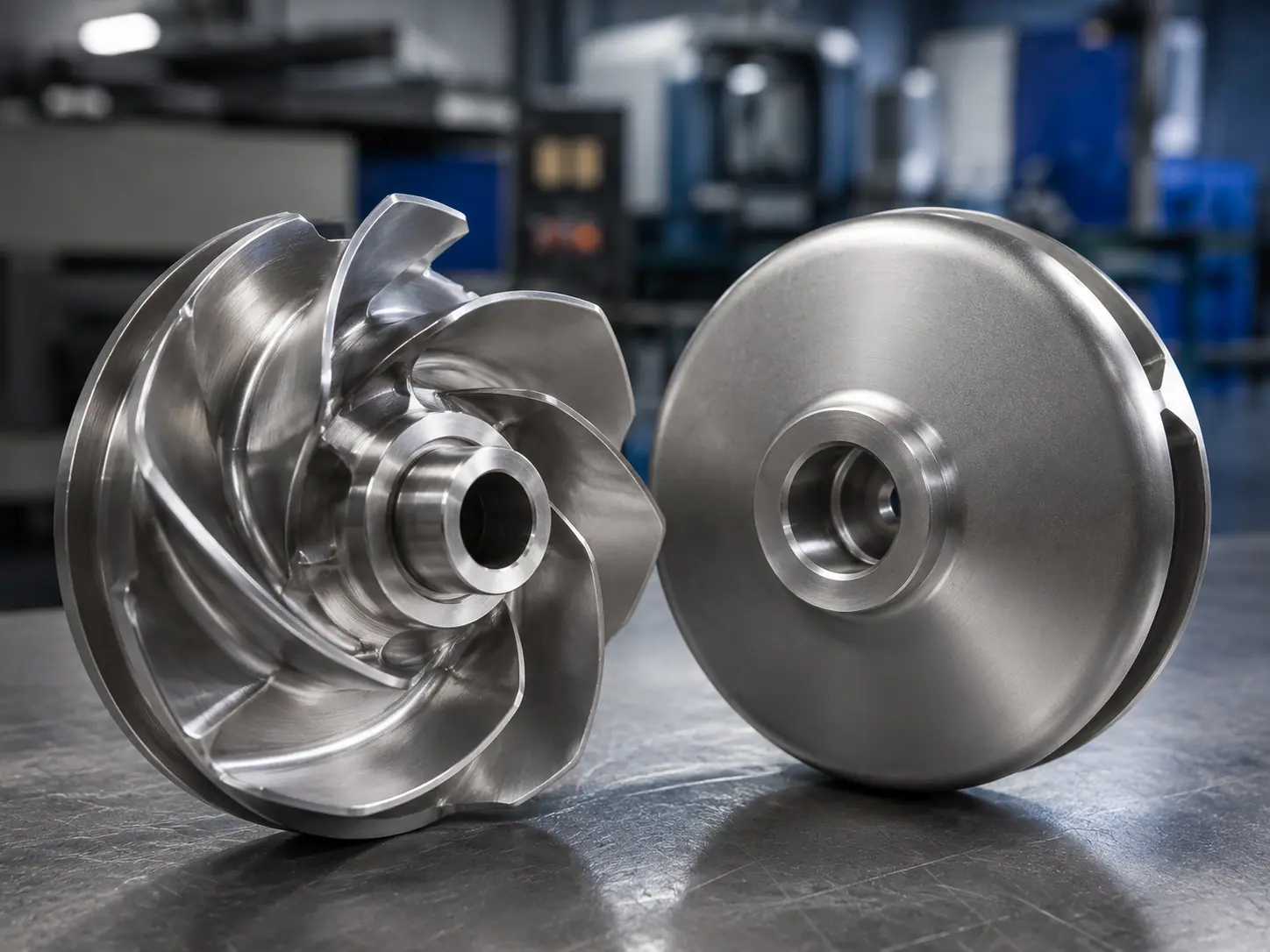
Send the controlled drawing and model, full-length and splitter counts, spacing and rotation definition, material grade and condition, quantity and inspection requirements. Include the engineering reference for the approved hydraulic configuration and identify whether the order is repeat manufacture or a released revision.
For sample-based work, distinguish an intact reference from a worn or repaired part. Missing vanes, worn trailing edges and concealed splitters can make an apparent count misleading. Resolve uncertain geometry before it becomes the manufacturing baseline.
Agree how repeated passages, thickness and accessible hydraulic surfaces will be inspected. No generic vane tolerance or balance grade is implied here. A conforming bore or balance report does not demonstrate that every passage matches the model.
Matson’s impeller manufacturing capabilities support drawing-based process and inspection review within the agreed supply scope. Component manufacture should remain separate from hydraulic optimization and complete-pump validation unless those responsibilities are explicitly assigned and supported.
Questions to settle before ordering
Do more impeller vanes always improve pump efficiency?
No. Increasing vane count can improve flow guidance, but the resulting geometry also changes blockage, wetted surfaces and internal losses. The useful comparison is the efficiency curve for the complete pump over the intended duties, alongside head and shaft power. Do not select the largest count from a quotation or treat a favorable result from one published model as a universal design rule.
Does a higher vane count automatically produce more head?
Not for every real pump and operating point. Reduced slip is one reason additional vanes can affect theoretical head, but actual performance also depends on the passages, blade geometry and stationary components. Request a consistent baseline comparison covering the required flow range. Record which other dimensions changed so that a head difference is not attributed to count when several variables were revised together.
Are fewer vanes always better for solids-containing liquids?
No. Fewer blades can leave larger spaces when other geometry is comparable, but the minimum passage still depends on the eye, throat, blade form and surrounding restrictions. Solids size, shape and fibers also matter. Ask for the approved passage and service basis rather than assuming a non-clogging capability from count alone. The released hydraulic design, not a general blade-count preference, should govern manufacture.
Are splitter vanes equivalent to additional full-length vanes?
No. A shorter splitter begins at a different location and forms a different passage arrangement from a full-length blade. Record both counts and define the splitter profile, length, start position and spacing in the model. A total visible outlet count does not establish hydraulic equivalence. Performance comparisons, frequency assessments and manufacturing inspection should all refer to the actual approved arrangement rather than a simplified blade total.
Can vane count predict noise or vibration from blade-passing frequency?
It can identify a basic passage frequency for a simple repeated geometry, not the resulting noise or vibration amplitude. For identical uniformly spaced full-length vanes, multiply count by shaft RPM divided by sixty. Splitters and nonuniform patterns need additional care. The equipment engineer must assess the assembled machine’s response and acceptance requirements. A higher frequency is not evidence that the pump will run more quietly.
Can a supplier change vane count while keeping diameter and bore unchanged?
Not as an unapproved manufacturing substitution. Unchanged mounting dimensions do not demonstrate unchanged hydraulic behavior or service suitability. Require a defined model revision, an identified engineering approver and the relevant validation before release. For repeat production, the supplier should manufacture the approved count and geometry. A simpler casting route or an apparently symmetrical pattern is not authorization to replace the specified hydraulic design.
Final Thoughts
Vane count belongs to the hydraulic design, not a ranking where more is always better. Compare flow guidance, losses, passage requirements, power and the assembled pump’s response before approving a change. Then release a complete model and inspection basis for manufacture. Matson can review custom pump impeller production against confirmed specifications, while hydraulic selection and equipment validation remain with the responsible engineering owner.
Send your approved model, vane and splitter arrangement, material grade, quantity and inspection requirements through Matson’s RFQ contact page for a manufacturing review.